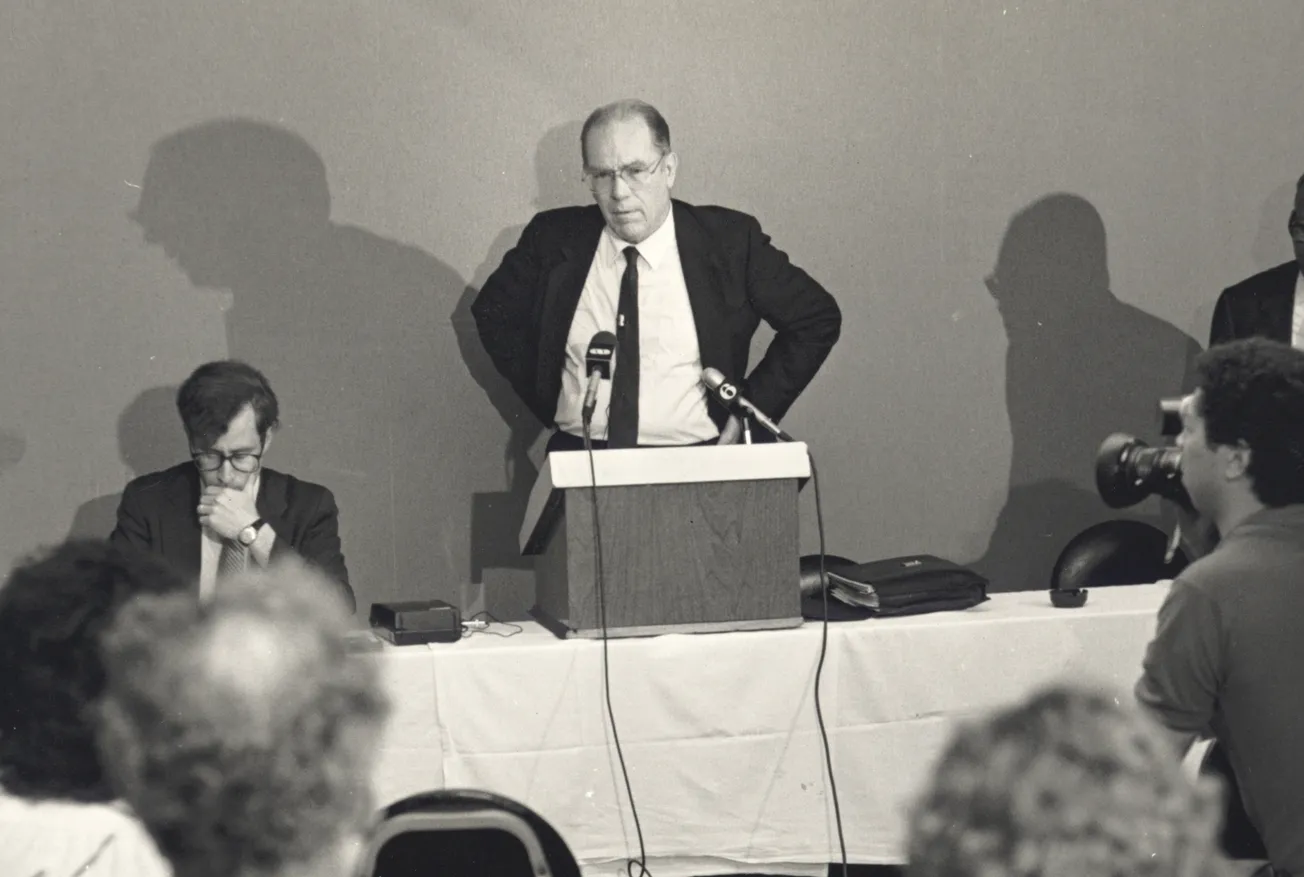
This Independence Day occurs on the 75th anniversary of the end of World War II, in which Lyndon LaRouche served as a soldier. During his deployment in Asia, President Franklin Roosevelt died. During his time in India, he saw first-hand the brutality of the British Empire against which Roosevelt intended to reshape the post-war world, ending empire globally and forever, fulfilling the promise of the American Revolution we celebrate today.
But the world Roosevelt intended was not brought into being.
LaRouche took up the challenge of qualifying himself for leadership and supplying it to the United States and the world, writing hundreds of articles, crafting dozens of studies, running eight times for U.S. President, and building a movement of collaborators around the world. In recent years, LaRouche pointed to the global nature of necessary solutions, and called for cooperation of four great powers — the United States, China, Russia, and India — to put into place needed reforms of finance and banking and to provide an articulated vision of the future: of scientific frontiers to conquer and of the necessary infrastructure platforms to make possible higher levels of physical productivity.
Today, the urgent need to implement LaRouche’s development of Roosevelt’s vision confronts us forcefully:
The coronavirus pandemic now most strongly afflicting the Americas points to failures, not of the recent months (although many mistakes were made), but failures over the decades to end poverty worldwide and achieve economic development and scientific advancement to develop fundamentally new approaches to fighting disease, especially viral disease.
Recent responses by India to the border skirmish with China — banning Chinese apps and banning Chinese firms from bidding on road projects — portends the danger of a real rupture between the two nations.
* Additional trillions of dollars worth of money are being created by the trans-Atlantic central banks, to prop up a financial system that now has almost no relationship to the physical economy. It will be impossible to achieve significant financing for economic development in a system so spectacularly dominated by speculation.
Schiller Institute Founder Helga Zepp-LaRouche’s call earlier this year for an emergency summit among Presidents Trump, Putin, and Xi underscored the need for an international approach to establish a higher level of cooperation and to defeat the origins of the coup against President Trump. Three weeks later, President Putin called for a summit of the leaders of the U.S., Russia, China, France, and the U.K. — the Permanent Five members of the UN Security Council, created at the close of World War II and whose importance Putin recently stressed again in his June article on the lessons of the 75th anniversary of that war.
Consider the potential discussion at such a P5 summit in light of U.K. Prime Minister Boris Johnson’s “Build, Build, Build” speech from Tuesday, in which he called for £5 billion of infrastructure investment and made explicit reference to the FDR legacy: “It sounds like a New Deal … that is how it is meant to sound and to be, because that is what the times demand.”
While the sum so far proposed is small, and Johnson defends the City of London — which must be attacked to have hope for true economic growth — his proposal can help catalyze a discussion at the level that is truly required: of international cooperation among sovereign nations, of nation-states “whose constitutional law,” LaRouche wrote in 2005, is “based on the triple principle of perfect sovereignty, the defense of that sovereignty, and the obligation of society to promote the general welfare of all of the people and their posterity.” This is in conformity with “the Preamble of the Federal Constitution of the U.S.A., and to the congruent, principled notion of natural law central to the 1776 U.S. Declaration of Independence, a formulation copied from Leibniz’s attack on John Locke’s folly, ‘the pursuit of happiness.’”