The Aug. 30 Washington Post, under “Business,” reported on motion within and around the Republican Party in favor of an “industrial policy”— a policy of using subsidies to encourage specific industrial production. President Donald Trump demanded a military-industrial policy in his first executive order (addressed to the Pentagon) in early 2017 and in 2020 has expanded this to medical supplies and equipment, including use of the Defense Production Act; he has often put Peter Navarro in charge of this effort. The Post only very briefly mentions that legislation for a scientific-industrial policy has also come from the Democratic Senate leadership, and has bipartisan sponsors.
The Post interviewed Sen. Marco Rubio, who wants “a 21st-century pro-American industrial policy,” identifying and subsidizing technologies for national security and economic growth. Bernie Sanders, Elizabeth Warren, Sherrod Brown, AOC, and even Joe Biden claim to be doing the same thing with green new deals and Biden’s crazy “buy-American green new deal”; but the right name for this is “anti-industrial policy,” since it will rob industry of energy and power. Rubio, by contrast, is for “boosting federal loan programs for small manufacturing companies and offering federal loan guarantees to help producers of medical equipment borrow money.” Sen. Tom Cotton (R-AR), Rubio’s ally in this, was also interviewed; he is responsible for a bill to subsidize a new U.S. wave of investment in semiconductor technology, presumably a “Huawei effect.” Both Senators are strongly anti-China in word and action, and clearly want to use “bounties” (as Alexander Hamilton called them) in significant part to counter China.
The paper also interviewed Navarro, who presented tariffs, defense-industrial spending, and the Defense Production Act invocations as an industrial policy leading to Operation Warp Speed for vaccines and other medical innovation boosting. Trump has just made a re-election point of tax incentives for companies to bring back medical and other manufacturing from China.
There are new think-tanks formed, including American Compass, headed by Rubio aide Oren Cass, and the Niskanen Center. Cass told the Post that the government should go beyond tax credits to “matching funds for … private sector investment in strategic industries.”
It must be understood that all of this points in a “Hamiltonian” direction antithetical to the power and policies of Wall Street, the City of London, and the Federal Reserve. And none of these advocates attack Wall Street or vote against it on any important matter. Although there is periodic huffing and puffing about the Federal Reserve “answering to Congress” or “being directed by the President,” nothing changes in its money-printing, bank-bailing activities which run directly counter to any industrial policy. Wall Street banks do not lend in a zero- or effectively negative-rate regime, even when guaranteed or subsidized, as we have learned from the Payroll Protection Program and similar episodes. Glass-Steagall bank separation is a must for industrial policy, because speculation is more profitable for “universal banks” — and stock buybacks and “financial engineering” with bond derivatives more profitable for large companies — than investments in new technologies. Equally fundamental are the lack of Hamiltonian national credit institutions essential to technological investments, or support for such institutions; the lack of interest in funding new platforms of basic economic infrastructure which supports private industrial advancement and is the biggest invention driver known to economics; failure to identify or support “science drivers” — either a big expansion of NASA funding to carry out the Artemis Moon-Mars mission, or a fusion crash program. Federal R&D funding, especially to national laboratories, is down to 0.7% of GDP in 2020 from 2.1% in 1970; ironically, 2.1% of GDP is what national R&D spending is now in China, which is moving decisively to raise it further during 2020. This R&D atrophy, 50 years in the making, is addressed in one bill, the “Endless Frontier Act of 2020,” proposed by economists linked to the Democratic Party, and sponsored by Senate Minority Leader Chuck Schumer and Republican Todd Young, and in the House by Democrat Ro Khanna and Republican Mike Gallagher.
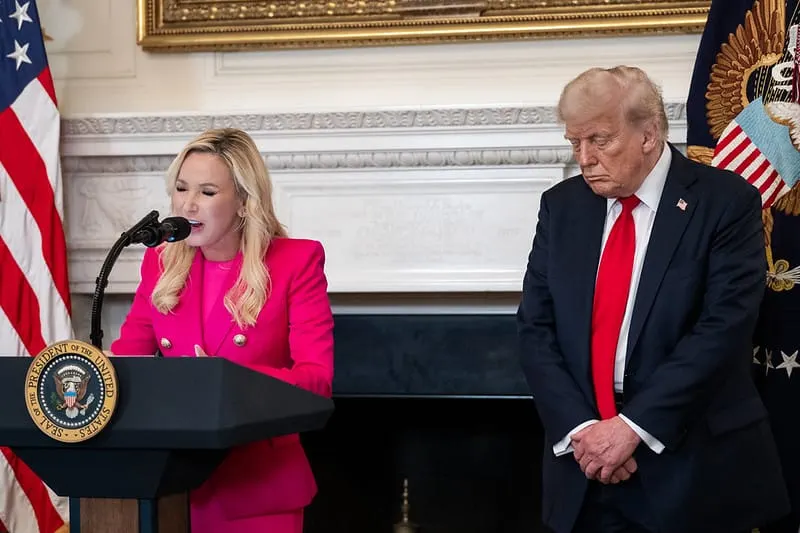
President Trump himself is the strongest advocate of an “American System” industrial policy, and uniquely not bothered by other major powers pursuing it for their nations while he pursues it for America. But his deadly adversary on this is not the Democratic Party, but the City of London and Wall Street, and the powerful central banks of the United States, the U.K., and Europe. His potential allies in putting it through are those other major nations: China and Russia above all.