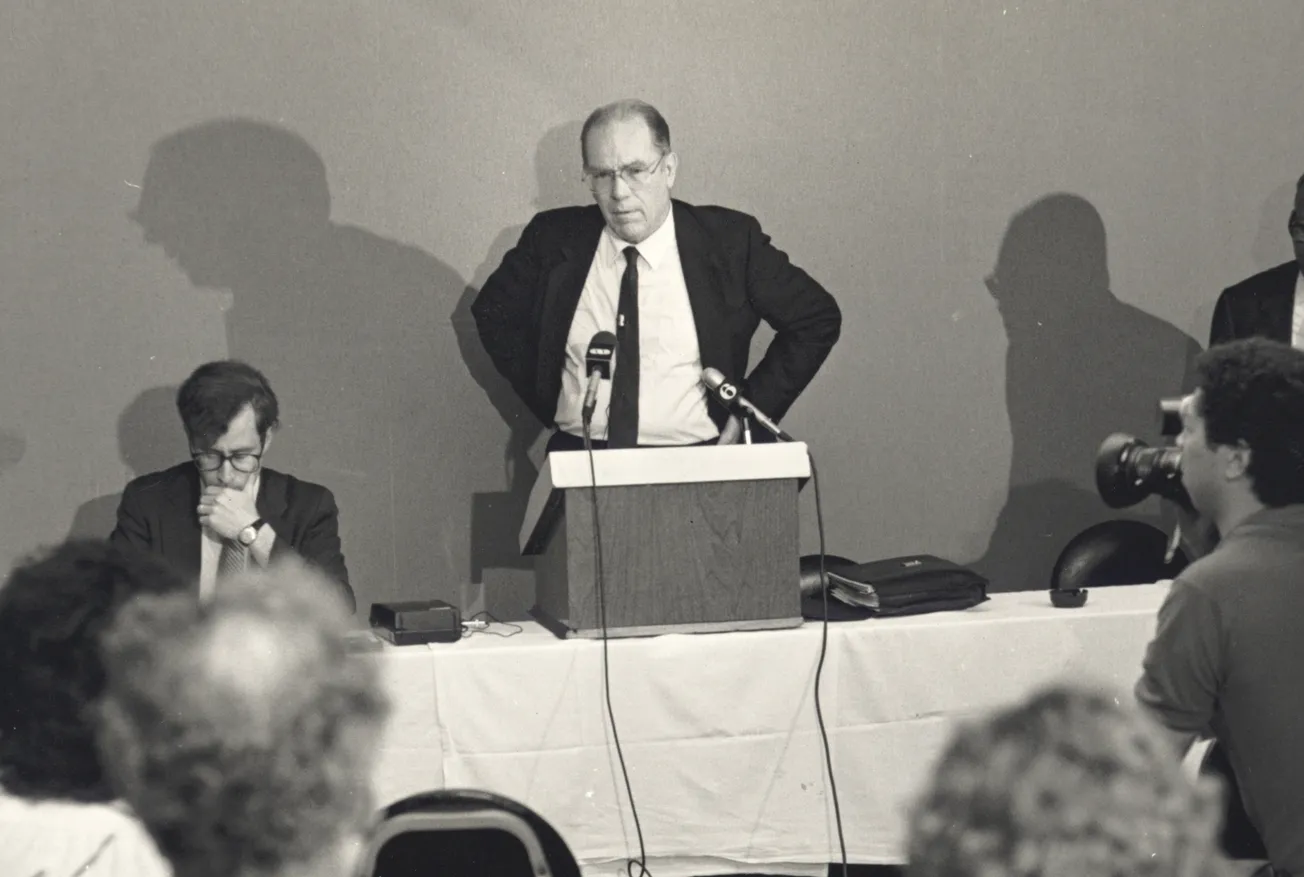
Given the intense fight taking place over the question of who will be the next President of the United States, it will be useful to hear the words of Lyndon LaRouche on the question of the required qualities of character to be a great President. LaRouche was himself a candidate for President in 1980 (and seven other times as well). During the New Hampshire Democratic primary race in 1980, Mr. LaRouche met with Republican candidate Ronald Reagan, and introduced Reagan to the idea of ending the British “Mutual Assured Destruction“ nuclear deterrence policy, through the development of particle beam or laser beam weapons, to “make nuclear weapons obsolete,” as Reagen put it on March 23, 1983, when he announced his adoption of LaRouche’s proposal, calling it the Strategic Defense Initiative.
During that campaign, LaRouche was asked by the press who he believed had been the greatest President. In answering, he discussed both Charles de Gaulle and Abraham Lincoln, as follows (slightly edited transcript):
LYNDON LAROUCHE: “Charles de Gaulle is probably the most remarkable leader of this [quality], even though he’s wrongly deprecated in his own country — a big propaganda against him. De Gaulle, in the middle of the 1950s, when France was in a grave crisis, stepped forward and said he had to become the President of France. He had no elected position at the time; he was coming totally from the outside. He said, here’s a crisis, I must step in and lead France out of this crisis. He succeeded; that’s how the Fifth Republic was constituted. And France, while it still has many shortcomings today, was brought out of this hideous condition in which it had been wallowing for decades, and began to develop, around nuclear energy, around its aerospace and a few other things. It began to develop.
“De Gaulle had a conception of France which is my conception of the United States. The function of a nation is to lead, to give that nation a moral purpose in the world. Then the people of the nation, through the nation, are participating in shaping the future of humanity, which is what our Constitution dedicates us to. It’s the life, liberty, and the pursuit of happiness for ourselves, but more importantly, for our posterity; the kind of world we’re creating. De Gaulle had that, he understood that, and he was, therefore, in my opinion, one of the greatest leaders of the present century.
“The function of a leader is not merely to pass laws. Laws are sometimes necessary, but we have an excess of dependence on laws, and passing a lot of laws is a symptom of a weak leader. The way you get things done in anything, especially government, is the function of a President, to define national goals and to appeal to the national consensus for those goals. Then you find the combination of public and private initiative, but particularly private initiative, to just get the thing done. And that’s the way it works. And that’s what’s been lacking. The function of a President is to be the instrument of self-government of the people; to provide the kind of leadership that they seek by selecting national goals which the overwhelming majority of people will get behind, which private initiative largely will get done, with the government supporting that action by private initiative….
“I think you have to give outstanding points to Abraham Lincoln. He was undoubtedly the greatest figure — he’s deprecated as some sort of a simple-minded fellow. He did have humility, and I think that’s necessary in a leader. A leader is really an instrument of a higher purpose, he’s not a dictator who’s gotten absolute authority. He is the servant of a higher purpose, like a priest or a pope, the same thing. And therefore, the leader must in a sense represent the lead in terms of competence, but he must have at the same time the humility which reflects the fact that he is an instrument of a higher purpose. He must radiate that as believing that and living from that standpoint. Lincoln had precisely that quality. He saved our nation, he preserved the foundation which the Founding Fathers had attempted to give us. Embedded in our nation are organic impulses that we call the American System, the American way of doing things, which despite many distortions imposed from the top, that up until recent times, all people have had a special quality we call the American method, the American way of looking at things. Which, despite all imperfections, is the best thing in the world in terms of a people. And Lincoln was the President who secured and gave us that perspective. I think those are examples of real leaders.”
Next week, on December 12 and 13, the Schiller Institute will hold an international online conference on the theme, “The World After the United States Election: Creating a World Based on Reason.” The question of the required quality of leadership for this time, the greatest crisis of civilization since at least the Second World War, will be a major topic of discussion. Register to participate in this online conference. https://schillerinstitute.nationbuilder.com/conference_20201121. There will be four panels over the two days, the first of which will be a report from an International Commission on Truth in Elections. The overall idea of the conference is called the Coincidence of Opposites. The concept is to give people the intellectual tools to figure out how to deploy the principle of power in the American Presidency on behalf of the world at large, and the United States in particular.