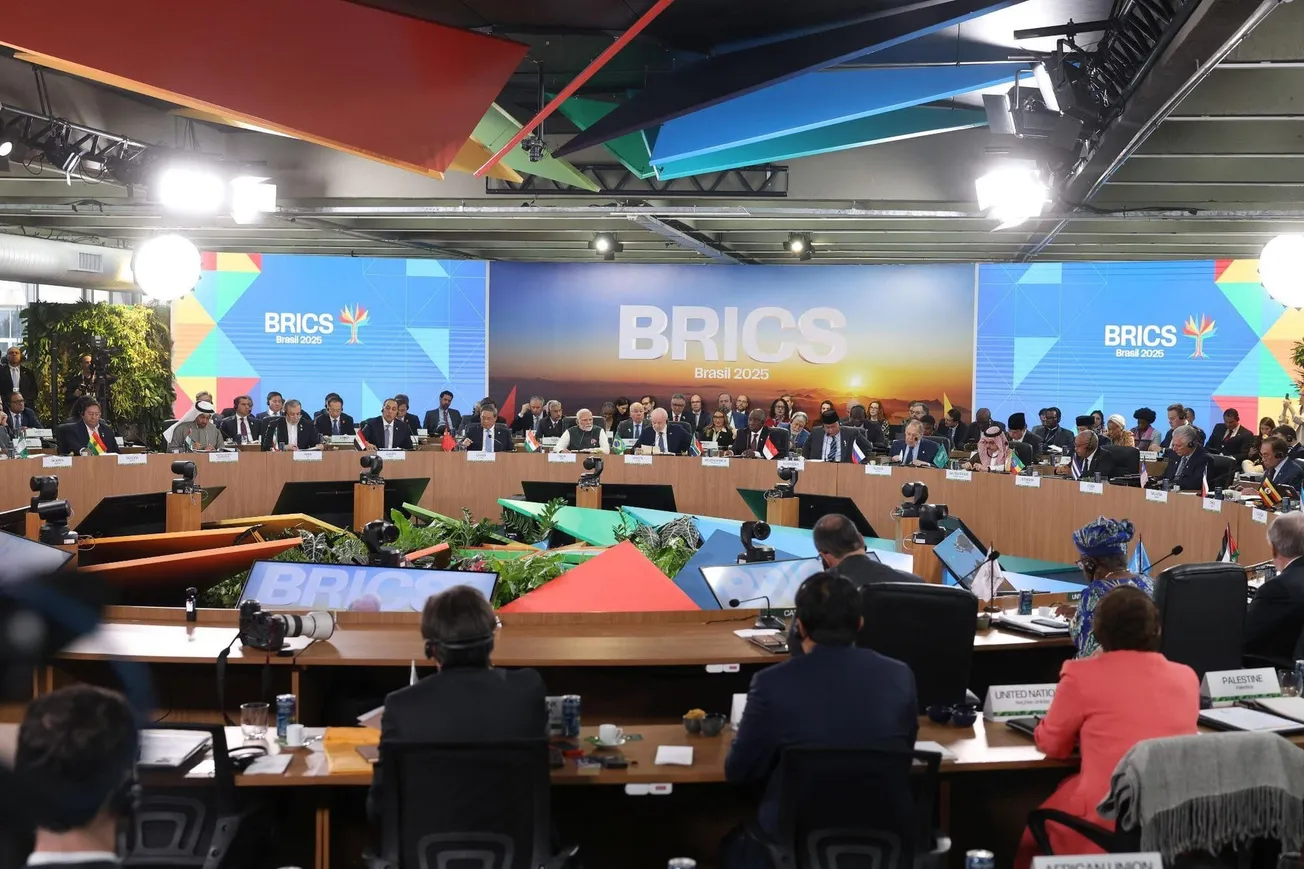
July 9—The 17th BRICS Summit took place in Rio de Janeiro, Brazil, on July 6-7. BRICS was established in 2009 by Brazil, Russia, India, and China, with South Africa joining in 2010. In the words of the host, Brazilian President Luiz Inácio Lula da Silva, BRICS “is the heir to the Non-Aligned Movement.” “This is the fourth time that Brazil has hosted a BRICS Summit,” he began. “Of all of them, this is the one that takes place in the most adverse global scenario. The UN celebrated its 80th anniversary on June 26, and we are witnessing an unprecedented collapse of multilateralism.” During the summit, Indonesia, the world’s fourth most populous country, was admitted as a full member of BRICS. Belarus, Bolivia, Kazakhstan, Cuba, Malaysia, Thailand, Uganda, Uzbekistan, and Nigeria were announced as partner countries on January 1, 2025. On June 13, Vietnam officially became the 10th BRICS partner country.
The summit did not produce a headline-grabbing revolutionary outcome, but rather, another step forward in what EIR editor-in-chief Helga Zepp-LaRouche and her colleagues in the International Peace Coalition have characterized as the transition from the 500-year era of colonialism toward a new paradigm which respects the rights of every nation to security and development. The proposal by Russian President Vladimir Putin to create a New Investment Platform to create and channel substantial credit into productive great projects, which he presented to the summit and which has the backing of Chinese President Xi Jinping, is of particular importance to achieve that goal.
Anxiety in the Anglosphere
In the citadels of the Anglo-American bloc, there was great fear that BRICS, which now accounts for over half the world’s population, might announce some sort of new currency to displace the dollar’s dominant role in world trade relationships. During the summit, U.S. President Donald Trump posted on Truth Social: “Any Country aligning themselves with the Anti-American policies of BRICS, will be charged an ADDITIONAL 10% Tariff. There will be no exceptions to this policy. Thank you for your attention to this matter!”

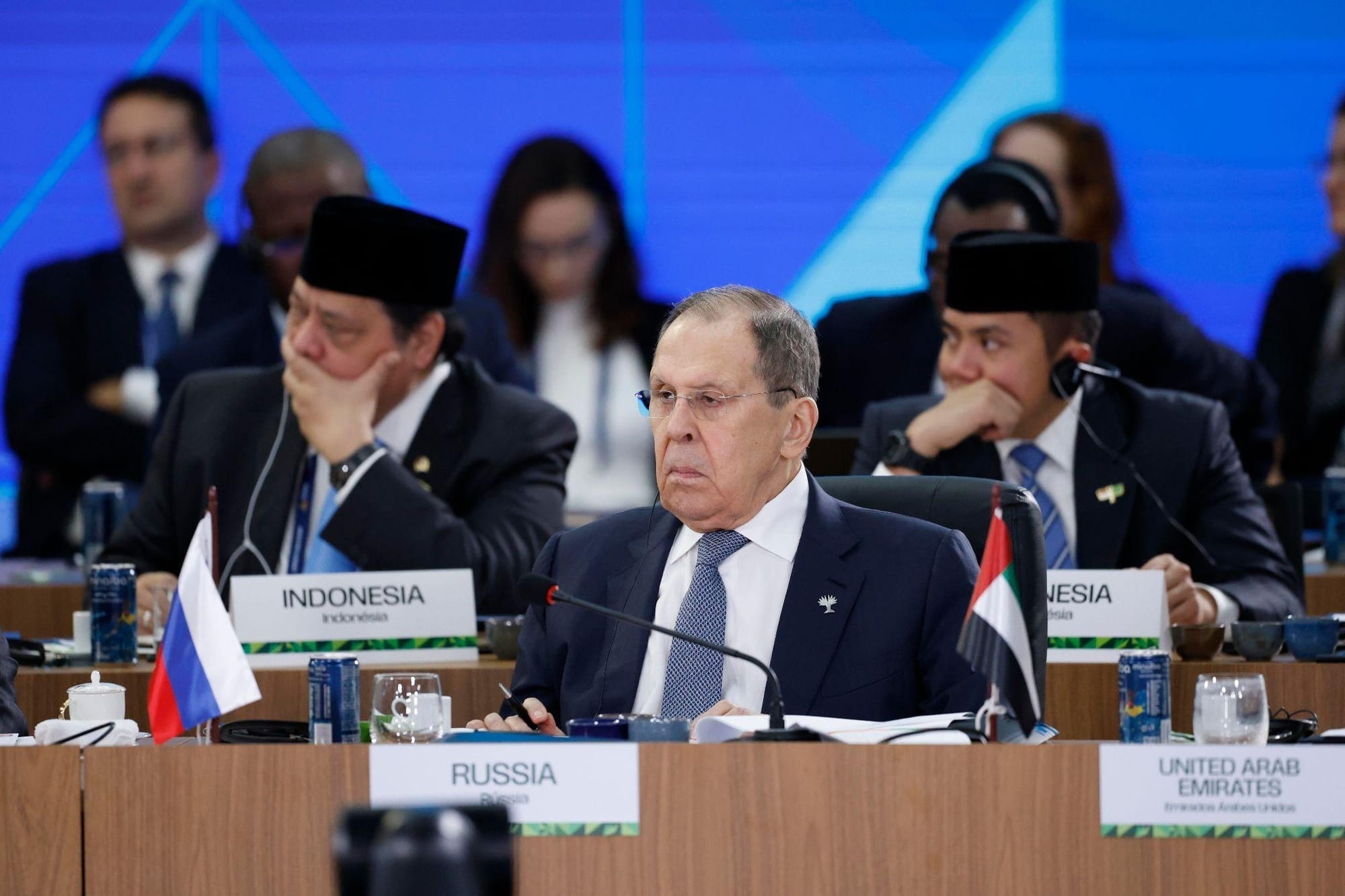
Encumbered by amateurish notions of economics and intoxicated by neocon dreams of a “unipolar world,” Anglophile leaders fail to recognize that the threatened demise of the dollar is not the fault of the BRICS or the Global South generally, but is rather the consequence of their own policies. By attempting to exploit the dollar’s dominance as a cudgel to bully the rest of the world, they have forced other nations to seek alternatives in the interests of their own survival. Russian Foreign Minister Sergey Lavrov underscored this during his conference presentation, saying that the fragmenting of the global trade and finance system is “exacerbated as a result of illegitimate unilateral sanctions and use of the dollar as a means of ‘punishment.’ The trust in the American currency as a formerly reliable payment instrument was undermined.”
However, the real threat to the dollar-based system of trade comes from yet another source: the insistence of the United States government on continuing to underwrite quadrillions of dollars in financial derivatives and other purely speculative instruments. The inevitable collapse of this bubble spells doom for any economy that is dependent upon the solvency of the dollar system.
The Chinese Foreign Ministry slammed Trump’s threat to impose a 10% tariff on BRICS members, and any country “aligned” with them. “On the U.S. tariff hikes, China has made its position clear more than once. Trade war and tariff war have no winners, and protectionism leads nowhere,” Chinese Foreign Ministry spokeswoman Mao Ning asserted at a press briefing. She reaffirmed that “BRICS is a positive force in the world. It advocates openness, inclusiveness and win-win cooperation. It does not target any country.”
Brazilian President Lula da Silva responded: “It’s not right for a president of a country the size of the United States to threaten the world online…. The world has changed. We don’t want an emperor. We are sovereign countries.” “The world needs to find a way so that our trade relationship does not need to go through the dollar,” Lula added. “Nobody has determined that the dollar is the currency standard.”
Putin’s Proposal
Although the question of a new currency was not on the agenda at the summit, President Putin, who addressed the conference by video, proposed a new credit mechanism to fund development in the Global South and East, with credit generated from within the BRICS countries themselves—i.e., outside the bankrupt dollar-denominated trans-Atlantic system.
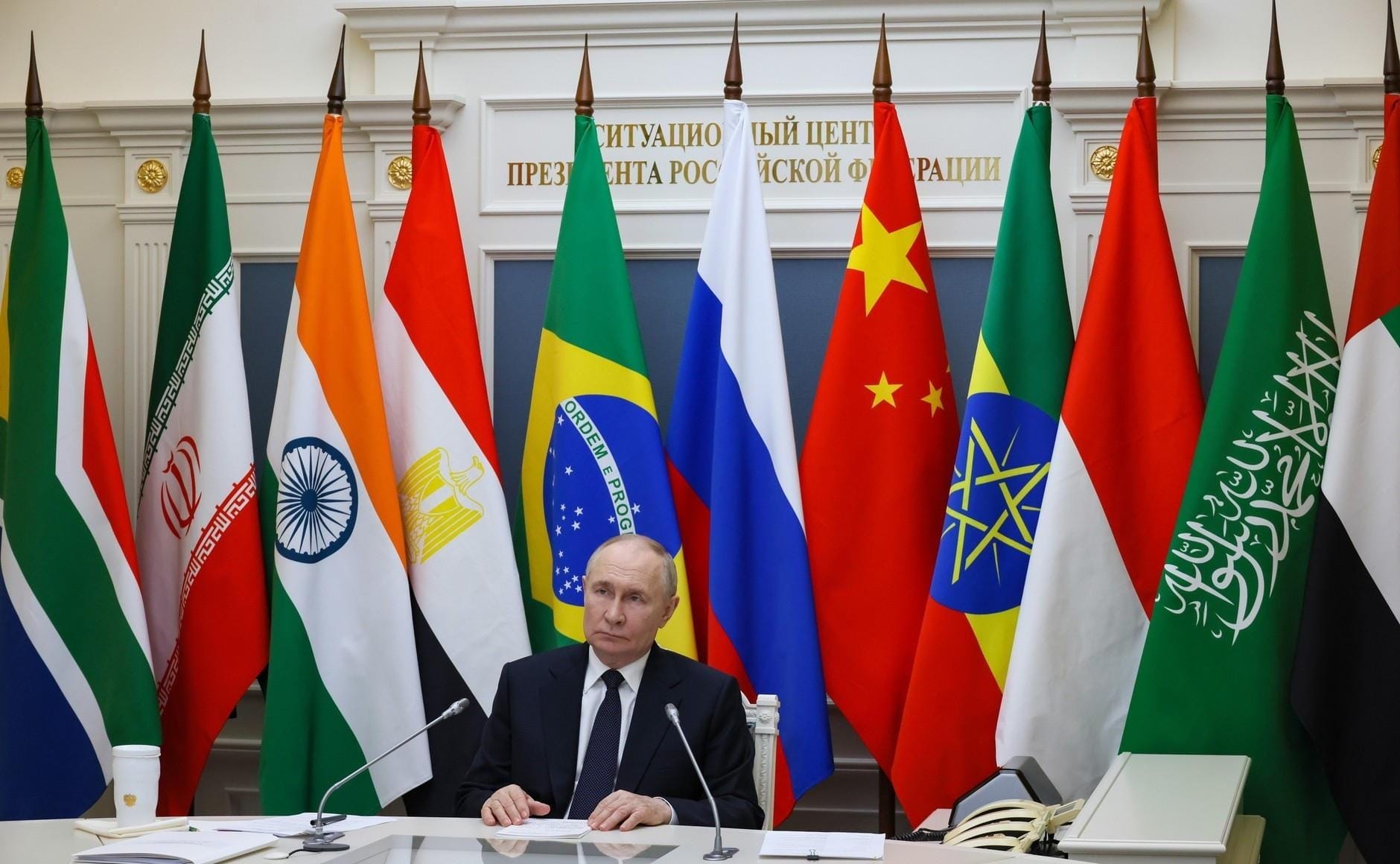
“Multiplying mutual capital investment by the BRICS countries, including through BRICS mechanisms, primarily, the New Development Bank, appears to be an important goal as well. To this end, Russia proposed creating a whole new BRICS investment platform. The idea behind it is to jointly develop coordinated instruments to support and to bring in the funds from the economies of BRICS countries and from the Global South and Global East countries.”
Other actions are needed, he specified, such as “creating an independent payment and monetary system within BRICS will expedite currency transactions while also ensuring their effectiveness and security.”
There is not yet a consensus among BRICS members on how to move forward with new credit mechanisms, which are urgently needed to sustain the enormous development projects required in the Global South. The BRICS finance ministers and central bankers, a grouping which is normally the most anxious to please the hegemonic powers, met before the summit on July 5, and issued a Ministerial Statement which suggests that the current system can be reformed. They called for the IMF to be better funded, because it stands “at the center of the global financial safety net,” and talked up reform of the World Bank.
Questions of War and Peace
The summit followed on the heels of the Israeli-U.S. attacks on Iran, which became a BRICS member in 2024. The attacks were ostensibly intended to thwart an alleged Iranian intention to develop nuclear weapons, but are being widely interpreted as a threat to any nation of the Global South that might dare to attempt to modernize and develop, including through the pursuit of nuclear energy. BRICS leaders issued a joint declaration condemning the military strikes against Iran, characterizing these strikes as a violation of international law, and expressed serious concern over deliberate attacks on civilian infrastructure and peaceful nuclear facilities. Additionally, the BRICS statement criticized Israel’s actions in Gaza, calling for a permanent and unconditional ceasefire, the withdrawal of Israeli forces from the Gaza Strip, and unhindered access for humanitarian aid.
Luis Arce, the President of Bolivia, which recently became a partner nation of the BRICS, stated at the summit, “There is a clear struggle between the old stagnant bloc of the U.S. and Europe, on the one side, and the emerging bloc of BRICS countries on the other.” He further characterized the Ukraine conflict as “a war being waged by the failing bloc between Europe and the United States on the developing community, which includes BRICS countries. The West needed the war between Ukraine and Russia to make it clear to the entire world that they won’t allow their bloc to collapse in the face of a new association and a new economic order emerging.”
Brazilian President Lula da Silva charged that “International law has become a dead letter, along with the peaceful settlement of disputes,” he added. “We are facing an unprecedented number of conflicts since World War II. NATO’s recent decision fuels the arms race. It is easier to allocate 5% of GDP to military spending than to allocate the promised 0.7% to Official Development Assistance…. It is always easier to invest in war than in peace.”
“Old rhetorical maneuvers are recycled to justify illegal interventions,” Lula said. He drew a pointed parallel between today’s “orchestration” of the International Atomic Energy Agency (IAEA), meant to serve the cause of peace, to what was done with the Organization for the Prohibition of Chemical Weapons (OPCW) earlier—a reference to how President George W. Bush’s administration drove Brazilian diplomat José Bustani out of his post as head of the OPCW, because he refused to repeat the Weapons of Mass Destruction lies used to set up the invasion of Iraq.
The result: “The fear of a nuclear catastrophe has returned to everyday life,” as the failed actions in Afghanistan, Iraq, Libya and Syria are being repeated. It is out of the fertile ground created by such unresolved crises that terrorism grows, he argued, not from any religion or nationality. Terrorism, wherever it occurs, in Kashmir or by Hamas, must be rejected, he stated, but “we cannot remain indifferent to the genocide practiced by Israel in Gaza and the indiscriminate killing of innocent civilians and the use of hunger as a weapon of war.”
“If international governance does not reflect the new multipolar reality of the 21st Century, it is up to the BRICS to contribute to its updating. Its representativeness and diversity make it a force capable of promoting peace and preventing and mediating conflicts….
“Postponing this process makes the world more unstable and dangerous. Every day we spend with an archaic and exclusionary international structure is a day lost in solving the serious crises plaguing humanity.”
Other Remarks by BRICS Leaders
Russian Foreign Minister Lavrov opened his remarks by stressing the key point made by President Putin in his plenary address earlier that day: that the BRICS had to launch a New Investment Platform to ensure the flow of substantial credit to development projects, rather than speculation. He promised that the implementation of this initiative “will be facilitated by our joint efforts to turn the NDB into an innovative development institution that is oriented towards the needs of its own stakeholders and that is not subject to the influence of external conjuncture.” He added that “multipolarity is not a choice but rather an objective reality which succeeds the outdated neoliberal model that actually builds on neocolonial practices. The traditional paradigm of globalization where the predominant role is played by the so-called developed states of the West is becoming a relic.”
“Today developing countries are spending more on debt service than they invest in their development. The situation is going out of control even in developed states—the U.S. has seen a record level of sovereign debt of more than $37 trillion, and it continues to grow.”
He continued: “Therefore, it is not surprising that the global majority is interested in creating development mechanisms independent from the West. Countries of the Global South and East are becoming a main driving force of global economic growth…. In this context conceptual and practical approaches are being developed to establish a new architecture of the world economy based on the principles of equality, multilateralism and non-discrimination in trade, financial settlements, technology, logistics.”
“Nowadays BRICS stands as an engine of such transformation, which seeks to create a more stable global economic architecture.” The newly expanded BRICS now accounts “for more than 40% of the global gross domestic product based on purchasing power parity, and together with partner countries, this figure is at 45% or $93 trillion. Today BRICS represents more than 20% of global trade and almost a half of world population. Ongoing work on the 2024 Kazan BRICS Summit arrangements are directed at a “Cross-Border Payment Initiative, [an] independent settlement and depositary infrastructure, to develop reinsurance capacity, to increase the effectiveness of special economic zones. The mechanism of the Contingent Reserve Arrangement, including the use of currencies alternative to the dollar, is being improved. The share of BRICS countries in trade with Russia is constantly growing and in 2014 it exceeded 48%, with 90% of mutual settlements made in national currencies.”
So, it’s time to “pursue the reform and depolarization of the Bretton Woods institutions which should reflect a real state of affairs in the world economy. The continued use of the IMF and WB [World Bank] with a view to preserve neocolonial practices is unacceptable…. The issues of development financing are becoming more and more pressing. According to the UN, its deficit is estimated at $4.2 trillion per year. If the current trends prevail, more than 600 million people will live in extreme poverty by 2030. Without sufficient funds and being unable to take out credits on acceptable conditions, countries of the Global South have to rely on official development assistance…. The increasingly aggressive attempts by the West to introduce ideological ultimatums into the dialogue as what are virtually the main criteria—based on Western interpretations of human rights and democracy—are having an extremely negative impact on the delivery of the UN sustainable development goals.”
Chinese Premier Li Qiang said that while “flames of war continue to rage in some regions, international rules and order face serious challenges, and the authority and efficacy of multilateral mechanisms are weakening.” He stressed that “the conflicts and disputes happening across the globe have their roots in the lack of trust and communication. Power politics and bullying are never the right way to solve problems. The security and development of all countries should be respected. There should be less arrogance and prejudice and more sincerity and understanding. We need to look for the best answer that serves the interests of all through friendly consultation conducted on the basis of equality.”
While not mentioning the specific recent violations of international law in the ongoing Israeli-perpetrated genocide in Gaza or the recent illegal bombing of Iran, Li said: “[W]e should uphold justice and safeguard world peace and tranquility. Achieving fairness and justice is a persistent pursuit of BRICS countries and an important theme of BRICS cooperation. When international rules are being undermined and bullying practices are on the rise, we need to stand up for what is right and speak up for justice. We need to act as a positive and stable force for good in the world….
“Second, we should focus on development and bolster the driving forces of economic growth. China’s journey of reform and opening up shows that in solving all problems, development is the foundation and key.”
Finally, he called for a dialogue of civilizations, and said: “With rich histories and cultures, BRICS countries should be advocates of harmonious coexistence of civilizations. We need to call for respect for cultural diversity in the world and work to ensure that different civilizations inspire each other and prosper together.”
EIR’s Timothy Rush Addresses BRICS Press Meeting
EIR and Schiller Institute representative Timothy Rush was the only American invited to address an all-day, pre-summit “BRICS Press Meeting” held in the city of Niterói, Brazil (just outside Rio) on July 4, one of many events organized on the sidelines of the BRICS Summit, although not part of the official proceedings. His message—that the United States could and must recognize that it faces only two choices: nuclear war or cooperating with the BRICS in developing the world—was clearly welcomed.

Rush’s beginning his 15-minute contribution on the panel on “Development of Independent Networks for the Global South” saying that he felt that he was “among friends,” was well-received, and his call, nearing his conclusion, for people “not to despair about the United States!” was met with general appreciative laughter from the 50-60 people present, primarily journalists, from Brazil and other Global South nations.
Indonesia’s President Sukarno rightly identified the founding of the United States as the first anti-colonial revolution at the famous Bandung meeting of 1955, Rush pointed out, adding that there is hope for a nation that could produce the likes of Washington, Hamilton, John Quincy Adams, Lincoln, Franklin Roosevelt, and Lyndon LaRouche. His reference to FDR’s collaboration with Brazilian nationalist Getúlio Vargas on great projects to develop Brazil during World War II, the basis for FDR’s proposed form of the Bretton Woods System, as opposed to the version pushed by Britain’s John Maynard Keynes, drew home his point for the case of Brazil.
Rush had introduced EIR as founded by the American statesman Lyndon LaRouche, who proposed in 1975 how to create an International Development Bank to replace the IMF system. He presented the LaRouche movement’s work today through its campaigns, from its call for the U.S. to join the BRICS, to its most current leaflet, warning of the danger of “thermonuclear fireworks” by July 4th. He read several paragraphs of that leaflet, emphasizing that the cause of the conflicts spreading throughout the world is one: the breakdown of the reigning international financial system and the fight over what systems will replace it.
Other participants in that panel were journalists from TV BRICS, Telesur, Sputnik, Prensa Latina, Al Mayadeen, and HispanTV.
The final statement issued from the meeting, “Letter from Niterói: BRICS, a New World and Many Voices,” expressing participants’ fierce commitment to creating “a New International Information Order” to support the BRICS’s fight to “free humanity from the bonds” of today’s unipolar world of colonialism and poverty, notably included amongst its demands:
“We also emphasize the need to adopt, at a global level, a New International Security and Development Architecture capable of defending the security interests and the right to development of all countries in the world.”
BRICS Assume ‘Global Leadership’ for Eliminating Diseases of Poverty and Inequality
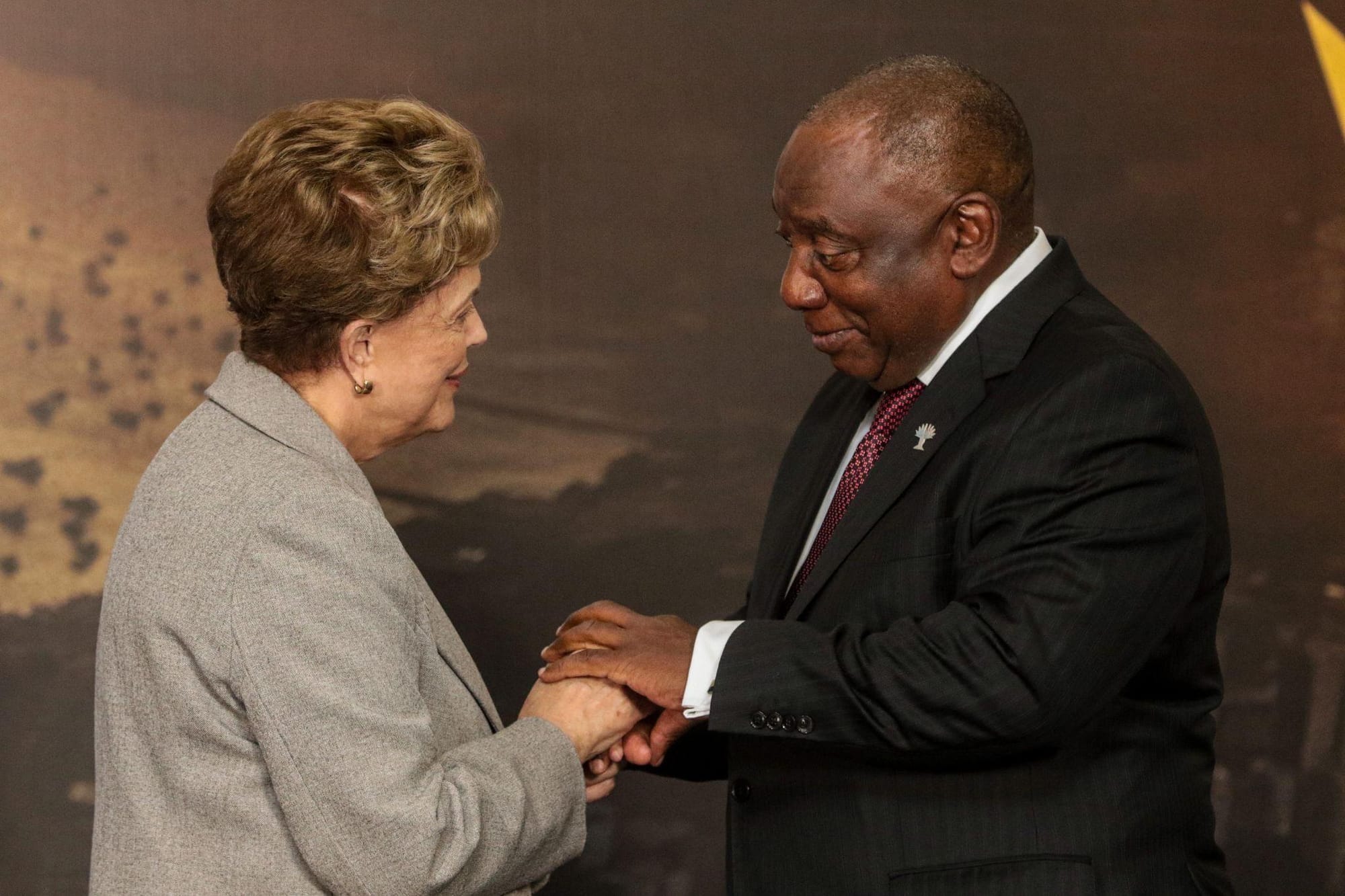
South African President Cyril Ramaphosa, during the BRICS plenary sessions July 7, emphasized the need to “drive the global health agenda,” that is “for disease elimination and targeted towards the most vulnerable populations.” The BRICS countries had announced a major new initiative on Sunday, July 6, the “BRICS Partnership for the Elimination of Socially-Determined Diseases (SDDs).” Its premise is that “health is a fundamental human right,” and its mission is to develop and mobilize the resources and capabilities required to “eliminate” the curable diseases which run rampant under the conditions of poverty and lack of adequate food, sanitation, housing, and health care in which billions of people are still condemned to live today.
President Lula da Silva explained in the Summit’s Third Plenary:
“The BRICS are betting on science and technology transfer to put life in first place. In Brazil and around the world, income, schooling, gender, race and place of birth determine who gets sick and who dies. Many of the diseases that kill thousands in our countries … would already have been eradicated if they had affected the Global North…. There is no right to health without investment in basic sanitation, adequate food, quality education, decent housing, work and income…. We are cooperating and acting with solidarity rather than indifference; putting human dignity at the center of our decisions.”
The Schiller Institute welcomed this BRICS initiative, its founder Helga Zepp-LaRouche having insisted in the third of her proposed Ten Principles for a New International Security and Development Architecture, that every nation requires a modern health system, because “the life expectancy of all people living must be prolonged to the fullest potential.”
The BRICS nations recognize that they “are well-positioned to assume global leadership in the elimination of SDDs by promoting research and development of innovative health approaches, vaccines, prevention, early detection, diagnosis and treatment,” their statement reads.
The new Partnership will coordinate “whole-of-government” approaches toward these diseases, “expanding access to remote and hard-to-reach areas, improving sanitation and housing conditions, tackling malnutrition and poverty, and leveraging innovative technologies—such as artificial intelligence, disease diagnostics, therapeutics, drugs and vaccines development, interoperable digital platforms, harmonized reporting systems, early detection mechanisms, surveillance, real-time data exchange, regulation, and integrated disease elimination tools.”
At the same time, “collaborative research, development, capacity-building, innovation, and technology transfer among members” will be geared up, “encouraging knowledge-sharing as a strategy to strengthen cooperation and drive innovative solutions adapted to local realities.”
Technical seminars, research network meetings and training activities, and talks with the New Development Bank on funding, are to go ahead immediately, while a more detailed “BRICS Roadmap” for accomplishing the goal is fleshed out.
Gretchen Small, Dennis Small, David Shavin, Tim Rush, Diane Sare, and Dean Andromidas contributed to this article.