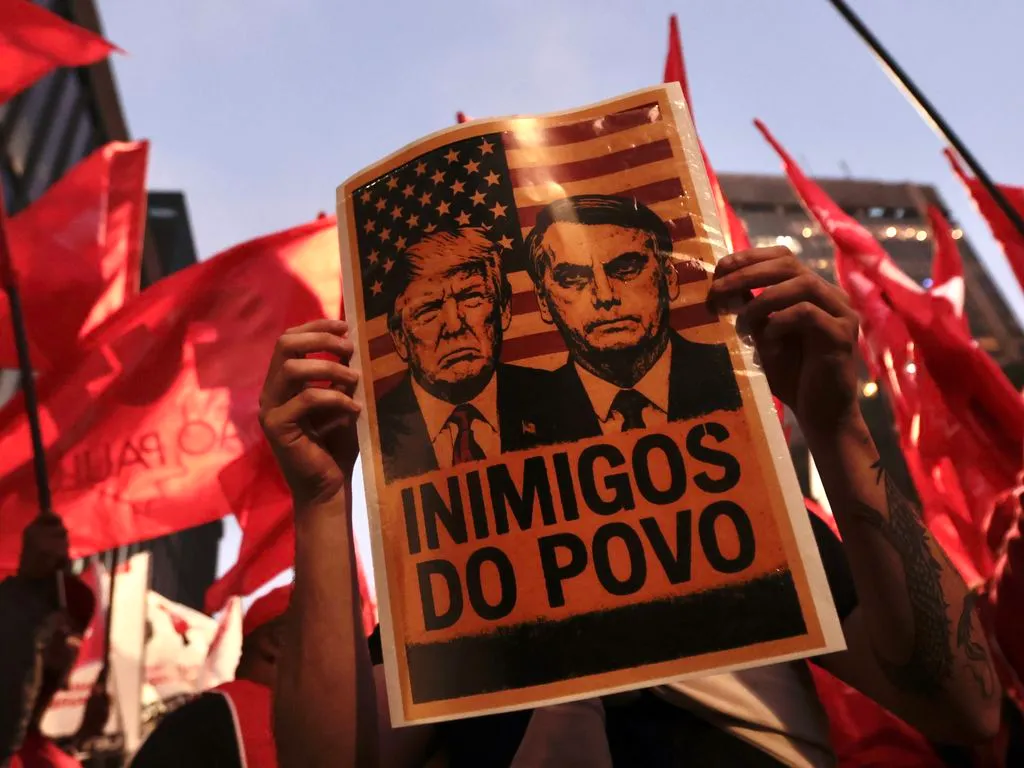
Using tariff policy as a sanction and an attempt at “regime change,” President Donald Trump issued a letter yesterday evening to the government of Brazil, announcing a 50% tariff on Brazilian exports to the United States beginning Aug. 1, and demanding the exoneration and elevation of former Brazilian President Jair Bolsonaro as the conditionality of the tariff.
Almost unnoticed at the same time, Trump proclaimed a 50% “sectoral tariff” on copper imports, wherever originated—targeting Chile, Peru, and BRICS member Indonesia in particular. These announcements followed the President’s July 9 afternoon Oval Office diatribe against the BRICS group of nations, which Trump claimed to be “breaking up because of what I’ve done to them.”
Brazil’s President Luiz Inácio Lula da Silva responded in a lengthy English-language post on X, in which he said—for the second time in 24 hours—that “Brazil is a sovereign nation with independent institutions and will not accept any form of tutelage.” Lula said that Brazil will respond with reciprocal tariffs to any unilateral tariffs imposed by the United States. Brazil’s currency, the real, fell by about 2% on July 10 after the Trump threat, although remaining above its level of early June.
The immediate questions raised include the following:
The White House stands under an order by the U.S. Court of International Trade that the tariffs being enacted without Congress are unconstitutional; the decision was stayed by the friendly D.C. Court of Appeals, for review. The Administration’s claim that trade deficits constitute an “emergency exception” was rejected by the Trade Court, and in this very major case, Trump bases the tariff on other, bizarre grounds: the prosecution of Bolsonaro; “Brazil’s insidious attacks on free elections and Americans’ free speech rights”; “the grave injustices of the current regime.” Trump included what he likely knew was a false statement of “unsustainable Trade Deficits against the United States”; America actually had a $7.4 billion 2024 trade surplus with Brazil.
Regime change: Trump lavished praise on Bolsonaro, who could claim the Presidency again, as his supporters insist that he was the rightful winner in Lula’s 2022 election. Bolsonaro is currently on trial for allegedly attempting to regain power and overthrow Lula’s government on Jan. 8, 2023, when his violent followers stormed the seat of government in Brasilia. Top military officers were also involved and are also on trial.
Lula and Indian Prime Minister Narendra Modi had just met at the BRICS 2025 summit in Rio de Janeiro, Brazil, and had aimed at tripling their bilateral trade. However, U.S.-Brazil trade is ten times greater, as Brazil is the United States’ second-largest trading partner after China. Brazil’s $41 billion in 2024 exports to the United States included iron and steel, aircraft, machinery, oil, coffee, sugar, and soy, among others. Both American businesses and third countries can take actions in defense of Brazilian trade.
This wild, punitive misuse of tariffs may be a strong impulse not only to Brazil, but to dozens of nations, to support each other’s economic growth, and to reduce the dollar holdings in their central bank reserves. Brazil’s are roughly $275 billion out of $345 billion total reserves, and it has been slowly diversifying into gold and China’s yuan, in particular.