

The Schiller Institute convened a powerful international conference July 12-13 in Berlin, in person and online, whose audience and speakers came from every continent, and represented a wide spectrum of leadership experience, all for the same goal: to steer the world away from war, and onto the plane of peace. Titled, “Man Is Not a Wolf to Man: For a New Paradigm in International Relations,” the event was the second of a pair, after the Schiller Institute international conference in the New York City region Memorial Day weekend, May 24-25, titled, “A Beautiful Vision for Humanity in Times of Great Turbulence!”
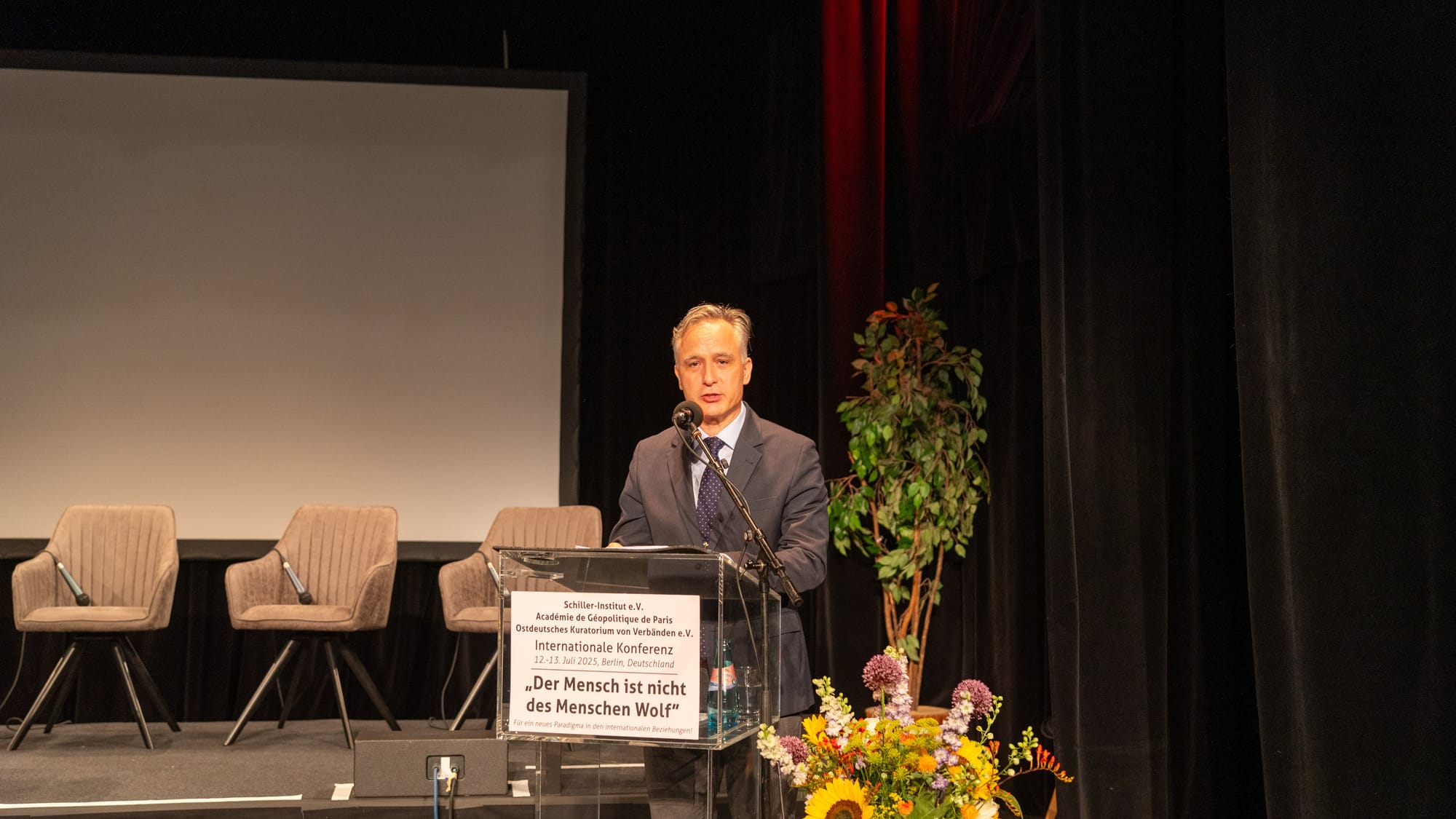
Two European organizations co-sponsored the Berlin conference, along with the Schiller Institute. From France, the Academy of Geopolitics of Paris (Académie de Géopolitique de Paris), whose President Ali Rastbeen addressed the conference on the first day, was a co-host. The third co-sponsor was the East German Board of Trustees of Associations (Ostdeutsches Kuratorium von Verbänden e.V.), whose Vice President Achim Bonatz also spoke on the first day.
Helga Zepp-LaRouche, founder and leader of the Schiller Institute, gave the keynote on the opening panel. The full transcript of her speech follows, under the title, “World War Three or a New Global Security and Development Architecture?” EIR will be covering more of the Berlin conference in upcoming issues.
The Conference Purpose, Process, Program
The purpose of these two conferences, and the ongoing process of organizing forces internationally, was described in a number of Schiller Institute statements released this Spring, by Helga Zepp-LaRouche. She wrote in April, “The strategic situation is presently undergoing not one, but several tectonic changes…. The major challenge facing the world as a whole, is to finally create a just, new world economic order, and to apply the concept of peace through development…. We need to catapult the entire world out of the present misery of geopolitical confrontation, out of the barbaric conception that everything is a zero-sum game, and that one always needs an enemy. We have reached a moment in history in which we absolutely need to reach a new paradigm that proceeds from the idea of the one humanity first, and then brings into cohesion the interests of all nations with that of the one humanity.
“We must create a new era in human history, based on completely new axioms, not those of the old order which has just imploded. For that, we need a new global security and development architecture that takes into account the existential interest of every single nation on the planet. It is the quality of a degraded, or a sublime character of culture, which determines how we think. The needed new paradigm requires that we replace the present ignorance, indifference and outright chauvinism with respect to other cultures, with curiosity, interest, knowledge and even love for the different cultures of the planet.”
The Berlin conference was designed to serve this purpose. Over the two days were four panels of presentations and discussions, each opening with music. On the first evening was a concert. The titles of each panel indicate the focus:
• Panel 1: The Cooperation Between BRICS and Europe, for the Realization of the Oasis Plan and Agenda 2063 for Africa
• Panel 2: Strategic Challenges and the Emerging New World Order
• Panel 3: Scientific Challenges in the New Paradigm
• Panel 4: The Beauty of Cultural Diversity and the Role of Youth in Shaping the Next 50 Years of Humanity
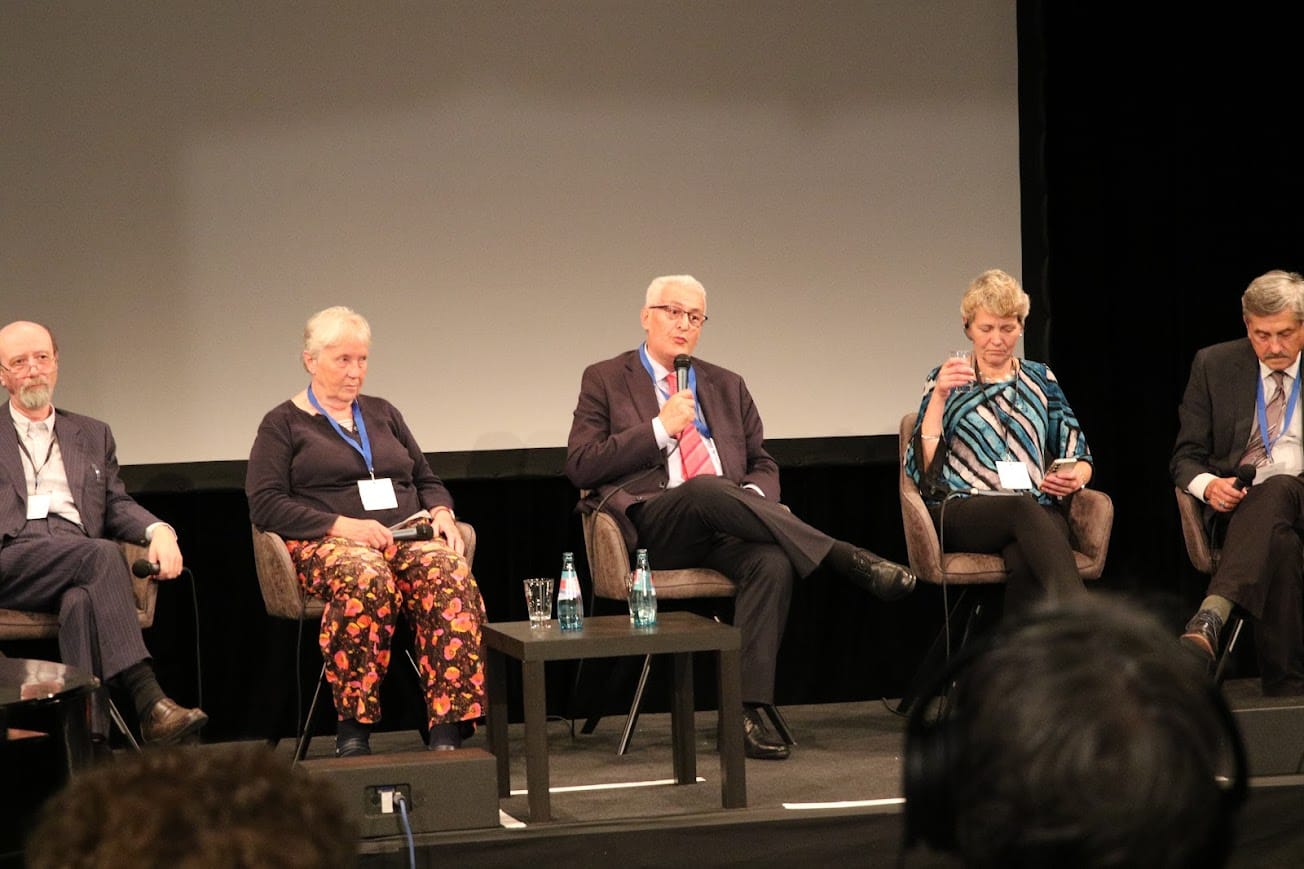
Thousands viewed the conference live online internationally, with a standing room only audience of some 250 people the first day, at the Berlin theater conference venue. The four panels, two each day, had 34 speakers on the roster, representing 10 countries, from Europe, Africa, Asia and the Americas. The speakers included scientists, engineers, skilled workers, diplomats, top government officials, strategic analysts, young peace activists, musicians, and those with other specialties.
John Quincy Adams Brigade

Leading up to the conference was a remarkable international intervention. Beginning in mid-June, a team of about 15 volunteers from North America, characterized by a strong youth contingent, traveled to Berlin and Paris to help organize in those cities in the countdown to the July 12-13 Berlin event. The delegation, which included representatives from half a dozen U.S. states as well as Mexico and Canada, called itself the John Quincy Adams Brigade, with the intent to revive the best traditions of trans-Atlantic cooperation, in contrast to the Imperial tendencies recently on display.
Anastasia Battle, from the United States, was in the Berlin contingent of the John Quincy Adams Brigade, and went to university campuses, busy public squares and other sites to organize. She is the coordinator and a moderator of the International Peace Coalition (IPC), initiated two years ago by Helga Zepp-LaRouche, and now involving leaders from some 50 nations. The IPC has met weekly on Friday by internet for 110 consecutive weeks, and made the Berlin conference its 111th meeting.
Battle described to EIR her work with the JQA Brigade in Berlin, as “kind of like optimistic angels coming in” to counter the cultural pessimism. Compared to the U.S., “it is very much thicker in Europe. You have no idea how thick it is until you’re actually in it. In the United States, it’s been bad, but there’s still some hope that you can do something. Here, people look at me and ask, ‘Do you really think that we can change things? Do you really think that can happen?’ I can see the anguish in their eyes. We’ve been using a lot of fun polemics; using Shakespeare, using Friedrich Schiller, Heine to really get people to remember that Germany has a beautiful culture. And that Classical artistic composition is the avenue in which you can inspire yourself and others to do good—to do the good. And just because you’ve seen these horrible things—there is a limit to the tyrant’s power, as they say.”
Momentum, in the Spirit of Mandela
Dr. Naledi Pandor, former South African Minister of International Relations and Cooperation (May 2019-June 2024) and currently chairperson of the Nelson Mandela Foundation, spoke (by internet) on the first panel, and in the discussion gave a moving call for people to create momentum, and act in the “spirit of Mandela.” July 18 marks the Nelson Mandela International Day, and Dr. Pandor asked people to honor his life and legacy, by taking action as he said to do.
A questioner asked her, “What is your motivation for expressing hope at this conference?” Dr. Pandor said that we all must contribute to momentum for positive change. “I’ve moved away from blame.” We must recruit and draw people in, and “produce activists.”
Dr. Pandor praised the work of the Schiller Institute, saying that it is “bringing the voice of freedom, justice, peace, and security to Berlin.” The leadership being provided by Zepp-LaRouche and the Schiller Institute “are providing us with a clear basis for pursuing the objectives I have referred to. I hope you will join the Schiller Institute in this important endeavor, and I look forward to seeing the conclusions for a massive growth in the International Peace Coalition.”
Kevin Pearl contributed to this article.