The Lead
A Good Time and Place for a Strategic Summit
by Dennis Small (EIRNS) — Aug. 15, 2025
August 15 is an auspicious date in history. It was exactly 54 years ago, on Aug. 15, 1971, that President Richard Nixon announced (on Wall Street’s orders) the end of the fixed exchange rate international financial system, ushering in the era of unbridled global speculation and deindustrialization which, Lyndon LaRouche warned at the time, would lead to wars, economic depression and genocide if not reversed.
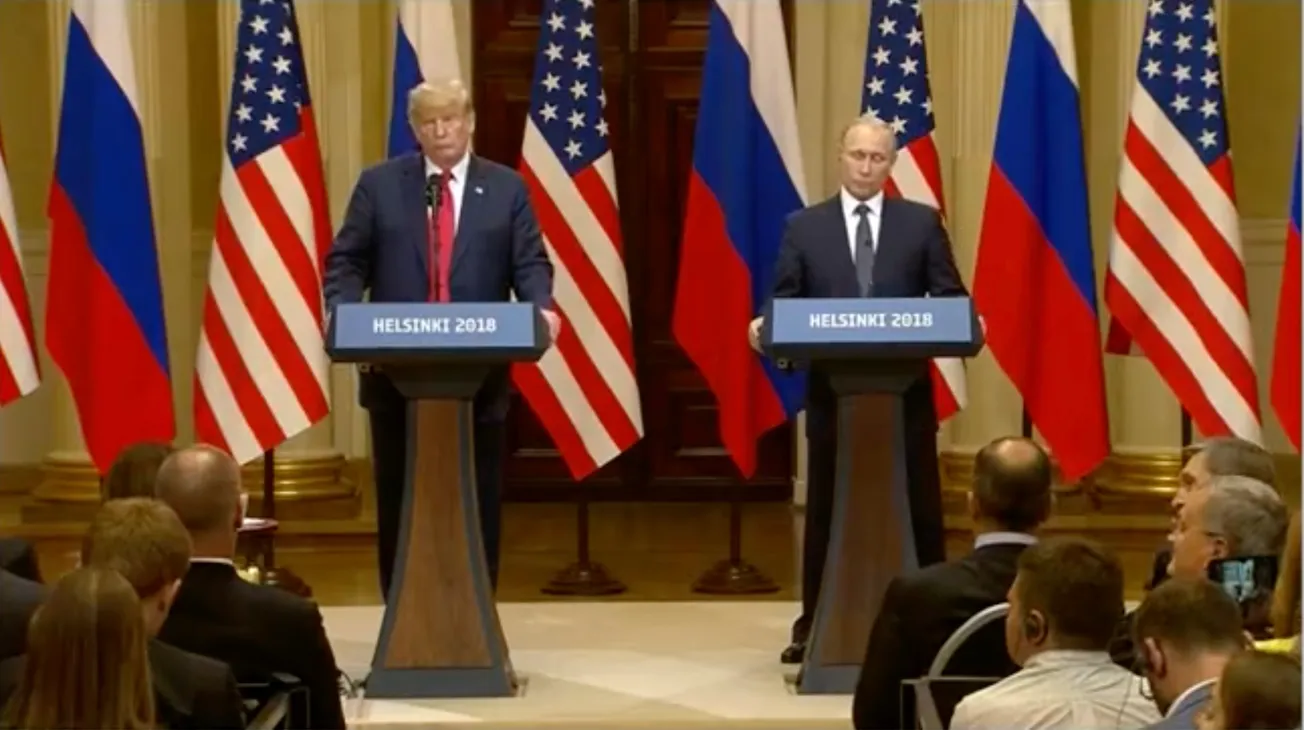
The subsequent half-century is testimony to the accuracy of LaRouche’s forecast, and the fact that his policy alternatives were rejected in the trans-Atlantic sector. It is that dynamic which has brought the world today to the brink of nuclear war, and to the urgency of the summit today, 54 years later, between President Donald Trump and President Vladimir Putin in Anchorage, Alaska.
Years hence, will we look back on this Aug. 15 summit and say that it, too, marked the beginning of a new era, but this one based on a new international security and development architecture? Will this be the date after which the danger of thermonuclear annihilation finally began to recede, and the development of all nations and all people became the metric of success?
There is no answer to that question yet. It is a future that we still must create.
In his remarks to the joint press conference after the Alaska summit, President Putin stressed that his meeting with President Trump had been very constructive and was long overdue, and that he hoped it would usher in an era of mutually beneficial ties between Russia and the U.S., including cooperation on space exploration and the development of the Arctic region. He said it was time to move from confrontation to dialogue, and that the two countries were scarcely kilometers apart over the Bering strait, and that it is possible there to cross over the International Date Line and “step over, literally, from yesterday into tomorrow.”
President Trump told the media that he and Putin had had “an extremely productive meeting,” and that they had made great progress on most points. He added that a few remaining points still had to be resolved before an announcement could be made, because “there’s no deal until there’s a deal,” and that he would immediately be calling the leaders of NATO and Ukraine to brief them. Trump stressed that he has a “fantastic relationship with Vladimir,” and that it was only the interference of the “Russia, Russia, Russia” campaign in the U.S.—"he knew it was a hoax, and I knew it was a hoax”—that made it “harder for us to deal as a country.” He concluded by telling Putin: “We’ll speak to you very soon, and probably see you again very soon.” To which Putin responded, in English: “Next time in Moscow.” Trump replied: “Ooh, that’s an interesting one. I don’t know. I’ll get a little heat on that one, but I could see it possibly happening.”
No further details of the talks were announced by either side, and no questions were taken from the press.
Although there has been endless tea-leaf reading by the media on both sides of the Pacific about what really happened at the summit, since nothing was formally announced, we remind our readers of two points. First, as Russia’s Deputy Foreign Minister Sergey Ryabkov has emphasized, the single most important thing to be achieved from the talks is a resumption of normal dialogue between the two countries, in order to start to address the strategic and arms control issues which have reached such a dangerous state.
And second, that British intelligence and policymakers have repeatedly insisted that a personal meeting between Trump and Putin had to be prevented at all costs. As Sir Richard Dearlove, the former head of MI6 and chief architect of the “Russiagate” scam, put it indelicately on the eve of the summit: “I am extremely worried; I just don’t know what Trump is up to.”
As the summit process was playing out, the BRICS and other nations of the Global South were responding to the Trump administration’s tariff warfare against them by studying ways to redirect their exports to friendly nations of the Global South, and create their own credit mechanisms for the kind of productive investments they need in order to develop. The Aug. 31-Sept. 1 meeting of the Shanghai Cooperation Organization (SCO) in Tianjin, China, followed by the Sept. 3 international celebrations in Beijing of the 80th anniversary of the end of World War II in the Pacific, are two coming occasions where a paradigm change in the international economic system will be on the table.
Now that Trump has met with Putin, it is more urgent than ever that the next strategic step be taken, as proposed by Schiller Institute founder Helga Zepp-LaRouche in an Aug. 11 appeal to Presidents Trump, Putin and Xi Jinping, “The Bering Strait Tunnel Project Is the Perfect War-Avoidance Policy": “The Bering Strait Tunnel and related great infrastructure projects could also serve as the basis for further in-depth discussions among Presidents Trump, Putin and China’s Xi Jinping, should President Trump be invited and agree to attend the 80th anniversary celebration of the end of World War II, to be held in China on Sept. 3—as I have earlier proposed. This project for integrated infrastructure of the whole world as the basis for development will lay the basis for ending war as a means of conflict resolution forever. The hope of humanity rests on you!”
Contents
Strategic War Danger
New World Paradigm
- Russian Strategic Analysts: 'A New Security Order Is on the Table in Alaska’ (↓)
- China and India Make Progress on Burying the Hatchet (↓)
- India's Response to Trump's Tariffs: We'll Export Elsewhere (↓)
- Sept. 3 Vladivostok Eastern Economic Forum To Take Up Issue of Arctic Development (↓)
- Iran and South Africa’s Military Leaders Agree on Expanding Ties (↓)
- Russian Media Publish Interviews with Indian and Pakistani Ambassadors to Moscow (↓)
U.S. and Canada
- Another Gabbard Bombshell: DNI Clapper Pressed NSA Rogers To Sign on to Phony Report (↓)
- 'Severe Staff Shortages' at Department of Veterans Affairs (↓)