
The following piece by Erman Çete was originally published in the Turkish publication Harici on July 28, 2025. It is reproduced here with the generous permission of the publisher, and represents the views of the author, not necessarily those of EIR. Subheads have been added.
Last June, an interesting announcement came from the Pentagon. An Army spokesperson announced that four technology executives would be appointed to the rank of lieutenant colonel and tasked with leading a new Army innovation unit within the Reserve Forces.
Colonel Dave Butler stated that the new unit, named “Detachment 201,”[[1]] was created to bring together technology innovation executives to “help the Army with broader conceptual issues, such as capability management and how to recruit and train tech-focused individuals.”

The companies whose executives were made lieutenant colonels were Palantir, Meta, and OpenAI.
This initial group of executives consists of Palantir Chief Technology Officer Shyam Sankar, Meta Chief Technology Officer Andrew Bosworth, OpenAI Chief Product Officer Kevin Weil, and Bob McGrew, who served as OpenAI’s Vice President of Research until November 2024.

These “generals without an army” align with the Trump administration’s plan to place the Pentagon at the service of Silicon Valley and venture capital (VC). For example, Michael Obadal, appointed by the White House as the Army’s second-highest civilian official, is an employee of Anduril.
Chairman of the Joint Chiefs of Staff General Randy George and Secretary of the Army Dan Driscoll are also focused on giving technology startups and “non-traditional” defense companies a more significant role within the service.
So much so that Driscoll had gone as far as to call it a “success” if a major prime contractor were to close its doors in the coming years because it couldn’t start operating more efficiently.
The Detachment 201 program also aims to help the service adopt commercial technologies like drones and robots and integrate them into its formations by bringing in part-time consultants from the private sector.
According to a report from Task & Purpose, which covers news from the U.S. military and defense industry, the idea of incorporating private-sector expertise originated in Ukraine. There, soldiers who work as engineers or computer scientists during the day produce makeshift drones or 3D-printed parts for use on the front lines against Russia.
The distinction between civilian and military use, civilian and military production, and civilian and military personnel is being erased by the Silicon Valley–Pentagon collaboration. The elimination of this distinction appears consistent with the concept of “total war,” which became widespread with World War I, and with the “ideology of war.”

Of course, becoming a lieutenant colonel is not easy: Spokesperson Butler emphasizes that the four tech executives will receive up to two weeks of online and in-person training at Fort Moore (formerly Fort Benning) in Georgia on “basic soldiering tasks” such as physical fitness, marksmanship, and Army customs and etiquette, rank structure, and uniform wear.
Still, the executives from companies including Palantir began their service with the rank of lieutenant colonel, a rank that most officers reach and hold in the second decade of their military careers. It is also worth remembering that the rank of lieutenant colonel commands battalion-sized units, typically consisting of 300 to 1,000 soldiers. With the correction, of course, that they are no longer generals without an army, but with one…
Data Collection and the New Spying Agency
In 2018, an article published in Bloomberg was titled, “Palantir Knows Everything About You.”
Palantir, whose market value for a time surpassed that of the “big five” (a term often used for the largest U.S. defense contractors) known as traditional arms companies doing business with the Pentagon, was a child of America’s “war on terror” era. Starting as a data-mining company, Palantir provided services to American soldiers in Iraq and Afghanistan as part of mine-sweeping operations.
Founded in 2003 by Peter Thiel and other members of the “PayPal mafia,” the company takes its name from the seeing stones in The Lord of the Rings series. In-Q-Tel, the CIA’s investment/venture capital arm, was its first investor.

The Bloomberg article describes Palantir’s operations as follows:
The company’s engineers and their products don’t do any spying themselves; they’re more like a spy’s brain, collecting and analyzing information that’s fed in from the hands, eyes, nose, and ears. The software combs through disparate data sources—financial documents, airline reservations, cellphone records, social media postings—and searches for connections that human analysts might miss. It then presents these connections in colorful, easy-to-understand, web-like charts. U.S. spies and special forces loved it immediately, using Palantir to synthesize and sort the blizzard of battlefield intelligence. The software helped planners reroute convoys to avoid roadside bombs, track insurgents for targeting, and even, in a small way, hunt down Osama bin Laden. Military success led to civilian federal contracts. The U.S. Department of Health and Human Services uses Palantir to detect Medicare fraud. The FBI uses it in criminal probes. The Department of Homeland Security uses it to screen air travelers and track immigrants.
The “civilian” contracts don’t stop there. For instance, we learn from the same article that Palantir has been providing “services” to JPMorgan since 2009, and the scope of this service was to monitor every movement of the bank’s employees. An “insider threat” detection unit employed by the bank, with Palantir’s help, collected emails and browser histories, GPS locations from company-issued smartphones, printer and download activity, and transcripts of digitally recorded phone calls. I quote again from the Bloomberg article:
Palantir’s software aggregated, searched, sorted, and analyzed these records, surfacing keywords and behavior patterns that [former Secret Service agent Peter] Cavicchia’s team had flagged for potential abuse of corporate assets. For example, Palantir’s algorithm would alert the insider-threat team if an employee began badging into work later than usual, a potential sign of disgruntlement. That would trigger more detailed inquiry and, possibly, physical surveillance by bank security personnel outside of work hours.
Ironically, this employee surveillance was reportedly halted when it began to extend to monitoring executives as well. Bloomberg, noting that this issue had not been previously reported, expresses surprise: Palantir, one of Silicon Valley’s most valuable startups, and its celebrated intelligence platform designed for the “global war on terror,” had been turned into a weapon against ordinary citizens in the country![[2]]
Yet the same report acknowledges that police and sheriff’s departments in New York, New Orleans, Chicago, and Los Angeles also use this system and that individuals “not suspected of committing a crime” are frequently caught in these digital nets.
We learn from Bloomberg: On Palantir’s software screen, people and objects appear in boxes connected by radial lines to other boxes. These lines indicate the relationship between individuals, with labels such as “Colleague,” “Lives with,” “Operator of [cell phone number],” “Owner of [vehicle],” “Brother of,” and even “Lover of.”
If authorities have a photograph, the rest is easy: As early as 2018, law enforcement agencies with access to databases of driver’s license and ID photos could identify more than half of the adult population in the U.S.
Thus, we are faced with a perfect state-capital collaboration. The partnership of the military, intelligence, finance capital, and police went hand-in-hand with the effort to subjugate all of society, especially workers, at home, and to conduct occupations (“war on terror”) abroad.[[3]]
Expanded Collection and ‘Reducing Bureaucracy’
In March, President Donald Trump signed a presidential executive order mandating data sharing among federal government agencies.
With the signing of the order, concerns arose about a single repository for the personal data of American citizens. This concern was not unfounded: The most important company with which the Trump administration had significantly strengthened its relationship in recent months was Palantir.
According to government records cited by The New York Times, the company had received more than $113 million in federal spending since Trump took office (let’s recall that the relevant article is dated May 30, 2025).
Moreover, this amount did not include a $795 million contract previously awarded to the company by the Pentagon.
According to six government officials and Palantir employees familiar with the talks, Palantir representatives were also in discussions with at least two other agencies (the Social Security Administration and the Internal Revenue Service) about purchasing its technology.
This initiative led to the adoption of Palantir’s key product, “Foundry,” by at least four federal agencies, including the Department of Homeland Security and the Department of Health and Human Services.
While Foundry serves as a data analysis platform, a product named “Gotham” is designed for security and defense purposes, helping to organize data and draw conclusions from it.
During what the author refers to as the “DOGE era,” Palantir engineers became involved in the work of the Internal Revenue Service (IRS), using Foundry to begin organizing data collected on American taxpayers.
The work began with the goal of creating a single, searchable database for the IRS but later expanded.
It is also noted that Palantir was in negotiations to sign a permanent contract with the IRS. At the time, a Treasury Department representative stated that the IRS was updating its systems to serve American taxpayers and that Palantir was contracted to complete this work alongside IRS engineers.
Palantir also recently began assisting Immigration and Customs Enforcement’s (ICE) enforcement and removal operations team. This work is part of a $30 million contract ICE signed with Palantir in April to create a platform for tracking immigrant movements in real time.
For some reason, the Times article emphasizes the concern that American citizens’ data might fall into Trump’s hands. However, firstly, it doesn’t highlight any concern about this data being in the hands of a private company. And secondly, the article mentions that during the COVID-19 pandemic, the Biden administration signed a contract with Palantir to manage vaccine distribution through the CDC. This contract does not seem to worry the Times.
But let’s return to the executive order. The White House says that with the order, titled “Preventing Waste, Fraud, and Abuse by Eliminating Information Silos,” it aims to take significant steps to remove “unnecessary barriers” to federal employees’ access to government data, promote “inter-agency data sharing,” and “enhance the government’s ability to detect overpayments and fraud while eliminating bureaucratic duplication and inefficiency.”
It’s as if Silicon Valley is speaking, not the White House. The data of American (and perhaps global?) citizens is becoming the property of Palantir under the guise of “reducing bureaucracy.” Along with personal data, the future is also being sold.
Do the Ends Justify the Means?
During a call with investors last February, Palantir CEO Alex Karp shouted enthusiastically, “We’re doing it! I’m sure you’re enjoying this as much as I am!”
What was this “success” he referred to? As reported by Mother Jones, it seemed to mean enabling the Trump administration to carry out mass deportations and police surveillance domestically, while also helping “the West” globally.
Karp also said on the call that “sometimes” these actions might require “killing”:[[4]]
I’m so happy to be on this journey with you. We are succeeding. We have dedicated our company to the West and the U.S., and we are very proud of the role we play, especially in areas we can’t talk about. Palantir exists to disrupt the order. And when necessary, to intimidate and sometimes kill our enemies.
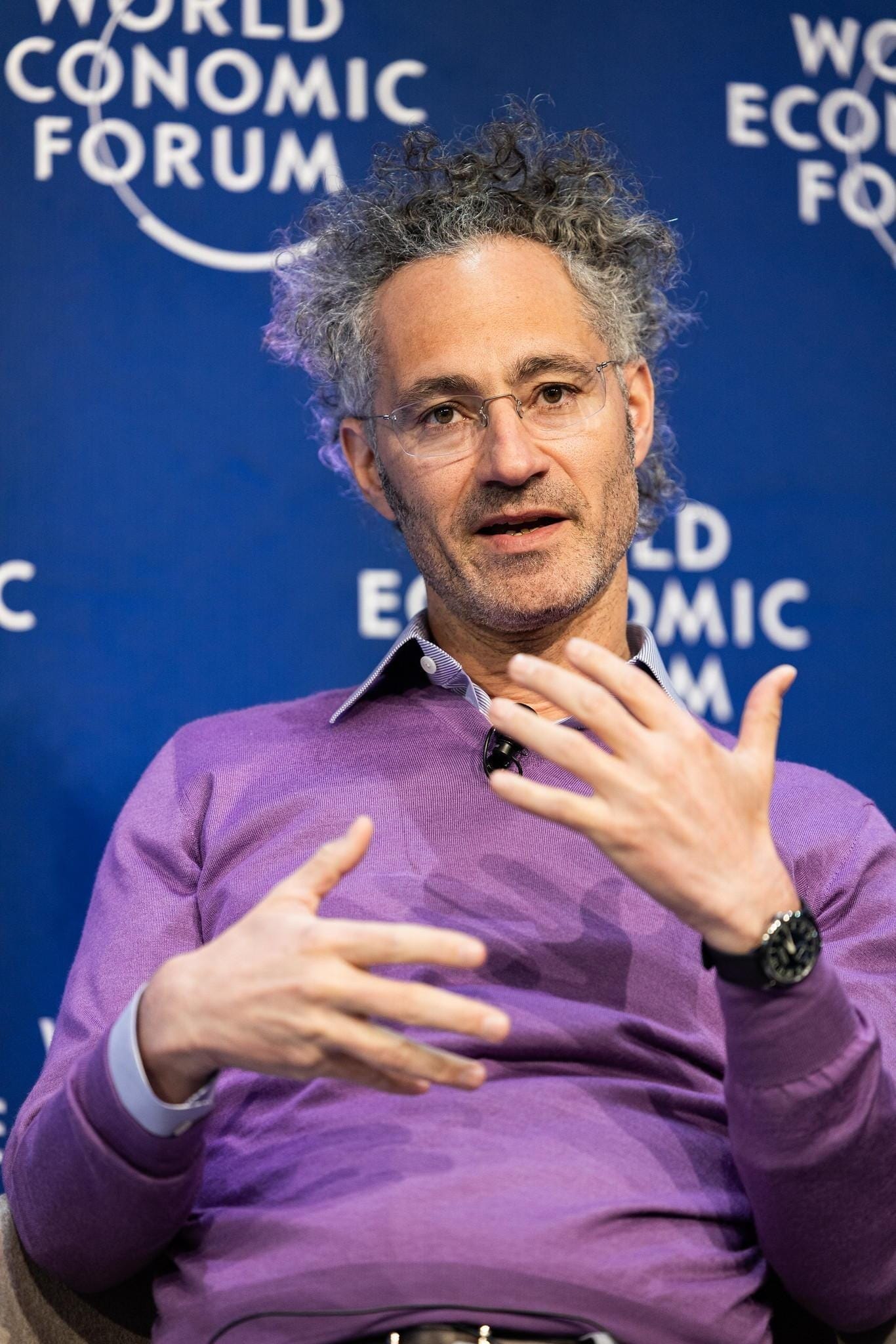
The ideology of war has become the master key for Silicon Valley’s wealthy, especially Palantir’s partners Karp and Thiel. Readers curious about Karp and Thiel’s worldview can look here and here.[[5]] But another reminder about Karp is necessary: According to the report mentioned above, in his letter to shareholders, the Palantir CEO quoted the famous political scientist Samuel P. Huntington, who wrote that Hispanics could not assimilate into American society. In his letter, Karp stated, “The rise of the West was not due to the ‘superiority of its ideas, values, or religion,’ but to ‘its superiority in applying organized violence.’ ”[[6]]
Karp praised what the author calls “DOGE’s saw,” saying they were experiencing a revolution and that “some people’s heads rolled.” And CTO Shyam Sankar, whom we should now call Lieutenant Colonel, said, “I think DOGE will bring meritocracy and transparency to government, and that is exactly the purpose of our commercial business.”
Let’s pause for a moment on the issue of meritocracy. Meritocracy, which unites the New Right, libertarianism, and Silicon Valley, appears as a renewed version of “scientific racist” thought. Supported by genetics and “IQ research,” this vision provides a foundation for both anti-immigrant sentiment in the U.S. and the search for an “ethno-economy”[[7]] that accompanies the “decline of the West” narrative. “Cultures” (some call them “neuro-castes,” but you can understand it as “races”) proven to be of “scientifically” high intelligence should separate themselves from others; instead of the theater of democracy, a meritocratic government should be established where games or politics no longer matter. One source of Thiel’s much-debated thesis that he “no longer believe[s] that freedom and democracy are compatible” is his belief in this kind of meritocracy.
Hostility to DEI (Diversity, Equity, and Inclusion), disgust for the welfare state, and indifference to aid for women/children/the poor all stem from this. This hatred also fuels violent language: Thiel, inspired by Richard Hanania, who wrote a book on the origins of “woke” thought, wrote, “DEI can never be defeated by words—Hanania shows that we need the sticks and stones of state violence to exorcise the demon of diversity.”
Lionel Shriver, author of We Need to Talk About Kevin, which was adapted into a film, captures the very “anxieties” of the Big Tech–Silicon Valley libertarianism led by Palantir in another novel, Mania. She depicts an America where the high-IQ “brain-arrogant” are seen as “brain supremacists,” and “Mental Parity” campaigns lower everyone’s expectations, stigmatizing achievement and excellence.
I2, Theft, and Imperial Justifications
We will analyze the story of Palantir creating a “Zionist surveillance state” in the next installment. But before we finish, there’s an anecdote that makes you think, “What’s a company without a little theft?”
According to the legend reported by Bloomberg, Thiel’s co-founder Stephen Cohen programmed the first prototype of Palantir’s software in two weeks, but it took years to snatch customers from I2, the long-time leader in the intelligence analytics market.
In an incident not mentioned in the stories of Palantir’s brilliant rise, I2 accused Palantir of misappropriating its intellectual property through a Florida shell company registered to the family of a Palantir executive.
A company claiming to be a private detective agency had licensed I2’s software and development tools and transferred them to Palantir for more than four years.
I2 discovered that this company was registered to the family of Shyam Sankar, Palantir’s director of business development.

The company sued Palantir in federal court for fraud, conspiracy, and copyright infringement.
I’ll conclude with Palantir’s response, an instructive tale about how the imperialist beast operates that leaves no room for interpretation:
In its legal response, Palantir argued that it had the right to use I2’s code for a greater good. In its motion to dismiss I2’s lawsuit, Palantir stated, "What is at stake here is the ability of critical national security, defense, and intelligence agencies to access their own data and to use that data interoperably on the platforms they choose to most effectively protect citizens."
The motion was denied. Palantir agreed to pay I2 approximately $10 million to settle the case. I2 was sold to IBM in 2011.
[[1]]: Andrew Bosworth explained on X that “201” refers to an HTTP status code, where a “201” response indicates that a new resource has been successfully created.
[[2]]: As the Palantir software “Metropolis” used by JPMorgan was established and developed, the Wall Street bank made a capital investment in the data-mining company and included it in its Hall of Innovation, while its executives praised Palantir in the press, Bloomberg also writes: Guy Chiarello, JPMorgan’s chief information officer at the time, told Bloomberg Businessweek in a 2011 interview that Metropolis “turns data dumps into gold mines.”
[[3]]: Thiel told Bloomberg in 2011 that civil liberties advocates should support Palantir because data mining was less oppressive than the “crazy abuses and draconian policies” proposed after 9/11. According to him, the best way to prevent another catastrophic attack without turning into a police state was to “give the state the best possible surveillance tools and build in safeguards against their abuse.”
[[4]]: Elsewhere, Karp said, “We built our company to support the West.” To this end, Palantir states that it does not do business with countries it considers adversaries of the U.S. and its allies, namely China and Russia. In the company’s early days, Palantir employees, quoting J.R.R. Tolkien, described their mission as “saving the Shire.”
[[5]]: After Palantir became a public company, it officially announced its move from Palo Alto to Denver, separating itself from Silicon Valley. Karp used his introductory letter to emphasize this point; he harshly criticized what he called the “engineering elite of Silicon Valley,” stated that Palantir was increasingly diverging from the values of the tech sector, and reaffirmed the company’s commitment to working with the U.S. military and defending the West. “We have chosen our side,” he wrote, in a comment implying that Silicon Valley had chosen the “other side.”
[[6]]: According to a long article published in The New York Times in 2020, Karp insisted that Palantir was more in line with U.S. public opinion than Google and other Silicon Valley giants. “We are strengthening Western institutions and, in some cases, making them dominant,” he said, continuing: “This is our narrative. Now, that’s probably not a popular narrative in Silicon Valley. In the rest of America, it’s a very popular narrative. What is Google’s narrative? ‘We’re destroying the media, we’re dividing the country, we’re taking your jobs, we’re getting rich, and by the way, when the country needs you, we’re not there.’ If the Google standard is established, our ability to produce software platforms, the greatest strategic asset America has, will be taken from our warfighters. And that means our enemies will de facto be in a much stronger position.” The article also contains a nice “coincidence”: in a photo showing Karp with Palantir employees Dave Glazer, Sara Peletz, and Mayer Schein, a large portrait of the French philosopher Michel Foucault is seen on the wall.
[[7]]: I use the term “ethno-economics” inspired by Quinn Slobodian’s book Crack-Up Capitalism: Market Radicals and the Dream of a World Without Democracy.