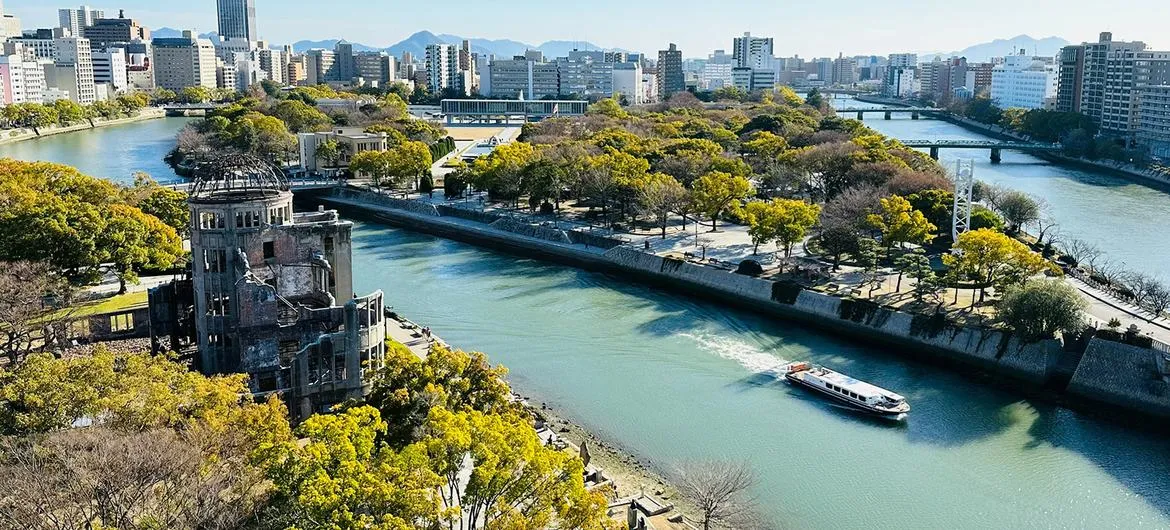
This week, we remember the 80th anniversary of the nuclear bombings of Hiroshima and Nagasaki, and all those who needlessly perished there as a result. The knowledge and memory of that entirely unnecessary and cruel event should forever serve as a living memorial that, in the era of nuclear weapons, mankind must find other means than war to settle its differences.
In an Aug. 6 op-ed in the New York Times, Nagasaki bomb survivor and co-chair of the Nihon Hidankyo organization of survivors, Dr. Terumi Tanaka, wrote: “There is no such thing as protection by nuclear weapons… If humanity does not pursue peace through international law based on the United Nations and its treaties, the next generation may very well live to see World War III—and that would be truly catastrophic for us all. As President John F. Kennedy once said about the existential nature of the nuclear threat: ‘The weapons of war must be abolished before they abolish us’.”
Yet, despite this, there are leading officials around the world who disagree and instead think that nuclear war could be won and therefore should be prepared to be fought. Rear Adm. Thomas Buchanan, Director of Plans and Policy at STRATCOM, is one example of this insanity, who argued at a CSIS event last year that, “If we have to have an [nuclear] exchange, then we want to do it in terms that are most acceptable to the United States… that puts us in a position to continue to lead the world.” This view is also now increasingly accepted by the governments of the UK, France, and Germany, which are all preparing themselves for long-term conflict with Russia and pushing for the US under Trump to join them, as EIR has recently documented.
President Donald Trump has assumed office at a moment of epochal transformation and historic potential. On the one hand, the previous ruling cliques across the trans-Atlantic have been caught red-handed—both in their unhinged support for endless war against Russia, even while their nations crumble, and in their undemocratic attempts to torpedo Trump’s first administration, as DNI Tulsi Gabbard is now exposing. On the other hand, the nations of the Global South and East, epitomized by the BRICS+ grouping, have emerged as a new source of growth and vitality, eager to collaborate with patriotic republics in the West for a new post-colonial era of growth, human flourishing, and peace. What a profound moment of opportunity that the best minds of the past could only have ever dreamed of!
But who will “hear” this music? Will enough courageous and inflamed souls work to capture these initial tones and shape them into a whole composition? Trump himself is surrounded by hostile influences in every direction—whether to revamp the confrontation with Russia, to embrace the madness of cryptocurrencies and tariffs, or to condone a genocide in the name of “defending Israel.” The answer to the above question lies less with Trump himself than with the creation of a political and cultural process around him that can shape the current period and realize the enormous potential before us.
Today, the most immediate way this can be realized is if Presidents Trump, Putin, and Xi meet in person, for example at the upcoming Sep. 3 celebrations in Beijing commemorating the defeat of Japan in World War II. As the recently-released Schiller Institute petition says: “If the three Presidents would attend the military parade on September 3rd, and together renew that sacred oath ‘Never again!,’ it would send the strongest message possible to the entire globe, that a new era of peace will begin.” The Aug. 6 meeting between special envoy Steve Witkoff and President Putin, and the ensuing announcement that Trump intends to hold an in-person meeting with Putin in the coming days, is a significant step in the right direction. The Schiller Institute petition should be circulated widely around the world as part of an effort to shape this dynamic over the coming period.
There is a common humanity that ties the world together, which, if acted upon, can become the basis for a new security and development architecture in the world. As Dr. Akiko Mikamo, author of the book 8:15 A True Story of Survival and Forgiveness from Hiroshima and the film, “8:15 Hiroshima—From Father to Daughter,” said in discussion with Helga Zepp-LaRouche on Aug. 6: “Emotionally, we have a choice—to become a little bit higher being ... as a human, and a little bit higher level of development emotionally, to look at things from a different perspective and learn from it. And really give back to humanity. That’s what I firmly believe. That’s the only way I can think of.”