On Friday, Aug. 8, the world learned that Presidents Donald Trump and Vladimir Putin had agreed to meet in Alaska on Aug. 15, to address the Ukraine and the broader strategic crises facing the two nuclear superpowers. The Russian side expressed interest in exploring common interests in major economic development projects between the two nations.
On Saturday, Aug. 9, the world learned from top Putin aide Yury Ushakov that a follow-up meeting between Putin and Trump has already been proposed, to be held in Russia. “Looking ahead, we would naturally expect the next meeting between the presidents to be held on Russia’s territory. An invitation to that effect has already been made to the President of the United States.” We also learned from Putin’s special envoy Kirill Dmitriev that “a number of countries that are interested in continuing the [Ukraine] conflict, will make enormous efforts (involving provocations and disinformation) to disrupt the upcoming meeting between President Putin and President Trump.” That comes as no surprise to readers of this news service, which has documented to a fare-thee-well the criminal role of the British, in particular, in fanning the flames of war—including nuclear war—in Ukraine, going back decades.
Dmitriev also seconded Ushakov’s call for joint economic projects between the two nations, mentioning the Arctic region as a leading area of common interest.
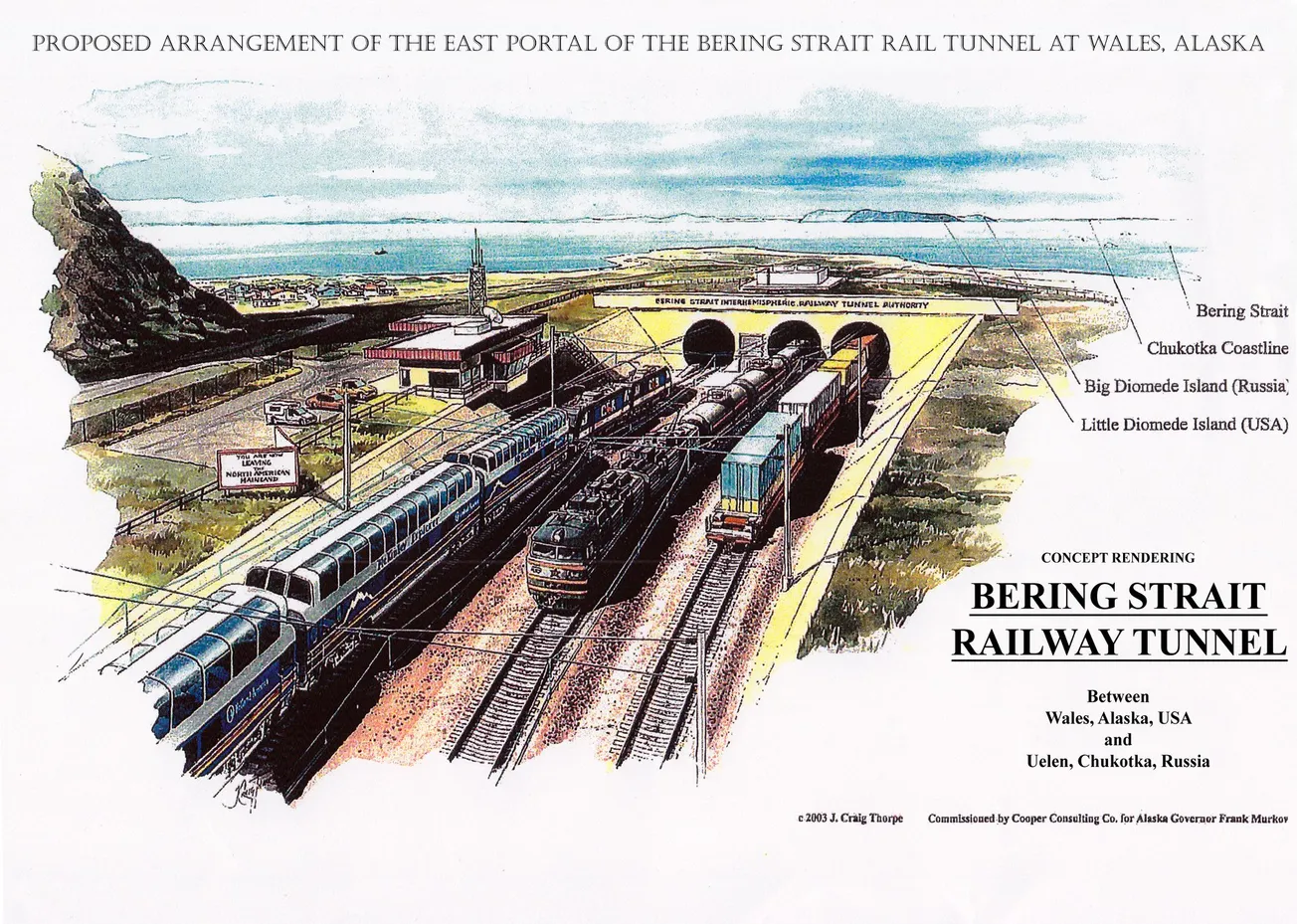
What immediately comes to mind is the long-standing proposal for the construction of a tunnel under the Bering Strait, to unite Russia and the United States—Eurasia and North America—with a high-speed rail line and related infrastructure to make both nations, and both continents, prosper. This is a project which Lyndon LaRouche championed around the world going back to the early 1970s, as a central feature of his World Land-Bridge program. It is a project which has been proposed, studied and approved for implementation at the highest levels of the scientific intelligentsia (including prominent government figures) of Russia and China. As one of China’s most famous tunnel and rail engineers and leading Bering Strait Tunnel advocate, Wang Mengshu, told the New York Times in 2014: “Some governments like to spend their resources on fighting wars. I think building a railway is far more meaningful than fighting wars.”
It is time for the U.S. to get on board. That is the key project and proposal that President Trump should take with him and put on the table at the Alaska summit. As the late former Governor of Alaska, Walter Hickel, said in campaigning for the Bering Strait Tunnel: “Why war? Why not a big project?”
But that is just the beginning. There are even greater prospects for fundamental change if the Alaska summit is taken as the stepping stone for a three-way summit of Putin, Trump and China’s Xi Jinping, who could all meet in Beijing on Sept. 3—less than three weeks after the Alaska summit—on the occasion of the celebration to mark the 80th anniversary of the end of World War II.
Schiller Institute founder Helga Zepp-LaRouche issued an urgent international appeal on Aug. 5—before the Alaska meeting had been announced—stating that “there is a great historic opportunity in front of us, where the leaders of three great nations could send a powerful signal to the world.… The people of the world could find hope that those three leaders would open a new chapter in the history of humanity,” Zepp-LaRouche insisted, “to pull mankind back from the abyss of annihilation and become the founders of a new era in human history!”
Now that Alaska is clearly on the world’s agenda, the Schiller Institute will be circulating extensive documentary material on the Bering Strait Tunnel and its role within the World Land-Bridge, over the coming weeks leading into the Alaska and Beijing summits, calling on those leaders and others to adopt that project—and the policy intention behind it—to pull the world back from the brink of global depression and threatened nuclear war.
With the nations of the BRICS in turmoil over Trump’s aggressive tariffs, planning steps to drastically alter their trade and economic relations away from the Wall Street and City of London speculative system, they too can be won to this perspective, and will rally behind the three leaders who champion it.
By early September, the world can be a very different place.