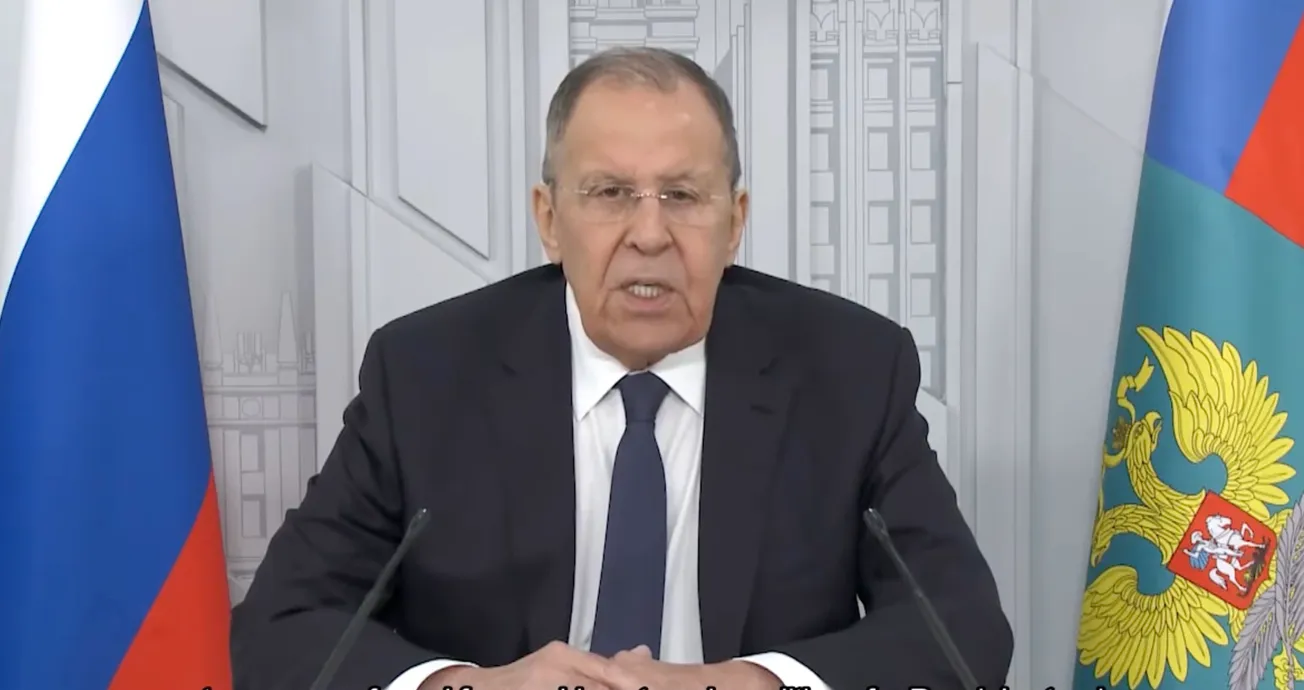
In a major article published in Rossiskaya Gazeta on Aug. 1 and available also on the Foreign Ministry website, Russian Foreign Minister Sergey Lavrov takes a look back at the post-Yalta institutions, including the 1974 Organization of Security and Cooperation in Europe (OSCE), which came out of the so-called Helsinki Accords. The idea was to create an organization in which the western Europeans as well as Russia and the countries of Eastern Europe could work out their problems through discussion and mutual cooperation.
While noting the 80th anniversary of the end of World War II this year, he also underlined that it was the 50th anniversary of the signing of the agreement on the OSCE. This was an initiative proposed by the Soviet Union in the hope of building some form of European security system; yet, most of its tenets and its aims have been undermined by the Western nations, which have turned it into a tool of oppression against the Russian Federation, Lavrov said.
“Irreparable damage has been done to the first basket, the military-political dimension of the Organization. You may remember that over time the member states have unanimously approved a number of fundamental documents that declared the indivisibility of security, meaning that no country has a right to strengthen its security at the expense of others’ security, and no country or organisation should strive for dominance in Europe. This principle has been formalised, in particular, in the decisions of the heads of state and government adopted at the summits in Paris (1990), Istanbul (1999) and Astana (2010),” he said.
“However, while adopting these and other high-flown declarations, the West was doing exactly the opposite, increasing NATO’s eastward expansion to the detriment of the interests of Russia and many other countries. They refused to hold serious discussions at the OSCE and the Russia-NATO Council (established in 1998) on measures that could at least offset the negative consequences of the bloc’s expansion for Russia’s security….”
The same thing happened to the economic agreements that were part of the Helsinki Accords, he noted. “However, cooperation in this sector has lost its practical relevance as the European Union devoured more countries and pursued a policy of enforcing neocolonial-style association agreements and other forms of collaboration on its external partners, including the OSCE countries from among the former Soviet republics. The Russia-EU Permanent Partnership Council, seemingly established with noble intentions, has effectively become a facade for advancing the unilateral agenda of Brussels bureaucrats who seek to dominate relations between Moscow and the national governments of all EU members.”
The “third basket” of these agreements had to do with “human rights” which were originally envisioned by the West as a tool to “monitor” civil rights or other violations by the Soviet Union. Now these “principles” have been totally ignored by the Western nations intent on eliminating Russia from the map and Russian culture from the annals of human history.
“The Western nations, the Secretary-General and all OSCE institutions maintain a deathly silence concerning the actions by the Kiev regime, which has enacted a series of laws since 2017 exterminating the Russian language and culture. People are prohibited from learning, reading, obtaining information and simply communicating in their mother tongue. The regime has further encroached upon the highly sensitive domain of religion by launching a campaign against the canonical Ukrainian Orthodox Church, revoking its primate’s citizenship in its most recent act. The neo-Nazis have stooped so low as to fight against those who perished in the war for liberating Ukraine from Hitler. The mind-boggling level of cultural degradation, bordering on savagery, was demonstrated in Lvov, where the remains of Soviet soldiers interred at the Hill of Glory were exhumed and offered by the mayor to be exchanged for Ukrainian prisoners of war.”
From an organization promoting peace, the OSCE has been increasingly used as just another tool in the European war against Russia, Lavrov said. “This brings historical events to mind: with their current leaders, modern Germany and the rest of Europe are transforming into a Fourth Reich. The situation is extremely alarming, and the OSCE is unlikely to be of any help.” He underlined the ongoing initiative of Russia, Belarus and other countries to create a Eurasian Security Architecture. “This is the aim of the Russian-Belarusian initiative to draft a Eurasian Charter of Diversity and Multipolarity in the 21st Century. Within such an architecture, there will be space for countries in Europe’s continental expanse—but they will certainly not call the tunes. If they wish to be part of this process, they must learn good manners, abandon diktat and colonial instincts, adapt to equality, and work as a team,” Lavrov said.