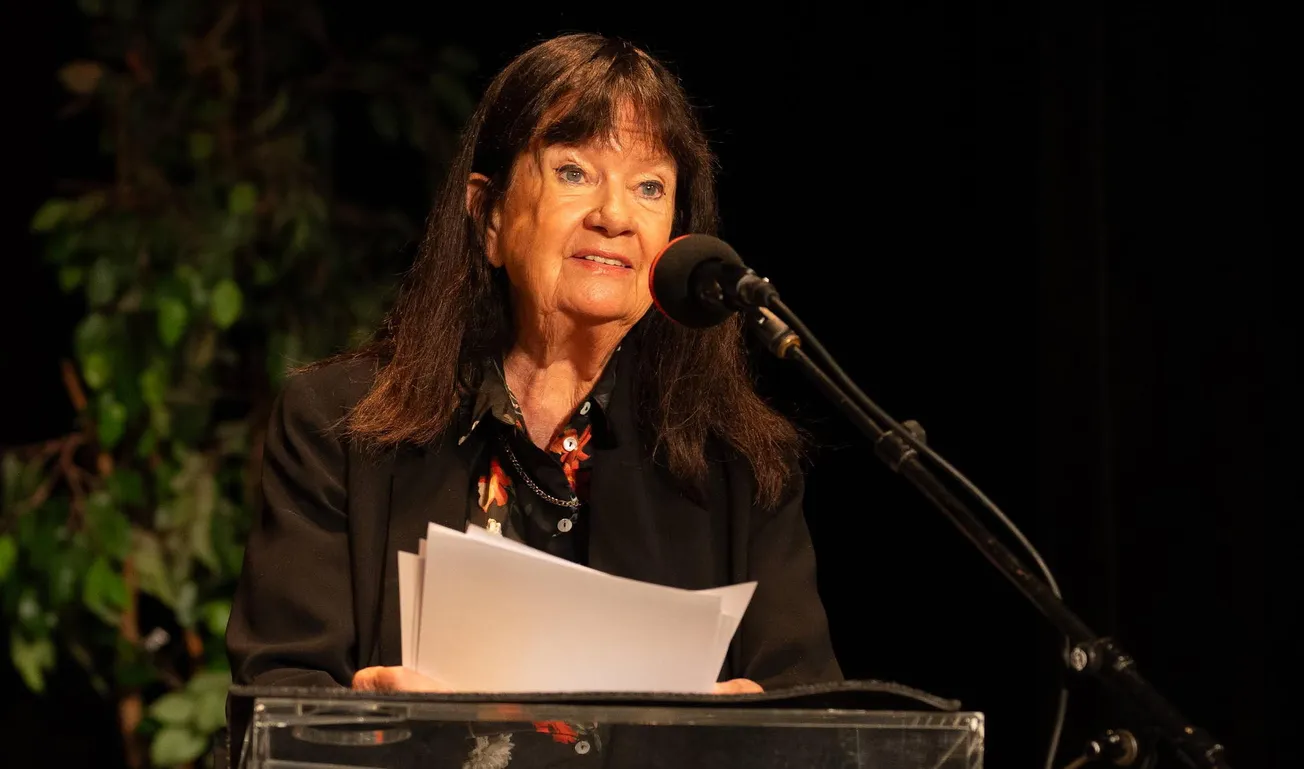
“The world situation is so fast moving and wild that we may be approaching what you might call the final storm in the strategic situation fairly soon.” Those were Helga Zepp-LaRouche’s opening words to the International Peace Coalition (IPC) meeting of August 1.
As if to prove her point, in the middle of that IPC meeting, U.S. President Donald Trump posted the following very alarming statement: “Based on the highly provocative statements of the Former President of Russia, Dmitry Medvedev, who is now the Deputy Chairman of the Security Council of the Russian Federation, I have ordered two Nuclear Submarines to be positioned in the appropriate regions, just in case these foolish and inflammatory statements are more than just that. Words are very important, and can often lead to unintended consequences, I hope this will not be one of those instances.”
Helga LaRouche commented, “This is an escalation of the utmost seriousness. … I think we need to make an extraordinary intervention in the strategic situation to get it off this course of step-by-step confrontation until the point of no return, which I’m quite extremely worried is getting very, very close.”
Earlier in the discussion, Zepp-LaRouche put forward the only approach that can, in her view, work: “The world order and world situation is completely out of shape and is moving very, very clearly into what I can only see if not remedied quickly by reintroducing some order, moving to the final storm, and that means we have to increase our efforts to move to solutions, and the only solution in my view is a new security and development architecture.”
Such a new system for the world, one which takes into account the legitimate security and development interests of all nations, is something that Zepp-LaRouche and the Schiller Institute have continued to insist upon as the urgent basis for escaping the suicide pact of geopolitics in a nuclear-armed world. Zepp-LaRouche’s proposal has been paralleled by that of, among others, the leadership of Russia. In an August 1 article on 50th anniversary of the Helsinki Act, Russian Minister of Foreign Affairs Sergey Lavrov put forward the need for a new, indivisible security system in Eurasia: “As a strategic objective, Russia envisions forming a flexible and resilient architecture of equal and indivisible security and cooperation in Eurasia, capable of addressing contemporary challenges. The goal of ensuring indivisible security proved unattainable in the OSCE, yet it can be fully realized within a pan-Eurasian framework open to all continental nations—embodying a new, polycentric world order.”
Such a new world order is especially urgent given the fact that as the Global Majority, typified by the BRICS-Plus nations, moves ahead with initiatives aimed at freeing the world from the vestiges of colonialism (a good thing!), the policymaking elites in the West, gripped by the evil that is geopolitics, become more desperate to stop such a global realignment—using all the means at their disposal. President Trump has stumbled (or perhaps sauntered) into this imperial trap, declaring, as he answered a question about the sanctions he had placed on BRICS founding member India, that the BRICS is “a group of countries that are anti-the United States,” and are leading an attack on the U.S. dollar.
“The world is falling apart; it’s flying in all directions,” Zepp-LaRouche said to the IPC. “If you look at all the different conflicts, the U.S. internal situation, the U.S.-BRICS conflict, the situation in the Middle East, the situation in Ukraine, all of these things are flying apart as if you have lost the handle. And we have to have the approach of re-establishing a level of discussion where you have a platform from which you can operate. And that has been our demand: We need a new security and development architecture which has to take into account the interest of every single country on the planet. And then, in that context, one can address these issues.”
Zepp-LaRouche called on participants in the IPC meeting—and all others, besides—to do everything they can, given the rapid escalation toward confrontation, to “alarm the whole world that we need to unify the peace movement with our demands in ways you may not have considered when you joined this call two hours ago.”