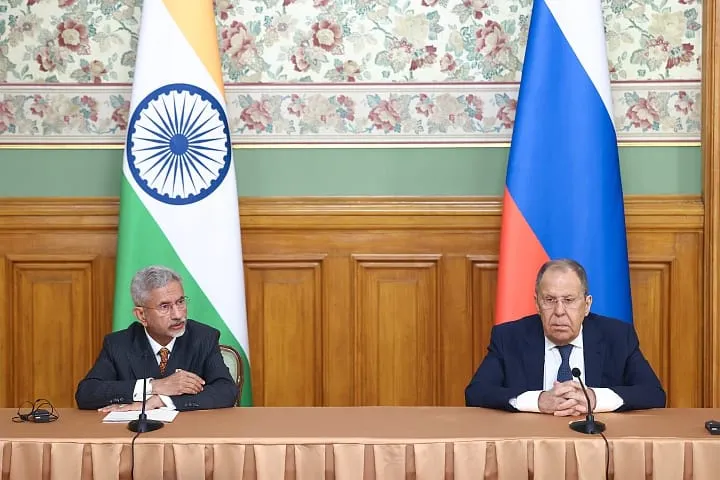
Russian Foreign Minister Sergey Lavrov reported, after meeting today with “my Indian colleague and friend, Minister of External Affairs of India Subrahmanyam Jaishankar,” on Jaishankar being “absolutely pleased with the outcomes” of “yesterday’s meeting of the Intergovernmental Commission on Trade, Economic, Scientific, Technical and Cultural Cooperation.” The Russian co-chair is First Deputy Prime Minister Denis Manturov, key to high-level economic projects in the region.
Lavrov reported that they “discussed joint cooperation projects in energy (including nuclear), outer space exploration, the manufacturing industry, transport, and infrastructure, to name a few. These projects are under consideration by the corresponding agencies and will definitely take bilateral trade, and economic and investment cooperation to a whole new level.” Bilateral trade had already jumped by 15% in 2024, to record levels.
In particular, an agreement to step up the implementation of the International North-South Transport Corridor (INSTC) project was made, and “ambitious plans to organize and scale up cargo transport along the Northern Sea Route are now in place. Cooperation in the hydrocarbon sector and Russian oil shipments to the Indian market are making wide strides. Both sides are interested in implementing joint energy production projects in the Russian Far East and the Russian Arctic shelf, among other sites.”
He summed up yesterday’s progress by saying: “The economic base of our special privileged strategic partnership is getting stronger in a steady and progressive manner which underscores the special nature of Russian-Indian relations. We are convinced this strategic partnership meets the fundamental interests of our respective peoples and contributes to regional security and stability, which is undeniably important considering the challenging international circumstances that we are operating under.”
Today, the two made preparations for President Putin’s “visit to India before the end of this year. A large package of documents will be put together for this summit.” Lavrov also “informed our Indian guests in detail about the state of the discussions with our U.S. partners, primarily, the talks in Alaska…. We also looked into how this push for a speedy settlement can be realized in practice in a manner that will fully take into account the legitimate security interests of all participants…. We enjoy close coordination at various multilateral institutions, such as the UN, BRICS, the SCO, and the G20, and agreed to keep it that way.”
Jaishankar met with Putin today, and India’s Prime Minister Narendra Modi is expected to see Putin in China for the Shanghai Cooperation Organization (SCO) meeting, Aug. 31-Sept 1. For the three countries, such large-scale scientific and economic projects agreed upon yesterday between India and Russia are at the core of drying out conflicts and establishing long-term stability and progress.