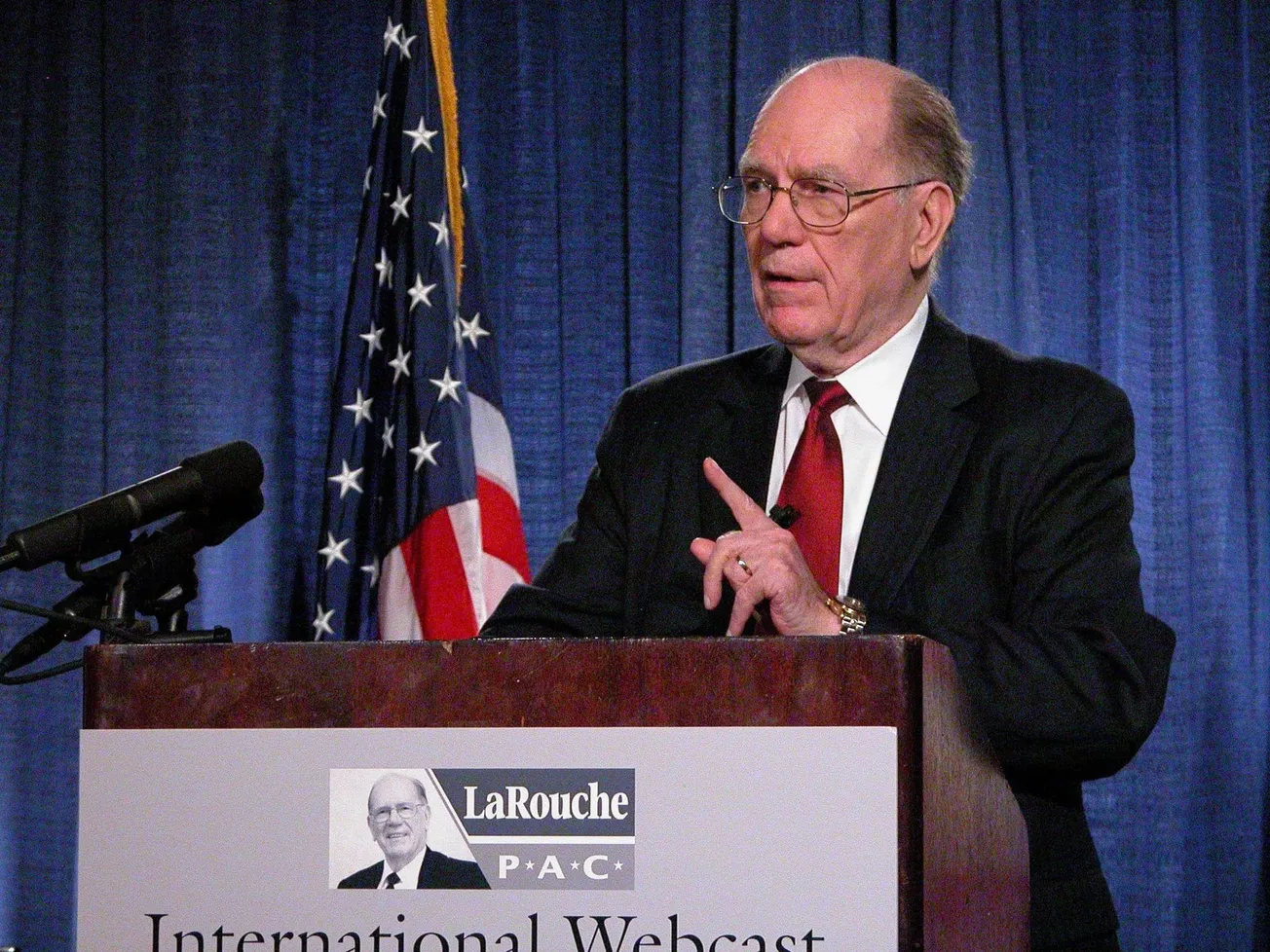
For nearly five decades, Lyndon LaRouche provided the intellectual and political leadership in the fight for a new world economic order for the planet, for the purpose of ending the historic imperial control by monetarism, in order to unleash mankind’s creative powers as a species.
The profound impact of LaRouche’s intellectual leadership is clearly reflected in actions being taken by the BRICS nations (Brazil, Russia, India, China, South Africa, and newer members and partners), the Shanghai Cooperation Organization (SCO), and others to create a new global financial architecture and strategic alliance among nations.
The July 15-16, 2014 BRICS summit in Fortaleza, Brazil and the September 2025 events in Tianjin, Beijing, and Vladivostok—highlighted in this issue of EIR—bookend that trend.
The LaRouche movement in the United States has campaigned throughout this 50-year period for this country to return to its American System tradition, as enunciated by President John Quincy Adams and others, and join the fight for a global community of sovereign nations in the interests of all: a new, just world economic order. These U.S. initiatives have notably included the call for Russian-American cooperation in the Strategic Defense Initiative; a New Bretton Woods financial system; the reinstatement of the “Glass-Steagall” U.S. Banking Act of 1933 to destroy the Wall Street monetarist faction; the Homeowners and Bank Protection Act of 2007; and such development projects as the North American Water and Power Alliance (NAWAPA).
This partial timeline of LaRouche’s role in leading the fight for a new world economic order, with an emphasis on international initiatives, was written by Matthew Ogden and originally published in EIR on Oct. 24, 2014. This updated version includes events from 2014 onward, with contributions from several members of the EIR staff. The chronology is based on a more extensive version on the Schiller Institute’s website, which has many links to excellent documentary material, including the original articles, speeches, and videos.
The 1970s
LaRouche Calls for International Development Bank
At press conferences in April 1975 in Bonn, Germany and Milan, Italy, LaRouche presents his plan for “the immediate establishment of an International Development Bank as an agreement among the three principal world sectors—the industrialized capitalist sector, the so-called developing sector, and socialist countries.” He specifies that the immediate concentration of the investment thus made possible should be industrial development and expanded food production worldwide.

LaRouche predicts that the present, or then-existing, international monetary system of the IMF, would inevitably go bankrupt, and should be replaced by a different credit-creating institution, namely, an International Development Bank (IDB), to facilitate long-term, low-interest credit for capital investment and capital-goods transfer from the industrialized sector to the so-called developing sector, in order to overcome the underdevelopment of Africa, Latin America, and large parts of Asia.
LaRouche issues a policy document for international circulation titled “IDB: How the International Development Bank Will Work,” in which he writes that two immediate, interconnected actions are imperative:
1. The declaration of a commitment to sweeping reorganization of the world monetary system, involving an orderly process of debt moratoria and the establishment of an institution such as the proposed International Development Bank (IDB).
2. Immediate commitment to enact, within each national sector of the capitalist world, these measures of emergency financial-reorganization legislation required to facilitate immediate economic recovery in conjunction with IDB efforts.
Non-Aligned Movement Endorses New International Economic Order
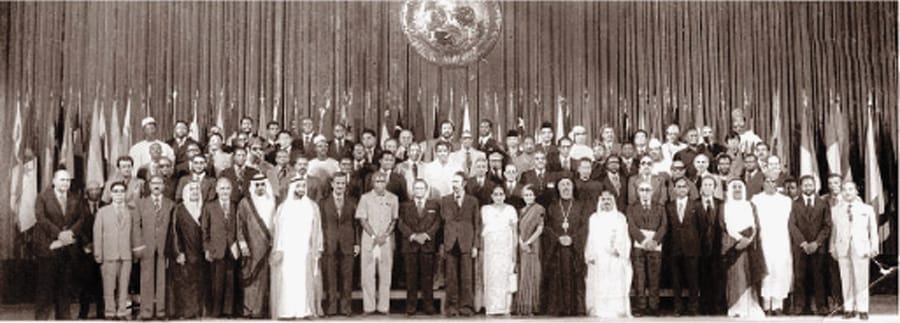
Within months, 85 nations, representing 2 billion people, meet in Colombo, Sri Lanka for the Fifth Summit of the Non-Aligned Movement and issue a unanimous declaration calling for a new international economic order on Aug. 19, 1976, identical in many regards to LaRouche’s proposals spelled out in his policy document from the preceding year.
The declaration endorses both the establishment of a new international monetary and financial system to replace the International Monetary Fund and provide capital for Third World development through the creation of a Bank of the Developing Countries, as well as a debt moratorium for the least developed countries whose outstanding debts at the time made economic development for those nations impossible. The heads of state of the Non-Aligned nations declare that this summit represented: “… a new step for the establishment of the new world economic order, and in particular, the essential element of such a new order, a new monetary and financial system.”
In her keynote address to the summit, Sri Lankan Prime Minister Sirimavo Bandaranaike endorses the establishment of a development bank for the Third World:
The developing countries are consistently denied the true value of their output by the vagaries of the international market and the manipulations of international finance. The developed countries have shaped the international financial system to suit their interests. Should we in the developing world sustain such a system? Should we not, instead attempt to develop a system all our own?… One area of great promise, would be the establishment of a commercial bank—a Bank for the Third World—the bank of Asia, Africa, and Latin America. This would not be another non-aligned solidarity fund. It would be a genuine commercial bank and a truly multinational enterprise.
Guyana’s Wills Calls for International Development Bank at UN
Immediately following the Colombo Summit, the Foreign Minister of Guyana, Frederick Wills, addresses the United Nations General Assembly in New York, on Sept. 27, 1976, and calls for a new international economic order through the creation of an international development bank and a debt moratorium for the developing world. Wills declares that “there can be no meaningful economic advance without the implementation of the new international economic order.”

Wills asserts:
The IMF and the Bretton Woods monetary system must give way to alternative structures like international development banks…. The crippling problem of debt and the servicing of debt has assumed a special urgency. Developing countries cannot afford to depart from their basic and fundamental demand made in Colombo earlier this year calling for measures of cancellation, rescheduling, and the declaration of moratoria. We cannot afford to mortgage the future of unborn generations to the obligations of burdensome capital repayments and crushing debt servicing. The time has come for a debt moratorium.
LaRouche: U.S. Must Integrate Itself into the IDB
As a Presidential candidate for the U.S. Labor Party in 1976, LaRouche celebrates the historic decisions made by the Non-Aligned Movement at the Colombo Summit saying:
We have succeeded in mobilizing 85 countries and 2 billion people around our program. That is what I have worked for all my life. Our small organization has accomplished what many termed impossible. We must use our victory at Colombo to organize the American working class behind our program. They want to do something, but the average person lacks the sense of how to fight. Colombo changes this prescription. Colombo has shown these forces what can be done on a world scale with a cadre of a handful of people…. The United States will have to integrate itself into the International Development Bank (IDB).
LaRouche Situates India’s Role in New International Economic Order
In a 1977 EIR Special Report titled “The Struggle for Indian Freedom: A New Program,” LaRouche states that India can lead the Non-Aligned Movement in declaring a debt moratorium as a “strategic weapon,” as well as establishing the International Development Bank:
The first contribution India must make in this battle is to lead the developing countries, in concert with leading Third World nations, in a declaration of moratoria on the payment of all debt to the bankrupt monetarist institutions of the IMF-World Bank and their aid consortia. The freezing of unpayable debts to the monetarists is not only morally imperative but is the strategic weapon we must wield to open the way to the establishment of a new monetary system. As the 1975 programmatic document, ‘The International Development Bank,’ proposed, the central task of a new world economic order is to facilitate the greatest possible flow of technologies and industrial processes from the advanced sector into the developing sector.
Indira Gandhi’s Interview with EIR

In 1978, the year before her stunning comeback victory as Prime Minister of India, Indira Gandhi gives the first of several interviews to EIR. In the interview, conducted at her home in New Delhi, Mrs. Gandhi strongly defends a return to the non-aligned foreign policy of her father Jawaharlal Nehru, and insists that only a policy of aggressive government support for investment in science and technology can save India from crushing poverty: “Science and technology, this is essential to fight poverty. It is ridiculous to say that you can solve rural problems without science and without industry; you simply can’t. In our scheme of things, there is no conflict between agriculture and industry; they complement one another.”
In another interview with EIR following her victory in the 1980 elections, Mrs. Gandhi elaborates on her development policy:
India is a developing country, and development has been rather uneven. It is obvious that where there is industry, it is much easier for that area to grow and for people to get more jobs. We have a program for developing backward areas and we have made progress in it…. We have to encourage investment to increase production, we have to build up the distribution system for essential commodities…. We have to take up again the special programs for the poorest and weaker sections of the population.
Program for the Industrialization of Africa
The Fusion Energy Foundation, an international association of scientists co-founded by LaRouche, holds an international conference in Paris in June 1979 titled “The Industrialization of Africa” on the subject of a new international economic order as the indispensable precondition for the development of the African continent.
The 1980s
Forty-Year Plan for the Industrialization of India

LaRouche releases a program to transform India into an industrial superpower, at a conference on May 5-6, 1980 in Frankfurt, Germany, sponsored by EIR and the Fusion Energy Foundation. Indian Prime Minister Indira Gandhi sends greetings to the conference:
Since 1947 India has made considerable progress in science and technology. The world now recognizes the versatility and capability of our industries. Our aim is to make our country self-reliant…. It is appropriate to assess our progress now and to look into the future. My good wishes to the conference on India’s industrial development being held by the European Fusion Foundation and the EIR.
LaRouches Meet with Prime Minister Indira Gandhi
In April 1982, Lyndon and Helga LaRouche travel to India where they meet with Prime Minister Indira Gandhi for the first time, along with several members of Parliament, leading scientists, industrialists and economists. While in New Delhi, LaRouche addresses the Indian Council of World Affairs, as well as the Institute for Defense Studies and Analysis, and the Jawaharlal Nehru University School of International Studies. LaRouche then travels to Bombay to tour the Bhabha Atomic Research Center.

LaRouche’s speech to the Indian Council on World Affairs is titled “A New Approach to North-South Relations” in which he states that the program adopted at the Non-Aligned summit in Colombo must be the model for achieving a new world economic order, and declares:
I propose that the developing nations, and the spokesmen of them, make a unilateral statement to this effect: that there will be international cooperation on East-West/North-South development interrelatedly; that conditions of political stability and peace be premised upon the mutual self-interests of the parties in promoting economic development.
LaRouche Meets with Mexican President López Portillo
Immediately after returning from his meeting with Indira Gandhi in India, LaRouche travels to Mexico City to meet with President José López Portillo on May 27, 1982. At a press conference at the Presidential palace Los Piños following the meeting, LaRouche proposes that the nations of Ibero-America unite to deploy a “debt bomb” against the City of London to force a restructuring of the world economic system as the means to usher in the new international economic order. Multiple leading Latin American newspapers publish stories on May 28 covering LaRouche’s proposal.
LaRouche Issues ‘Operation Juárez’ Proposal for South America

In the aftermath of his meeting with President López Portillo, LaRouche issues a major policy document titled Operation Juárez, on Aug. 2, 1982, in which he elaborates his original proposal for an International Development Bank in the context of the debt crisis facing South America. LaRouche proposes that the nations of Ibero-America use their collective strategic leverage as debtor-nations to unite in a common bloc and unilaterally declare a restructuring of their debts and the establishment of a new monetary order.
The formation of an international development bank among these nations, he writes, would serve “as a coordinating agency for planning investments and trade-expansion among the member-republics. This bank will soon become one of the most powerful financial institutions in the world…. The Ibero-American continent could rapidly emerge as a leading economic power of the world, an economic super-power.”
López Portillo Demands New International Economic Order at UN

In August 1982, Mexican President José López Portillo acts on LaRouche’s proposals as contained in Operation Juárez by adopting credit controls on Mexico’s currency, nationalizing the banking system, and announcing a debt moratorium on Mexican debt. On Oct. 1, 1982, he addresses the UN General Assembly, where he declares:
The most constant concern and activity of Mexico in the international arena, is the transition to a new economic order…. It is imperative that the new international economic order establish a link between refinancing the development of countries that suffer capital flight, and the capital that has fled…. Let us not continue in this vicious circle: it could be the beginning of a new medieval Dark Age, without the possibility of a Renaissance….
LaRouche in Rome: ‘The Theory of the New World Economic Order’
LaRouche delivers a speech on Oct. 20, 1982 in Rome titled “The Theory of the New World Economic Order” in which he says, “I shall summarize the scientific basis for the establishment of a new world economic order.” LaRouche states:
“My chief personal role in the effort to establish a just new world economic order has been to apply my special skills as an economist to design policy-structures of economic and monetary policies.” LaRouche elaborates the scientific theory behind his Operation Juárez proposal, specifying “potential relative population density” as the necessary measure for the performance of economies, and states: “We define economic science as a study of the manner in which the use of technological progress maintains and increases this potential relative population density.”
Founding Conference of the Club of Life
With simultaneous founding conferences in Rome and Wiesbaden, West Germany Oct. 20-22, 1982, joined by supporting conferences in nine cities of the Americas, the Club of Life was born, as proposed by Helga Zepp-LaRouche, to galvanize a counterpole of optimism throughout the world to the rampant neo-Malthusian ideology being fostered by organizations such as the Club of Rome. More than 1,000 people attend, including some 400 in Rome, despite efforts by the U.S. Embassy to discourage participation.
Attendees included the embassies of Colombia and Guatemala to the Vatican; the embassies of Senegal, Venezuela, and Vietnam to Italy; the Italian Foreign Ministry; cultural and trade union groups; and large student delegations. There were also economists, anti-Malthusian activists, journalists, scientists, and industrialists.
Zepp-LaRouche sounds the theme of the events with her keynote in Wiesbaden, “On the Urgent Necessity to Create a Just New World Order.” Lyndon LaRouche follows with a presentation on the economic theory behind the new world economic order, noting especially the process underway since the Malvinas War in lbero-America, towards forced debt renegotiation.
Indira Gandhi Hosts Non-Aligned Summit: ‘New Economic Order or Nuclear War’
Prime Minister Indira Gandhi hosts the 7th Summit of the Non-Aligned Movement in New Delhi, March 1983, where she warns, “Humankind is balancing on the brink of the collapse of the world economic system and annihilation through nuclear war,” and calls for the convening of “an international conference on money and finance for development.” She specifies that such a conference “should suggest comprehensive reforms of the international monetary system to facilitate the mobilization of developmental finance for investment in vital areas of food, energy and industrial development.” Mrs. Gandhi also calls for “a major debt restructuring exercise,” stating that the “debt problem of developing countries has assumed an unprecedented dimension.” She appeals to the 100 heads of state present to seize the “marvelous opportunity” before them, saying: “The eyes of the world are upon us. Let us decide here to usher in a new international economic order, to call for an international conference on money and finance for development.”

The “New Delhi Appeal” which is adopted by the 100 world leaders present, representing almost half of humanity, echoes Indira Gandhi’s warnings of “the threat of a worldwide nuclear catastrophe” as well as her demands for an international conference on finance for development:
A thoroughgoing restructuring of the existing international economic order through a process of global negotiations is necessary. Non-aligned countries are committed to strive for the establishment of the new international economic order based on justice and equality. We propose the immediate convening of an international conference on money and finance for development, with universal participation, and a comprehensive restructuring of the international monetary and financial system.

LaRouche’s call for debtor-nations to unite and unilaterally declare a restructuring of their debts, as specified in his Operation Juárez, pervades the debate at the summit, and is raised by the President of Nicaragua, Daniel Ortega, who calls for the establishment of “a common organization of debtor countries” to conduct “joint efforts and actions that would induce the creditors to seriously consider the necessity of a new international economic order.” Ultimately, the Economic Declaration of the summit states: “It is essential to secure a cancellation of the external debt owed to developed countries.”
Reagan Announces Strategic Defense Initiative

On March 23, 1983, President Ronald Reagan shocks the world by announcing the Strategic Defense Initiative (SDI), calling on the scientific community to “turn their great talents now to the cause of mankind and world peace; to give us the means of rendering nuclear weapons impotent and obsolete.”
The policy unveiled in this historic announcement had been discussed for months in back-channel negotiations with Soviet representatives, which Lyndon LaRouche conducted personally at the behest of leading members of Reagan’s national security team.
LaRouche began calling for economic and scientific collaboration with the Soviet Union in the mid-1970s to develop new physical principles for space-based missile defense systems as a driver for global development.

LaRouche began calling for collaboration with the Soviet Union in the mid-1970s, to develop new physical principles for space-based missile defense systems as a driver for global development.
LaRouche had proposed beginning in 1977, in a pamphlet titled “Sputnik of the Seventies,” that an international crash program to develop such a system would provide the economic driver to fuel global development. The pamphlet proposed “long-range economic and scientific collaboration with the Soviet Union among other nations, which will eliminate the danger of world obliteration,” and emphasized the “tremendous revolutionary industrial implications available to this nation and the world if the political will of the United States forces a recommitment to technological progress in the form of an International Development Bank (IDB) and its national concomitant, the Third National Bank.”
On March 24, LaRouche greets Reagan’s announcement:
There is, at last, hope that the thermonuclear nightmare will be ended during the remainder of this decade…. The words the President spoke last night can never be put back into the bottle. Most of the world will soon know, and will never forget that policy announcement. With those words, the President has changed the course of modern history. Today I am prouder to be an American than I have been since the first manned landing on the Moon. For the first time in 20 years, a President of the United States has contributed a public action of great leadership, to give a new basis for hope to humanity’s future to an agonized and demoralized world. True greatness in an American President touched President Ronald Reagan last night; it is a moment of greatness never to be forgotten.
LaRouches Meet With Indira Gandhi for Second Time
On July 13, 1983, as part of a tour of several nations in Asia, Lyndon and Helga LaRouche have their second meeting with Prime Minister Indira Gandhi. Ten days later, Mrs. Gandhi inaugurates a new heavy-water nuclear reactor at Kalpakkam, saying:
Our science, particularly nuclear science, is dedicated to development, the achievement of freedom from want, and the provision of essentials and an honorable life for the masses. We are to make the deserts bloom.
In the weeks following, LaRouche issues an EIR Special Report titled “A 50-Year Development Policy for the Indian-Pacific Oceans Basin,” proposing three projects for the development of the Pacific region: 1) a canal through the Kra Isthmus of Thailand, 2) a new sea-level canal across the Panamanian Isthmus, and 3) the expansion and improvement of the Suez Canal. LaRouche writes that the preconditions for developing the Pacific Basin are the “required reforms of the international monetary system specified in Operation Juárez” which would create “a new international economic order not inconsistent with the monetary and economic policies of the American System. The paradigm for a republican monetary order is the statement of policies set forth in U.S. Treasury Secretary Hamilton’s famous Reports to the Congress, on credit, a national bank, and manufactures.”
LaRouche Addresses Conference in Bangkok on Kra Canal


LaRouche travels to Thailand in October 1983 to address the first of several conferences in Bangkok on building the Kra Canal, jointly sponsored by EIR, the Fusion Energy Foundation, and the Thai Ministry of Communications. This conference is followed by another in October 1984 for which LaRouche writes a policy paper titled “The Pivotal Role of Thailand in the Economic Development of Southeast Asia” in which he states:
The prospect of establishing a sea-level waterway through the Isthmus of Thailand, ought to be seen not only as an important development of basic economic infrastructure both for Thailand and the cooperating nations of the region; this proposed canal should also be seen as a keystone, around which might be constructed a healthy and balanced development of needed basic infrastructure in a more general way.
LaRouche Visits Argentina, Meets President Alfonsín
LaRouche visits Buenos Aires the week of June 24-30, 1984, for discussions with representatives of the major political parties in Congress, the trade union movement, the scientific and cultural communities, and the Armed Forces, culminating in a meeting with President Raúl Alfonsín on June 28. The visit comes at a time when Argentina is under fierce pressure from its foreign creditors to submit to the austerity conditionalities of the IMF. He was invited by several private institutions whose leaders thought it urgent that his policy recommendations, elaborated in the August 1982 document Operation Juárez, and his evaluation of the world financial and strategic crisis, be widely disseminated in their country.
The trip occurs 10 days after Ibero-American debtor nations met in Cartagena, Colombia, to coordinate their approach to the continent’s debt crisis; and as the Alfonsín government approached another end-of-quarter cliffhanger, in which it had to choose between paying $460 million in back interest payments, or seeing creditor banks declare its foreign debt to be non-performing.
In a press conference following his meeting with the Argentine President, LaRouche announces that were he elected President of the United States, he would aid Argentina “with justice and equality, to overcome the crisis unleashed by its foreign debt.”
Schiller Institute Founded, Adopts Declaration of Inalienable Rights of Man
Helga Zepp-LaRouche founds an international strategic and cultural organization, the Schiller Institute, named after the German “Poet of Freedom,” Friedrich Schiller, at conferences in July 1984 in Arlington, Virginia, and in September 1984 in Wiesbaden, Germany. In describing the purpose of the Schiller Institute, Zepp-LaRouche states:
Let us enter into the solemn pledge to work to end for all time every form of imperialism, and that means above all that we must bring about a just world order that will make possible the urgently necessary development of the Southern Hemisphere.


The Schiller Institute adopts “The Declaration of the Inalienable Rights of Man” as its founding document, based on the U.S. Declaration of Independence, at a conference in Richmond, Virginia, on Nov. 24, 1984. The document asserts:
The history of the present International Financial Institutions is a history of repeated injuries and usurpations, all having in direct object the establishment of an absolute Tyranny over these States; They have refused their Assent to our plans of development, the most wholesome and necessary for the public good; They have forbidden their Banks to engage in business of immediate and pressing importance for us, and in equal terms; They have dictated to us terms of trade and relations of currency, that have relinquished our Rights as Equals in the World Community, a Right inestimable to them and formidable to tyrants only; They have overthrown legitimate governments repeatedly, for opposing with manly firmness their invasions on rights of the people; They have endeavored to prevent the necessary population increase for industrialization of these States….
We, therefore, the Representatives of the Peoples of the World, do solemnly declare … that all human beings on this planet have inalienable rights, which guarantee them life, freedom, material conditions worthy of man, and the right to develop fully all potentialities of their intellect and their souls. That therefore a change in the present monetary and economic order is necessary and urgent, to establish justice among the peoples of the world….
Call for an ‘Indira Gandhi Memorial Summit’ for a New Economic Order
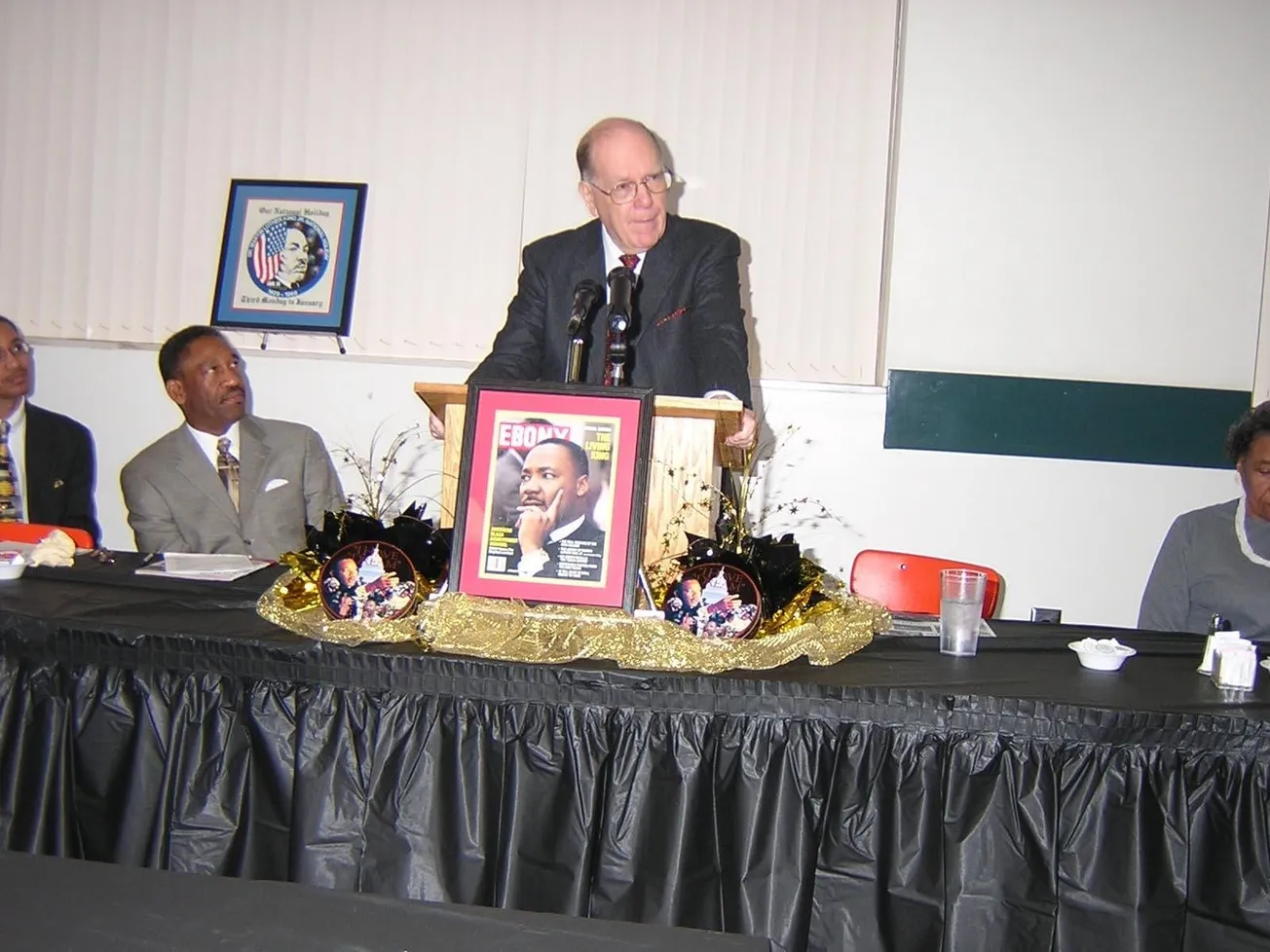
On Jan. 15, 1985, Helga Zepp-LaRouche addresses a 10,000-person “March for the Inalienable Rights of Man” in Washington, D.C. organized by the Schiller Institute in honor of Martin Luther King, Jr.’s birthday, to call for the convening of an Indira Gandhi Memorial Summit between debtor and creditor nations “to implement a rapid program for massive debt renegotiation for a new, just world economic order.”
Program for ‘The Integration of Ibero-America’

In 1986, the LaRouche movement publishes a book-length special report in Spanish, La Integración lbero-Americana, as an elaboration of LaRouche’s Operation Juárez, specifying great projects for the development of the continent, including the construction of a interoceanic sea-level “Second Panama Canal.”
The introduction states:
During the Malvinas War, in May 1982, U.S. economist Lyndon H. LaRouche, Jr. traveled to Mexico to meet with President José López Portillo and other important political leaders. Some of them asked him to write out his proposal for dealing with the problem of the foreign debt. Three months later, the historic essay Operation Juárez was published, in which LaRouche takes up the old integrationist idea, and poses the necessity of immediately forming a Debtors’ Club and an Ibero-American Common Market…. This book intends as its primary purpose to contribute to the realization of that longed-for integration, demonstrating both the feasibility and the conceptual grounding for the Ibero-American Common Market. Its more detailed elaboration will be the task of that successful integrationist movement that we also seek to awaken and consolidate.
LaRouche in Bretton Woods: ‘A New International Economic Order’

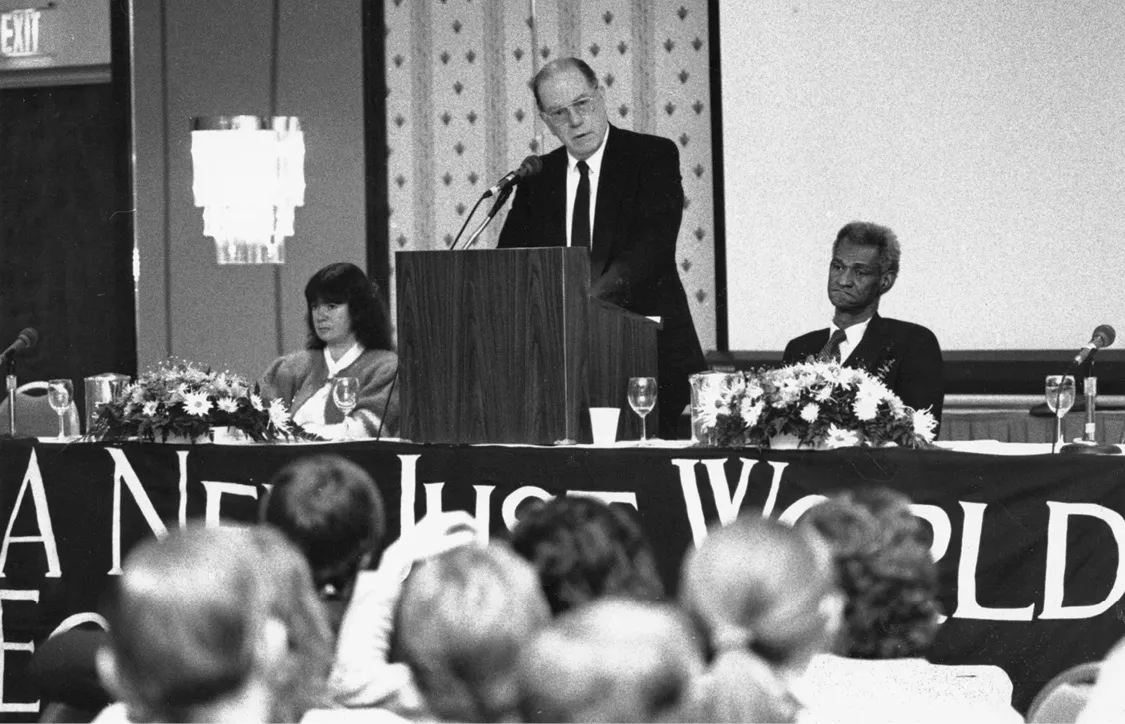
The Schiller Institute sponsors a conference in Bretton Woods, New Hampshire titled “A New Just World Economic Order: Development Is the Name for Peace” on Jan. 30-31, 1988. In attendance is Frederick Wills, former Foreign Minister of Guyana, who delivers a speech titled “The History of the Fight for the New World Economic Order” relating how he first became acquainted with Lyndon LaRouche and his idea for an International Development Bank. Wills declares: “It is time to return to the fundamental appreciation that money and monetary systems are the servants of humanity.”
LaRouche in Berlin Forecasts Reunification of Germany

On Oct. 12, 1988, LaRouche addresses a press conference in West Berlin “on the subject of prospects for the reunification of Germany,” asserting that “the world has now entered into what most agree is the end of an era. The state of the world as we have known it during the postwar period is ended.” LaRouche states: “The economy of the Soviet bloc is a terrible, and worsening, failure…. The Soviet bloc economy as a whole has reached the critical point, that, in its present form, it will continue to slide downhill from here on.” Therefore, “the time has come for early steps toward the re-unification of Germany, with the obvious prospect that Berlin might resume its role as the capital.”
LaRouche elaborates a program for the cooperative development of Eastern Europe as an engine for creating a new economic system:
Let us say that the United States and Western Europe will cooperate to accomplish the successful rebuilding of the economy of Poland. There will be no interference in the political system of government, but only a kind of Marshall Plan aid to rebuild Poland’s industry and agriculture. If Germany agrees to this, let a process aimed at the reunification of the economies of Germany begin, and let this be the punctum saliens for Western cooperation in assisting the rebuilding of the economy of Poland.
‘Productive Triangle’ Development Plan for Europe
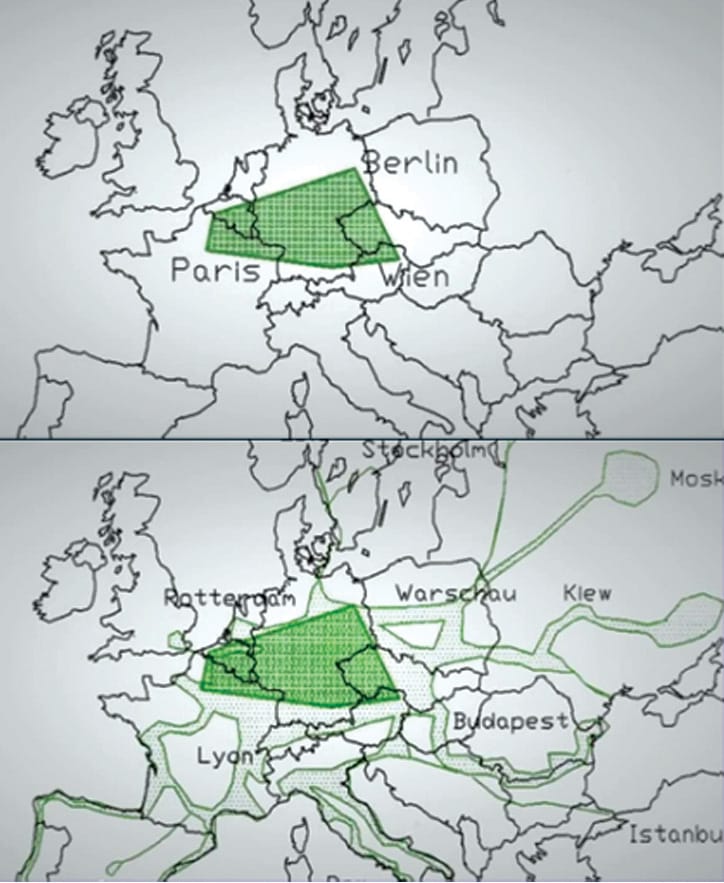
LaRouche commissions a policy study in 1989 to elaborate his proposals from the previous year to use the modernization of Eastern Europe as the “locomotive” for the economic development of Eurasia. The concept takes the form of the “Productive Triangle” linking together Paris, Berlin, and Vienna through high-speed rail, thus creating an integrated, high-density 320,000 km2 industrial development zone, spiraling out into eastern Europe via transport, energy, and communication development corridors.
The 1990s
Helga LaRouche Campaigns for ‘Productive Triangle’
Special reports on the “Productive Triangle” program are published in every major European language, and Helga Zepp-LaRouche launches an aggressive speaking tour throughout Europe, addressing conferences in numerous capitals including in many Warsaw Pact and other Soviet countries that are newly gaining their independence, including Hungary and Poland. Representatives of the Schiller Institute host seminars on LaRouche’s program across Eastern Europe, including in Czechoslovakia, Belarus, and Ukraine, as well as nearly every country in Western Europe.
Zepp-LaRouche issues a statement on July 18, 1990, in which she says that Germany has the opportunity to function as the locomotive for the world economy, both of the East and “above all for the development of the Southern Hemisphere,” finally rising to the moral challenge of realizing a new, just world economic order:
Germany, the heart of Europe, must be the locomotive which raises the economic development of the whole of Europe to a qualitatively new level. The program of the ‘Productive Triangle,’ proposed by the U.S. economic scientist LaRouche, is the crucial key to this. A high-speed rail system will not only connect the Paris-Berlin-Vienna triangle, but, simultaneously, will enclose a region with the greatest immediate growth potential, as far as industrial and labor capacities are concerned. The rapid expansion of infrastructure and, especially of a productive Mittelstand in industry and agriculture can initiate a new economic miracle here, which, through new industrial corridors, will soon be able to reach the whole of Eastern Europe, the not-so-developed regions of Western Europe, and also the Soviet Union. The great expanse of Europe, with the ‘Productive Triangle’ as its core, will make possible such a great increase in productivity and in the output of capital goods, that it will function as the locomotive for the world economy—not only for the infrastructure and industrial development of the East, but above all for the development of the Southern Hemisphere….
Productive Triangle: Cornerstone of New Economic Order
In March 1991, the Schiller Institute convenes a conference in Berlin on the “Productive Triangle” program, attended by representatives from a number of newly independent Eastern European nations and not quite yet independent republics of the Soviet Union, including Hungary, Czechoslovakia, Poland, Latvia, Lithuania, Russia, Armenia, Bulgaria, and Croatia. In a message to the conference, LaRouche calls for “a sphere of cooperation for mutual benefit among sovereign states” in Eurasia.
The conference adopts a “Berlin Declaration,” which calls for the nations of Europe to seize the “unique historical opportunity” presented by the disappearance of the Iron Curtain, and states: “We strive for a just, new economic order, which secures peace, in that all peoples are given the same opportunities for economic and social development. For, development is the name for peace.”
LaRouche elaborates the Productive Triangle proposal in a policy paper in EIR, May 10, 1991, “For the Economic Development of Eastern Europe,” in which he counterposes his “Productive Triangle” program for development to the shock therapy policy being implemented in Eastern Europe, which he asserts is merely a different form of the “primitive accumulation” that brought down the Soviet state.
Productive Triangle Concept Extended to ‘Eurasian Land-Bridge’
Following the dissolution of the Soviet Union in 1991, LaRouche expands the concept of the “Productive Triangle” to include the former Soviet territories in Russia and central Asia, stretching all the way to the Pacific coastlines of China and Russia. This proposal, which becomes known as the “Eurasian Land-Bridge,” concentrates on three “development corridors” spanning the Eurasian continent: a northern route via the Trans-Siberian Railroad to Vladivostok; central routes through Ukraine-Russia-the Caucasus-Iran or Russia-Kazakhstan, Central Asia, and China; and southern route from Western Europe through Turkey and Iran, and on to China via Central Asia or India. This plan would economically integrate the Eurasian continent, maximizing the productive potential of its territory and peoples for the common benefit of all, and resolving the artificially imposed strategic divisions among the great powers through the promotion of development in their mutual interest.

EIR publishes a study, July 17, 1992, elaborating this “integrated Eurasian development network stretching from the Atlantic to the Pacific,” stressing that it will serve as the centerpiece and foundation for creating “an alliance of nations committed to a common programmatic perspective for establishing a just world economic order.” This new economic and monetary order would be comprised of a “community of interest among sovereign nations committed to rapid economic development” to replace the failed financial systems of both East and West, bridging the rich and diverse cultures of the Eurasian continent and ending the legacy of the geopolitical “Great Game” policy of perpetual war.
Helga Zepp-LaRouche states that the world is experiencing the opportunity for “the beginning of a new more hopeful time and the emergence of a new, just world economic order” and issues a call for a peaceful revolution to establish an “international coalition for peace and development.”
Russian Edition of LaRouche’s Economics Textbook Released

The Schiller Institute sponsors its first-ever conference in Moscow, on Oct. 30-31, 1992, to announce the release of a Russian-language edition of LaRouche’s textbook on physical economy, So, You Wish To Learn All About Economics? With Russia undergoing the disastrous effects of the IMF “shock therapy” policy, the conference is titled “Alternative Approaches to Economic Reform,” focusing on LaRouche’s proposals for a rapid reconstruction of the Russian economy by means of the Productive Triangle/Eurasian Land-Bridge program. The conference, held at the Russian State Humanitarian University, is attended by over 50 people representing leading political and academic institutions, and is co-chaired by Prof. Taras Muranivsky, rector of the Ukrainian University in Moscow. Muranivsky delivers a speech on “establishing a new economic theory” based on LaRouche’s science of physical economy.
In the foreword to the Russian-language publication of his text, LaRouche writes:
The Russian edition of this textbook appears at the moment the greatest financial bubble in history is collapsing upon us. If we fail to take appropriate corrective action soon, this collapse could become the worst economic disaster in European history. Out of the wreckage of that monetary collapse, a new form of national economy must be constructed.
LaRouches Visits Moscow for the First Time

In April 1994, Lyndon and Helga LaRouche travel to Russia for a week of meetings and speaking engagements. Lyndon LaRouche’s first public event is a lecture sponsored by the Economic Academy of the Ministry of Economics of the Russian Federation on April 25, where he states:
The problems in Russia are a reflection not of conditions internal to Russia, but the reflection of a collapse in the world economy…. What is going to happen, without question, is a general total breakdown collapse of the global financial system…. If there is an agreement on principles of sound economy, then there can be an agreement among states to reestablish, in a very short period of time, a new world financial and monetary system to replace the old one, while we put the old one into bankruptcy.
LaRouche also addresses seminars at three institutes of the Russian Academy of Sciences: the Institute on Scientific Information on Social Science (INION), the Institute of Oriental Studies, and the Africa Institute. At the INION, he stresses that the Russian intelligentsia must understand the collapse of the Soviet system was merely one part of a global process of collapse, caused by a general failure to abide by the fundamental laws of physical economics, which would doom the free-market system of the West as well: “You get a reflection of a failure to comprehend this problem, and a belief that the disease which is called free trade, is the superior alternative to communism. So instead of bowing to the statue of Karl Marx, you are now supposed to bow to the statues of Adam Smith and Ricardo. This tends to create an instinctive lack of appreciation for the fact that the entire global system is now about to collapse.”
Additionally, LaRouche is hosted by Dr. Pobisk Kuznetsov at a gathering of the “Prezident” group of approximately 60 scientists. Following LaRouche’s visit, Kuznetsov publishes a report in the journal Rossiya 2010, in which he calls for a new unit of measurement to be applied to physical economics, which he proposes be called “the larouche,” or “La” for short:
Let us introduce the physical magnitude of ‘a larouche,’ designated by La, which gives the number of persons who can be fed from 1 square kilometer, or 100 hectares, during one year. Our base magnitude of area is 1 square kilometer or 100 hectares. This base value of area is necessary, in order to bring all existing world food statistics to a single basis. The figures cited above … correspond to ‘potential relative population density,’ introduced by LaRouche…. We share LaRouche’s view that the magnitude of potential relative population density can serve as an indicator of ‘intellectual culture,’ but taking into account the quite diverse values for farv (photochemically active radiation per vegetative period), we shall compare not simply 100 hectares, but 100 hectares for a given local farv value.
Upon his return to Washington, LaRouche gives a report on his trip to a meeting of diplomats and press, where he repeats what he had stated at the Ministry of Economics in Moscow:
Have no doubt that the present global financial and monetary system is not only going to collapse, but is going to go into an absolute breakdown collapse, unless various governments, including the U.S. government, were to put the present monetary system into bankruptcy. That would stop the collapse, and nothing else will stop it. Therefore, intelligent governments will consider nothing serious, except to make preparations for this collapse and to organize quickly a recovery of a new financial system and a new monetary order the instant the collapse occurs.
Hearings in Russian Duma on LaRouche Program
On Feb. 20, 1995, the lower house of the Russian Parliament, the State Duma, holds hearings to discuss emergency measures to prevent the disintegration of Russia’s economy. A memorandum submitted by LaRouche, titled “Prospects for Russian Economic Revival,” is presented to the hearing, in addition to oral presentations by representatives of the Schiller Institute in Moscow.
LaRouche writes:
The present phase of the economic crises inside Russia and nearby countries is the result of the interaction between the ongoing, new phase of collapse in the world monetary and financial systems, and the relative exhaustion of Russia’s ability to deliver a stream of loot to Western financier interests. There exists no possible solution to this crisis, either for Russia or for the world, within the bounds of the previously accepted terms of dominant international economic and financial institutions. The present world system, as derived from the post-1971 form of ‘floating exchange-rate’ international monetary system, and present doctrines of IMF ‘conditionalities,’ is doomed to extinction during the near- to medium-term. The present system will either be brought to an end in an orderly way, through governments acting responsibly to put existing central banking and financial systems under state-controlled reorganization in bankruptcy, or through a chain-reaction form of rapid, ‘thermonuclear’ implosion of that speculative financial bubble which the world’s financial system has become. All workable alternatives to general collapse require governments to assume responsibility for the establishment of new monetary and financial institutions to replace the bankrupt institutions which continue to dominate the world up to this moment.


LaRouche Makes Second Visit to Moscow, Speaks at Duma
In June 1995, Lyndon and Helga LaRouche visit Moscow, where LaRouche speaks at the State Duma on “The World Financial System and Problems of Economic Growth.” He also speaks at the Methodological University of Russia, the Institute of Economics of the Russian Academy of Sciences, and Moscow State University, where he states that the world is headed toward what Rosa Luxemburg identified as “a breakdown crisis” and the only solution is to declare the IMF bankrupt and initiate an international credit system to build the Eurasian Land-Bridge project: “Some believe the present IMF system must be reformed by essentially only administrative reforms. Others of us take the view, as I do, that the international monetary and financial system of the world today, is totally bankrupt, and that only the elimination of that system by bankruptcy, and the establishment of a new system, is possible.”
LaRouche: Russia and U.S. Must Create New Monetary System

EIR on Aug. 25, 1995 publishes a report by Academician Dmitri Lvov, the vice-director of the Central Economic-Mathematical Institute (CEMI) in Russia, titled “Toward a Scientific Grounding for Economic Reforms in Russia.” CEMI had studied LaRouche’s economic model in the 1980s at the time it was examining the strategic and economic implications of the Strategic Defense Initiative. Lvov’s paper is prefaced by a short introduction by LaRouche, titled “The New Role for Russia in U.S. Policy Today,” in which he writes:
As the present, IMF-centered, global monetary and financial system disintegrates in a holocaust of reversed financial leverage, Russia’s present, most crucial predicament will be shared by every nation of this planet. The challenge will be, to prevent the collapse of the Earth’s physical economy, by launching immediately a new world monetary and state-credit system, on the basis of ‘American System’ principles contrary to every direction of change in economic policy, under the IMF and World Bank system, during the recent thirty years. In short, the Adam Smith system is shortly to be carried away by the same Styx of dead history into which the Soviet system had been thrown an historical instant earlier.
LaRouche Makes Third Trip to Russia for Meetings with Intelligentsia
In April 1996, LaRouche makes his third trip to Russia for meetings with academics and policymakers. He participates in a round table discussion jointly sponsored by the Institute for Socio-Political Research of the Russian Academy of Sciences and the Free Economic Society of Russia, established in 1765. The event is chaired by Leonid Abalkin, head of the Institute of Economics of the Russian Academy of Sciences. LaRouche, speaking on the subject “Russia, the U.S.A., and the Global Financial Crisis,” emphasizes that a partnership among the United States, Russia, and China, of the sort that President Franklin Roosevelt envisioned in the 1940s for a post-colonial world, would be the combination of world powers necessary to reorganize the international financial system:
We are in the middle of the worst international monetary and financial crisis of the century…. The combination of the United States and Russia, now, as in 1945, with the cooperation of China, can change the course of world history, and get out of this economic mess…. Only a majority combination among great powers can break the power of these international authorities. Therefore, not in order to create another global hegemonic system, but to create a world which is safe for sovereign nation-states. We’re in a great struggle. We’re in a great, strategic world-historical struggle. And therefore, as in war, the unity of great powers can be decisive in whether you win the war or lose it, as Roosevelt understood before he died.
Participating in the dialogue with LaRouche were Valentin Pavlov, former prime minister and finance minister of the U.S.S.R., and Vyacheslav Senchagov, director of the Center for Banking and Financial Research at the Russian Academy of Sciences Institute of Economics. At the conclusion of the event, Academician Abalkin stated: “Today we are facing the necessity of developing a new paradigm in the social sciences…. I see all the work of Professor LaRouche as a step on the path to this paradigm.”
Zepp-LaRouche Travels to China to Promote Eurasian Land-Bridge
Helga Zepp-LaRouche attends the “International Symposium on Economic Development of the New Euro-Asia Continental Bridge,” in Beijing, sponsored by the Ministry of Foreign Trade and Economic Cooperation of the People’s Republic of China. She delivers a speech on May 8, 1996, “Building the Silk Road Land-Bridge: The Basis for the Mutual Security Interests of Asia and Europe,” in which she states:
The governments of Eurasia should agree on an integrated infrastructure program, which connects the industrial centers of Europe and Asia with the population centers in South and Southeast Asia, through ‘development corridors.’ The development of those main axes of traffic, through great projects for infrastructure in transport, energy, water, and communications, is the precondition, for the industrial development of the Eurasian landmass, and can thus become the motor for overcoming the world economic crisis.
Zepp-LaRouche calls for the establishment of a Eurasian Development Bank modelled on Lyndon LaRouche’s original International Development Bank proposal, to facilitate cooperation among the sovereign states of Eurasia for development:
The right to generate credit must be brought back under the control of sovereign governments. Through appropriate legislation, national banks must be able to generate credit lines for these projects. As these credits are related to future production, wealth is being created, and they are not inflationary…. As the realization of infrastructure projects of this magnitude, will require all available industrial capacities of the participating nations, and, as new capacities have to be created, the different countries should work in a division of labor, and thereby balance existing three-way trade flows through so-called clearing-houses. A newly founded Eurasian Development Bank could take over this task.

Finally, she calls for “an emergency monetary policy meeting of the principal nation-state powers, for the purpose of establishing a new international monetary system, based on stabilized parities of currencies, to the purpose of fostering a global revival and expansion of agricultural and industrial production, based upon capital intensive, energy-intensive modes of investment, in scientific and technological progress.”
LaRouche Calls for ‘New Bretton Woods’
On Jan. 4, 1997, LaRouche delivers an address in Washington, in which he first issues his call for a “New Bretton Woods” to reorganize the world financial system, calling on President Bill Clinton to convene an international conference to launch a general monetary reform for the planet on the basis of mutual development of sovereign nations:
The President must say, ‘We are going to proceed to put what we know to be bankrupt financial and monetary institutions, into bankruptcy, that is, into receivership, for financial reorganization under the supervision of government. The United States must act, together with other powers, to put the world into bankruptcy reorganization. Every financial system, every banking system in the world, is presently bankrupt! Therefore, the United States must take international leadership in proposing a new Bretton Woods…. We’re going to take the Eurasian Land-Bridge concept and what it represents as a policy, as a global policy, and we’re going to rebuild this planet.’
LaRouche elaborates on this at a conference of the Schiller Institute in February 1997, at which a resolution titled “Urgent Appeal to President Clinton To Convoke a New Bretton Woods Conference” is endorsed by the participants. The appeal declares:
We appeal to you, President Clinton, to use the Powers of the Presidency of the United States, to convoke, on an emergency basis, a new international Bretton Woods conference, to replace the present bankrupt monetary system with a new one. A global debt reorganization, the establishment of fixed-parity exchange rates and a new set of trade and tariff agreements are the absolute precondition for stability in world economic and financial relations, which are required for a return to economic growth.
EIR Releases Special Report on ‘Eurasian Land-Bridge’

On Feb. 5, 1997, Lyndon and Helga LaRouche host a seminar of diplomats in Washington, to announce the release of a book-length EIR Special Report, “The Eurasian Land-Bridge: The New Silk Road, Locomotive for Worldwide Economic Development.” In the introduction to this 300-page detailed compendium of development projects across the Eurasian landmass, LaRouche is quoted: “Call together an immediate emergency conference of crucial powers, an international monetary conference setting up a new monetary system to replace the bankrupt one.”
The introduction further states:
The realization of the ‘New Silk Road’ and the ‘Productive Triangle,’ a real reconstruction of Russia and Eastern Europe, the development of the entire Eurasian landmass with the most modern infrastructure, would be the central economic issue at such a monetary conference of world powers….
Zepp-LaRouche Returns to China

Helga Zepp-LaRouche visited Beijing in October 1998 to participate in a second conference on the Eurasian Land-Bridge, titled “Asia-Europe Economic and Trade Relations in the 21st Century and the Second Eurasian Bridge.” In her speech at the keynote session, titled “Principles of Foreign Policy in the Coming Era of the New Eurasian Land-Bridge,” she states:
While the present meltdown of the global financial system obviously represents enormous dangers for the existence of entire nations and their populations, the profound discrediting of the institutions associated with that system, represents, at the same time, a unique and unprecedented chance, to replace the unjust principles of the old political and economic order with new, just ones, which will allow the survival and well-being of all nations on this planet.
President Clinton Calls for ‘New Financial Architecture’
President Clinton calls for an international summit to create a “new financial architecture for the 21st Century,” in a speech in New York City on Sept. 14, 1998. This is needed, he says, to “douse the flames of the international financial crisis” and resolve “the biggest financial challenge facing the world in a half-century.” He states:
In the face of this new challenge, America can and must continue to act and to lead to take the urgent steps needed today to calm the financial crisis, restart the engine of growth in Asia, and minimize the impact of financial turmoil on other nations, and to make certain that for tomorrow the institutions and rules of international finance and international trade are prepared to support steady and sustainable growth over the long term.
López Portillo: ‘World Must Listen to Wise Words of Lyndon LaRouche’
At a seminar in Mexico City, Dec. 1, 1998, former Mexican President López Portillo joins Helga Zepp-LaRouche to discuss the urgency of establishing a new world economic order, asserting, “It is now necessary for the world to listen to the wise words of Lyndon LaRouche.” In an editorial comment published in the Mexican daily El Universal, López Portillo states: “The new economic order must be oriented to the increase of production, and not to the control of demand, the latter fundamentally directed to favoring capital (frequently, that of speculative capital) through outright depressive measures which reward profits, even if this postpones the satisfaction of real human, social needs.”
The 2000s
LaRouche in Sudan for New World Economic Order
In January 2001, LaRouche travels to Khartoum, Sudan for a conference sponsored by EIR and the Schiller Institute on “Peace Through Development: Nile Valley Development and the New Just World Economic Order.” His keynote address is on “The New Bretton Woods System as a Framework for a New Just World Economic Order” in which he specifies three principles that must serve as the foundation for a new international economic system:
First, we must restore the characteristics of the old Bretton Woods system of the immediate post-war decades. That means, a system of fixed-exchange rates, capital controls, currency controls, and financial controls, and global growth fostered by the same methods employed through institutions such as Germany’s Kreditanstalt für Wiederaufbau, to promote large-scale development of basic economic infrastructure, and to use the market potential generated by that infrastructural development, as the base for creating a still-larger rate of growth in development of agriculture and industry.
Second, we must do as President Roosevelt had intended: All sovereign nations must be, on principle, full partners in the new international monetary system. This is the fundamental difference between the old Bretton Woods system, and what must happen now. We cannot have a system which is going to work, which does not treat the majority of the human race as full partners in the system. Otherwise, it won’t work.
Third, we must rely chiefly on credit created by the authority of perfectly sovereign nation-state governments, to generate the medium- to long-term domestic and international trade agreements on which the economic recovery and expansion will be centered.

LaRouche in Russia Addresses State Duma
On June 29, 2001, LaRouche speaks before a hearing of the lower house of the Russian Parliament, the State Duma, sponsored by economist Sergei Glazyev, the chairman of the Duma Committee on Economic Policy. Titled “On Measures To Ensure the Development of the Russian Economy Under Conditions of a Destabilization of the World Financial System,” the hearing is attended by 150 parliamentarians and government advisors and broadcast live into all Duma offices.

LaRouche states that “nothing can save the present world financial and monetary system in its present form” and lists four necessary measures to reorganize the global economic system including the cancellation of illegitimate debts and the reorganization of the rest, stating:
The reorganization of the world monetary and financial systems, must be based upon the use of large-scale, long-term cooperation in infrastructural development within, and among nations, and heavy emphasis upon adopted targets of scientific and technological progress. The pivot for world economic growth, shall be a new system of transcontinental cooperation among the sovereign nation-states of continental Eurasia.

LaRouches Return to New Delhi
Almost two decades after their earlier trips to India to meet with Prime Minister Indira Gandhi, Lyndon and Helga LaRouche return to India in December 2001 to participate in an EIR seminar at the Jawaharlal Nehru University School for International Studies, and to meet with India’s President K.R. Narayanan, advisors to Prime Minister Atal Benhari Vajpayee, and other current and former officials of the Indian government, including two former prime ministers, Chandra Shekhar and I.K. Gujral.

LaRouche concludes his keynote address to the seminar, “World in Crisis Needs a New Monetary System”:
We’ve come to a time, when the alternative has failed. Free trade, globalization, and so forth, have become horror-shows, which destroy us. The floating-exchange-rate system has destroyed the world. It must end…. Indira Gandhi was right, in her instinct for protectionism. Her father, and others, were right, in the Non-Aligned Movement, in saying, ‘You can not function, merely on national protectionism. You must find a new, more just world economic order.’. . .
And that is exactly what we proposed in terms of the Eurasian Land-Bridge. If we can agree, and understand that the nations of East and South Asia require an early, and rapid infusion of technology, to develop these economies so that they can survive; and if this can be done through credit arrangements, extended by governments at interest rates of 1 to 2% simple interest, on long term; and if we take the great infrastructure projects as the driver force; and if we unite the need of Western Europe for markets for this type of technology, and the role of Russia, as the transmission belt between East and South Asia, and Western Europe; and if we think of this as the center of the world, and bring nations in Africa, in the Americas, into the same arrangement, then we have the basis for creating a new monetary system, under which this world can come out of this mess.
LaRouche in Moscow for Kuznetsov Memorial Conference
For the second time in one year, LaRouche travels to Moscow, Dec. 10-14, 2001, to participate in a scientific conference honoring the memory of scientist Pobisk Kuznetsov, who had died the previous year. The Kuznetsov memorial symposium is titled “Space & Time in the Evolution of the Global System Nature-Society-Man” at which LaRouche speaks on “Russia’s Role in Solving the Global Crisis.” He states:
If the world is to come out of this great financial, and monetary, and economic crisis successfully, Russia, as a Eurasian nation, must play a very crucial, central role…. I have proposed that we must develop development corridors, superseding the Trans-Siberian Railroad, across Eurasia…. This would require, and would mean, the greatest transformation in the biosphere, in the history of humanity.
LaRouche also addresses a seminar hosted by Academician Dmitri Lvov at the Central Mathematical Economics Institute and meets with the Mayor of Moscow, Yuri Luzhkov.

LaRouche in Brazil, Calls for Emergency Financial Conference
In June 2002, LaRouche travels to Brazil to participate in a series of seminars on reorganization of the world financial system. He also receives an honorary citizenship from the City of São Paulo. At a meeting of the Commercial Association of São Paulo, he calls for “an emergency monetary conference” to create a new international economic system.

LaRouche states:
Governments must act to put the system into bankruptcy reorganization…. What does this mean? First, we require a global, monetary financial reform. The best model we have is the 1945-1964 system, not as a perfect model, but as a political model. Under this, we must have, therefore, financial reorganization in various countries. We require an emergency monetary conference among leading countries to immediately negotiate a general reform and bankruptcy reorganization. We must also, then, take certain steps in each country and in treaty agreements to get the world economy moving upward…. We must generate a tremendous amount of capital investment. How do we do that? We must create a credit system.
LaRouches in India: Reorganize the World Financial System
In January 2003, Lyndon and Helga LaRouche participate in public and private events in Calcutta, New Delhi, Jaipur, and other cities, on the subject of creating a Eurasian alliance to reorganize the bankrupt world financial system. One seminar keynoted by LaRouche is hosted by the Institute of Economic Growth at Delhi University, which serves as a think-tank for the government of India; he also speaks at a conference hosted by the Political Science Department of Jaipur University. He emphasizes in his speech to the Institute for Economic Growth, titled “The Indispensible Role of the State in Reorganizing a Bankrupt System,” that the “Strategic Triangle” of Russia, China, and India must be the primary engine for economic growth in the world.
In his speech in Jaipur, titled “Globalization Is a Prescription for Disaster,” LaRouche again highlights the Strategic Triangle of Russia, China, and India “as a keystone for bringing together the nations of Asia in an alliance of mutual security and economic progress” and defines the means by which credit can be created to develop Eurasia: “We need to go back very quickly to a fixed-exchange rate system…. We need a system under which nations can cooperate, as I indicated in the case of Asia: a 25-year period….”
In May 2003, the LaRouches return to India for an international conference co-hosted by the Schiller Institute and the Center for Social Justice of India. The conference opens with a speech by Member of Parliament Shri K. Natwar Singh, who was the Secretary General of the Non-Aligned Movement under the government of Prime Minister Indira Gandhi when India hosted the Non-Aligned Movement Summit in New Delhi in 1983. Singh emphasizes the historic role of the Non-Aligned Movement as leading the fight for the new international economic order.
LaRouche echoes that theme and declares:
We must have what we fought for at Colombo, Sri Lanka in August of 1976. We must revive the spirit of Bandung, as a part of an international movement. We must revive the concert of a just, new world economic order—now!
How can this be brought into being?. . . We need a monetary system, with many of the best features of the Bretton Woods system, of the immediate postwar period. But, this time, the United States can not run it, as the United States did back then…. We must have a concert of nations which does this….
LaRouche submits a policy document to the conference, “A Précis: The Peaceful Concept of Technology Transfer,” in which he details the necessary scientific principles for “establishing a more just, peaceful, and profitable new world economic order within a global community of perfectly sovereign nation-states.”
The conference participants endorse The Bangalore Declaration: “Toward a New World Political-Economic Order” which states:
Establishing a just and equitable economic order in the world is an urgent necessity if the vast majority of people in the world are to enjoy the benefits of human and scientific progress…. Developments leading to war, especially the position adopted by some of the leading powers, demonstrate that the international order is becoming less aligned. This opens new opportunities to strengthen the process and build a more cooperative International Order. What we need is a new community of nation-states, non-aligned in military terms, but aligned against all forms of political, social, and economic injustice, and a global movement to pursue a new, just political-economical order…. The conference calls upon the peace-loving people, especially young men and women, to launch a worldwide movement to achieve the above goal.
Russia’s Glazyev Calls for New World Financial Architecture
Member of the Russian State Duma Sergei Glazyev, who had invited LaRouche to Russia in 2001, calls for a “new world financial architecture” during a Feb. 4, 2004 press conference in Moscow announcing his campaign for President of Russia. Glazyev states:
The key priority today in world politics, where Russia could take the lead, is the formation of a new world financial architecture…. We should get away from the excessive dependence of the world financial system on the currency issues of any one country, and shift to a system of equality-based financial and monetary relations. In practical terms, it is possible to reach a consensus among a large group of countries and begin to move to a new world financial and monetary system that would be more stable, more reliable and more fair.
LaRouche Travels to Russia, Publishes ‘Economics of the Noösphere’

In April 2004, LaRouche travels again to Moscow to keynote a conference co-sponsored by the Vernadsky State Geological Museum of the Russian Academy of Sciences and the Schiller Institute. LaRouche’s speech, “Entering the Economy of the Noösphere,” echoes the themes that he elaborates in his newest published book, The Economics of the Noösphere, featuring the ideas of Ukrainian-Russian scientist Vladimir I. Vernadsky.
LaRouche declares that mankind is entering “a new era” which must impel revolutionary changes in the existing economic order:
Hopefully, the increasing severity of the present world economic and related crises, will compel us to institute those urgently needed changes in the present world order…. The growing needs of humanity could not be met without the kind of scientific revolution which we should associate with what the great V.I. Vernadsky defined as the Noösphere…. We are entering a new era of mankind, an era which must grasp more fully, more practically, the implications of V.I. Vernadsky’s development of the notion of the Noösphere.
LaRouche Details ‘New Westphalian’ World Order
At an EIR seminar in Berlin, Nov. 29, 2005, involving Russian, Chinese, Indian, American, and European policymakers, Lyndon and Helga LaRouche elaborate the “Westphalian” principles which must serve as the foundation for a new international order. Lyndon LaRouche authors two discussion documents for the conference, titled “Toward a Second Treaty of Westphalia: The Coming Eurasian World” and “The Dialogue of Eurasian Civilizations: Earth’s Next Fifty Years.”
LaRouche invokes the fight for a new economic order, saying, “go back to 1976 to this experience, where the Non-Aligned nations group, in majority on the initiative of India, actually, adopted a resolution on a just new world economic order.” In his speech, titled “We Need a New Treaty of Westphalia,” LaRouche declares:
We’re going into either a period of chaos, which could be a Dark Age, or we’re going into a period in which the assumptions of relations among states, especially respecting economic and related kinds of relations, will be changed forever…. The decision is on the table: Are we going to create a new monetary system, which presumes that a concert of nation-states, sovereign nation-states, will put the existing IMF system into bankruptcy receivership? In other words, governments would take these banking institutions into receivership and manage these bankrupt entities, in such a way as to promote the general welfare.

Helga Zepp-LaRouche’s speech, titled “Society Needs a New Paradigm Worthy of the Dignity of Man,” elaborates the history of LaRouche’s role in leading the fight for a new international economic order and asserts the urgent need to “put the new world economic order back on the agenda.” “In 1971,” she says,
when Nixon decoupled the dollar from gold, creating the private banking power over money creation in the offshore markets, LaRouche said, this will lead to a new depression, the new danger of fascism, and the danger of a collapse of society—or, the just new world economic order…. In 1975, Mr. LaRouche went to Iraq, to participate in the celebrations of the Ba’ath Party. And he came back, and he made for the first time, the proposal to have the International Development Bank, as an instrument to replace the IMF, to be the vehicle for a $400 billion credit per year for clearly defined development projects. This idea, we then circulated for one year, among 85 countries, the countries of the Non-Aligned Movement. Many of these countries did feasibility studies, with the idea of Mr. LaRouche’s work. Then, in Colombo, Sri Lanka, in 1976, eighty-five nations accepted the idea of a new world economic order…. Then, the next major thing was when LaRouche got the cooperation of López Portillo, to make a proposal—again, to have a new world economic order. This time coming from a debtors’ cartel, from the Latin American debtor countries: Mexico, Brazil, Argentina.
She traces this history through the collapse of, first, the Soviet Union, and then of the free-market “globalization” system, asserting:
This is now the opportunity to put the idea of a just new world economic order back on the agenda. If you want to have a just new world economic order, it’s not a technocratic question; it’s not only a question of a new financial system, a new economic system; it’s a question of a passionate idea, of the idea of the international community of people…. So, I think we need to have the discussion on this level, and put the new world economic order back on the agenda.
Argentine President Kirchner Calls for New Financial Architecture at UN

Néstor Kirchner, the President of Argentina, delivers a speech before the UN General Assembly on Sept. 21, 2006, in which he calls for a “new financial architecture” to replace the failed and destructive IMF system.
Denouncing the violation of national sovereignty and prevention of economic development that the IMF “conditionalities” regime represents, Kirchner declares:
There is sufficient empirical evidence to demonstrate that the participation of the international financial organizations in the promotion of development of poorer nations has not been successful, and in many cases, with their conditionalities, they have acted in a contrary sense, preventing development…. That is why, together with the majority of countries, we support the reform of the international financial architecture, such that it will lead to the progress of the poorest nations. In noting the scant willingness of these international financial organizations to produce a real change in their policies, we deem it necessary to make this change, and to consider the creation of new international financial instruments that will permit the building of development projects to combat poverty and hunger in the world and to provide real options for advancement.
Conference in Moscow Demands Bering Strait Tunnel

Lyndon LaRouche participates in a conference on April 24, 2007 in Moscow, titled “Megaprojects of Russia’s East: A Transcontinental Eurasia-America Transport Link via the Bering Strait,” organized by the Russian Academy of Sciences Council for the Study of Productive Forces, in conjunction with the Russian Ministry of Economic Development and Trade, the Russian Ministry of Transport, the state-owned company Russian Railroads, and several regional governments in Siberia and the Russian Far East.
LaRouche’s prepared speech, delivered on his behalf, is titled “The World’s Political Map Changes: Mendeleyev Would Have Agreed.” It states:
This onrushing collapse of the world’s presently hyperinflated, disintegrating world monetary-financial system, requires early concerted emergency action by responsible leading nations…. These must include the U.S.A., Russia, China, and India, as the rallying-point for a new, spreading partnership among perfectly sovereign nation-state economies. In such cooperation, the development of a great network of modern successors to old forms of rail transport, must be spread across continental Eurasia, and across the Bering Strait into the Americas…. The bridging of the Bering Strait becomes, thus, now, the navel of a new birth of a new world economy.
LaRouche in Moscow as Guest of Academy of Sciences

LaRouche is invited in May 2007 to attend a celebration sponsored by the Russian Academy of Sciences of the 80th birthday of economist Stanislav Menshikov. The celebration is also attended by Academician Alexander Granberg, who sponsored the Bering Strait forum earlier in the year, and Dr. Sergei Glazyev, also a member of the Academy of Sciences. LaRouche tells the gathering: “The United States must change its behavior, by approaching Russia, China, and India, in order to create a new order of relations in the world, bringing all the smaller nations in to cooperate with them. I think we can do it: We can change history.”
During his visit to Moscow, LaRouche is interviewed by several Russian media, both television and print, including by economist Mikhail Khazin, during which LaRouche reviews his role in shaping economic policy relations between the United States and Russia:
From 1994 on, since I was visiting Russia, in that period, my concern, which I shared with many of my Russian friends in high positions, was to try to get an understanding with President Clinton, and people in Russia. So, some of the key people here in Russia organized a meeting which I addressed in Moscow. They were prepared, through me, because they knew my connection to Clinton, to open a new channel of economic understanding and cooperation with the United States. Academician Gennadi Osipov was one of the leaders of that group, to organize it. The former Prime Minister, Valentin Pavlov, was part of it. But the Vice President of the United States, Al Gore, was a close friend of Yeltsin, and they put pressure on Clinton not to do it. Finally, in 1998, in August and September, Clinton recognized I had been right…. We must have a dialogue between Russia and the United States, involving other countries, like China, India, and so on, who understand that we believe the same thing about the present world crisis, and can understand what we must do for the next 50 years.
LaRouche Forecasts Financial Crash, Calls for HBPA
On July 25, 2007, during a webcast in Washington, D.C., LaRouche states that the banking system had reached the point where a catastrophic collapse must be expected in the immediate future. Three days later, Bear Stearns goes under, triggering a chain reaction crisis throughout the entire global financial system.
On Aug. 22, 2007, the LaRouche Political Action Committee announced a mobilization for LaRouche’s proposed Homeowners and Bank Protection Act of 2007 (HBPA), to stop millions of home foreclosures and evictions, and to launch a larger process of bankruptcy restructuring of the U.S. and global dollar-based financial system.
LaRouche defines the purpose of this legislation as follows:
The crisis will proceed in successive phases. We have entered the first phase, which is typified by the collapse of a global real-estate bubble on which the entire current monetary-financial system hangs today. The most immediate of these challenges, is being presented at this time. The U.S.A. and other governments must now react to the need for an immediate placing of home mortgages and chartered banks of the U.S. under bankruptcy protection by law. This measure is the indispensable lawful protection needed to prevent an uncontrollable, chain-reaction, hyperinflationary collapse of the present world monetary-financial system as a whole. An uncontrolled crisis of that type would be comparable to the chain-reaction set into motion by the Fourteenth-Century collapse of the House of Bardi.
Zepp-LaRouche: Land-Bridge Is Cornerstone of New Economic Order

The Schiller Institute holds a conference in Kiedrich, Germany on Sept. 14-15, 2007 attended by 350 people from 40 nations, with presentations and papers from Russian academicians and political figures, including Prof. Stanislav Menshikov of the Russian Academy of Sciences; Victor Razbegin, deputy chairman of the Council for the Study of Productive Forces; and Dr. Sergei Cherkasov and Academician Dmitri Rundqvist, both of the Vernadsky State Geological Museum.
LaRouche calls for bankruptcy reorganization of the world financial system:
The only peaceful remedy for the present world situation, today, would be by actions which, in effect, place the present world monetary-financial system into a process of reorganization in bankruptcy; and a return to a design consistent with what U.S. President Franklin Roosevelt had intended for the Bretton Woods System, had he lived. No possible solution for this crisis exists within the structures of the present world financial-monetary system. Only a political reform of the world system, as it must be promoted by the initiative of a relevant leading group of powerful nation-states, could turn the tide of horror now gripping the fate of this planet as a whole.

Helga Zepp-LaRouche describes the purpose of the gathering:
This conference is supposed to be the beginning of a worldwide dialogue, and forum, of people who want to reconstruct the world; of putting together the combination of people who want to fight for the old idea, which used to be the agenda, for example, of the Non-Aligned Movement, to build a just new world economic order.. . . We have reached a situation where either we establish a new world economic order based on the Eurasian Land-Bridge, and go for global reconstruction, or we will plunge into a dark age…. The question of the new world economic order has been our life’s work, and it is now the time to implement it.
Zepp-LaRouche: We Need a New Bretton Woods
Helga Zepp-LaRouche issues a call, titled “World Financial System Faces a Meltdown; Call for a New Bretton Woods System; We Need a New World Economic Order!” on July 17, 2008. She specifies eight points:
An emergency conference must be called, at the level of heads of state, to establish a new financial architecture. This emergency conference for a New Bretton Woods must resolve that:
1. The present world financial system must be declared hopelessly bankrupt, and replaced by a new one.
2. It must promptly set up a fixed-exchange-rate monetary system, so that long-term investments in international infrastructure projects are possible, under predictable conditions.
3. Derivatives speculation and speculation in food, energy, and raw materials must be banned by treaty among governments.
4. There must be an immediate reorganization, including, for example, cancellation of debts.
5. In a New Deal for the world economy, in the tradition of Alexander Hamilton, Friedrich List, Henry Carey, and Franklin D. Roosevelt, new credit lines must be made available for investments in basic infrastructure and technological renovation.
6. Building the Eurasian Land-Bridge, as the core project for reconstruction of the world economy, is therefore the vision that can not only bring a new economic miracle, but also bring peace to the 21st Century.
7. Food production must be doubled worldwide in the coming years.
8. A new ‘Peace of Westphalia’ must, within at least 50 years, secure the availability and development of raw materials for all nations on this planet.
We maintain that the system of globalization, with its brutal, predatory capitalism, is economically, financially and morally wrecked. Instead, man must be placed at the center again, and the economy must serve the common good. The new world economic order must guarantee the inalienable rights of all men on this planet.
Helga Zepp-LaRouche in Rhodes: A New Westphalian World Economic Order
Zepp-LaRouche addresses the World Public Forum’s “Dialogue of Civilizations” conference, in Rhodes, Greece, Oct. 9-13, 2008, with more than 700 people from 70 countries attending. The Forum was founded and chaired by Vladimir Yakunin, chairman of Russian Railways, and brings together political, religious, and intellectual leaders from around the globe for annual conferences. Zepp-LaRouche’s speech is titled “For a New World Economic Order in the Tradition of the Peace of Westphalia.” She states:
An emergency conference, modeled on the Bretton Woods Conference of 1944, has long been proposed by Lyndon LaRouche…. In order for this new system to have credibility and integrity, the initiating powers—the U.S.A., Russia, China, and India—have to build the core of a representative group of nations which, in the tradition and spirit of the Treaty of the Peace of Westphalia, decide on a multicultural and multinational credit system, even while the current monetary and financial system is put through an orderly bankruptcy process…. The most important principle of the Westphalia Treaty, upon which international human rights are based, was the idea that, in the interest of peace, all foreign policy must be oriented to the “advantage of the other.
LaRouches Promote Four-Power Alliance in New Delhi
Lyndon and Helga LaRouche attend a seminar in New Delhi in December 2008, sponsored by the Forum for Strategic Security Studies, a military think-tank, in addition to participating in private meetings on the subject of organizing a Four Powers alliance among India, China, Russia, and the United States to lead in creating a new global political and economic order.
LaRouche tells the seminar:
There are four nations on this planet, which are significantly large and important enough, that they could, if willing, make a decision which would eventually change the direction of affairs on the planet…. How do we expand the capacity for carrying the world’s population in a stable, growing way, which can’t be done under the present monetary system? If these four nations agree to form a nucleus, in recognition of defense against this crisis, then we can change the world…. These four governments, the United States, India, Russia, China, can sponsor the idea of an agreement to deal with this particular crisis by creating a new credit system to replace the present bankrupt monetary system.
LaRouche: Reorganize Banking for Glass-Steagall
In October 2009, Lyndon LaRouche outlines a program for bankruptcy reorganization of the financial system, specifying that, through the application of the “Glass-Steagall standard,” fictitious values of speculative debt will be distinguished from productive debt with legitimate economic value. LaRouche asserts that the speculative debt must not be honored or bailed out, while the legitimate productive debt must be protected and reorganized as was done by Alexander Hamilton.
He declares:
What is required is to put all regular commercial banks through reorganization in bankruptcy…. The accounts which are in commercial banks will be put into reorganization in bankruptcy, such that those accounts which correspond to a Glass-Steagall standard will receive full protection and will be assigned protection under the category of a Glass-Steagall qualified account. These banks, which we will clean up in that way, have to be under bankruptcy protection, even though they’ve been purged of this garbage…. We’re going to put the commercial banking system through a Glass-Steagall-standard reorganization; we’re going to use the end-product of that reorganization to reestablish the full support of the Federal system, as a credit system, not a monetary system.
LaRouches Attend World Public Forum in Rhodes
Lyndon and Helga LaRouche are invited to address the World Public Forum in Rhodes, Greece, Oct. 8-12, 2009, attended by over 500 academics, religious leaders, economists, politicians, artists, and journalists, from 60 countries.
Lyndon LaRouche gives an address titled “A Four-Power Agreement Can Create a New World Credit System” in which he states:
The task is for Russia, and the United States, and China, and India, to agree, as a group of countries, to initiate and force a reorganization of the world financial and credit system, under those conditions, with long-term agreements, of the same type that Franklin Roosevelt had uttered before his death…. The result of this, will be the elimination of the monetary system of the world that has been dominating European civilization since the Peloponnesian War.
Helga Zepp-LaRouche’s speech is titled “New Alliances for a New World System,” which she concludes by saying:
We must open a new era of humanity, one in which oligarchical and imperial designs have been defeated once and for all, replaced with an alliance of republics which are perfectly sovereign, yet, which are united through the higher interest of mankind as a whole. It is possible to bring this about, but it will require interventions by courageous individuals who are fired by a passionate love for mankind.
The 2010s
BRICS New International Financial Architecture
At their fourth summit in New Delhi on March 29, 2012, the leaders of the BRICS issue a statement calling for “a more representative international financial architecture, and the establishment and improvement of a just international monetary system that can serve the interests of all countries and support the development of emerging and developing economies.”
The New Delhi Declaration announces:
We have considered the possibility of setting up a new Development Bank for mobilizing resources for infrastructure in BRICS and other emerging economies and developing countries. We direct our Finance Ministers to examine the feasibility and viability of such an initiative, set up a joint working group for further study, and report back to us by the next Summit.
EIR: ‘There Is Life After the Euro!’

EIR publishes a Special Report in June 2012 titled “There Is Life After the Euro: An Economic Miracle for Southern Europe and the Mediterranean,” which details the development programs which could reconstruct Europe if the European nations were to free themselves from the collapsing euro system.
Helga Zepp-LaRouche writes, in the introduction:
The euro system, and the entire trans-Atlantic financial system, are in the process of total disintegration…. A solution does exist. That solution, however, is absolutely impossible within our current system. The hopelessly bankrupt system of globalization, and today’s casino economy, must be replaced by a credit system that is oriented exclusively toward future investment into the real economy, with high energy-flux densities. We must return to national currencies, fixed exchange rates, and an economic reconstruction program for Southern Europe, the Mediterranean region, and the African continent….
Schiller Institute Initiates ‘New Paradigm for Civilization’ Conferences
The Schiller Institute sponsors a conference in November 2012 near Frankfurt, Germany titled “A New Paradigm for Civilization,” as the first in a series of international conferences. The conference is attended by over 300 participants from 25 countries.
Lyndon LaRouche’s remarks to the conference feature the steps that must be taken to reorganize the bankrupt financial system:
1. The first of the three essential preconditions for recovery is that the relevant, combined leading nations of both the United States and the leading parts of Eurasia, must immediately enact the Glass-Steagall law….
2. A recovery of the economy of the relevant nations depends upon the actual creation of a set of systems based on the principle of national credit, among respective nations. This means that the future investments must be those rightly deemed physically worthy of the credit which is uttered under the authority provided by the credit systems of the respective sovereign nations….
3. It must be recognized, that it is the increase of physical wealth which must be made practicable by the respective nations’ extension of systems of public credit….
LaRouche Interviewed in Chinese Press: ‘Change the Direction of History’
Lyndon LaRouche is interviewed by Xinhua, the official Chinese news agency, on July 27, 2013. Interviewer Zhang Mian states, “As an economist, you’ve committed yourself to establish a new world economic order” and asks what is required to accomplish this goal.
LaRouche replies:
We have to create a new world, a new world which is based on a commitment to high technology, because only by increasing the technological potential of the nations of the planet, can we possibly work our way out of this problem. That could be done. China is potentially a very important part of this new world system. We can create an agreement among leading nations of the world, to change the general direction of the history of this planet in modern times—and China is a key nation in this whole process….
Chinese President Xi Jingping Announces ‘New Silk Road Economic Belt’
Chinese President Xi Jingping visits Kazakhstan on Sept. 7, 2013 and announces his policy for a “New Silk Road Economic Belt,” stretching “from the Pacific Ocean to the Baltic Sea.” “To forge closer economic ties, deepen cooperation and expand development in the Euro-Asia region.” He says,
we should take an innovative approach and jointly build an ‘economic belt’ along the Silk Road. This will be a great undertaking benefitting the people of all countries along the route…. We must expand the development of Eurasia, creating an economic belt along the Silk Road. China and the Central Asian countries are at a crucial stage; we need a broader vision for cooperation. The peoples of this ancient Silk Road together can compose a wonderful new chapter in the much-told story. Now is a golden opportunity for development.
Zepp-LaRouche: New Economic Order Begins with New Silk Road
Helga Zepp-LaRouche publishes an appeal to the United Nations, endorsing President Xi Jinping’s Silk Road policy as creating the opportunity to “put the legitimate demand of the Non-Aligned Movement for a just world economic order back on the agenda.” She writes:
We all know that the current economic order in the world only allows a very small percentage of the population to live a life of luxury, that only a relatively small percentage live decently, that many languish in inhumane poverty, while what Pope Francis called ‘hidden euthanasia’ is widespread. It is high time to put the legitimate demand of the Non-Aligned Movement for a just world economic order back on the agenda.
Zepp-LaRouche Returns to China To Support ‘New Silk Road’


In February 2014, Helga Zepp-LaRouche returns to China for the first time since 1998 to participate in over a dozen seminars, conferences, and media interviews on the New Silk Road. President Xi Jinping’s announcement of his “Silk Road Economic Belt” policy precipitated numerous invitations to Zepp-LaRouche from academics and policymakers familiar with her leadership role since the early 1990s in promoting the Eurasian Land-Bridge. She is featured in a half-hour interview on the prime-time CCTV “Dialogue” program by Yang Rui, who introduces her as the person “who first advocated the idea of a Eurasian Land-Bridge more than 20 years ago” noting that she is referred to as the “New Silk Road Lady.”
In the interview, Zepp-LaRouche stresses that the extended Eurasian Land-Bridge can serve as the foundation for “a peace order for the 21st Century” and create a paradigm shift away from perpetual war.
BRICS Countries Take First Steps Toward New World Economic Order
The heads of state and government of the BRICS nations, meeting in Fortaleza, Brazil July 15-16, 2014, issue a 72-point Fortaleza Declaration, including the decision to form a New Development Bank to fund infrastructure and other development projects in BRICS and other developing countries. It will be initially capitalized at $50 billion, with equal contributions from each of the five countries. The declaration also announces the establishment of a Contingent Reserve Arrangement, with an initial size of $100 billion, “to help countries forestall short-term liquidity pressures.”
The Declaration also criticizes the IMF’s unresponsiveness to the economic crisis, and states: “We call for an international financial architecture that is more conducive to overcoming development challenges. We have been very active in improving the international financial architecture through our multilateral coordination and through our financial cooperation initiatives, which will, in a complementary manner, increase the diversity and availability of resources for promoting development and ensuring stability in the global economy.” But the document also notes, “We will continue to pursue our fruitful coordination and to promote our development goals within the international economic system and financial architecture.”
Lyndon LaRouche Issues Four Cardinal Laws for Economic Recovery
On June 8, 2014, Lyndon LaRouche issues a statement for international circulation, “Not an Option: An Immediate Necessity,” addressing the economic breakdown situation underway in the West, and providing “Four New Laws To Save the U.S.A. Now!” He begins, “The economy of the United States of America, and also that of the trans-Atlantic political-economic regions of the planet: are, now, under the immediate, mortal danger of a general, physical-economic, chain-reaction breakdown-crisis of that region of this planet as a whole.”
He provides “four specific, cardinal measures,” which fast become reference points for principle and action in other nations, and for a new world financial architecture. First, there must be an immediate re-enactment of the “Glass-Steagall” U.S. Banking Act of 1933, to separate speculative financial activity from sound banking and credit. Secondly, there must be, “a return to a system of top-down, and thoroughly defined National Banking,” providing for a sound currency and banking system. Thirdly, there must be the provision of “a Federal Credit-system” that will “generate high-productivity trends” in employment, infrastructure and standards of living. Fourthly, LaRouche advises, “Adopt a Fusion-Driver ‘Crash Program’,” of scientific research and application, furthering the “progressive increase of the productive and related powers of the human species” in the universe.
Zepp-LaRouche Tours Silk Road Route on Return Visit to China
Helga Zepp-LaRouche is invited to return to China to tour the Silk Road route and address several conferences on the Silk Road Economic Belt initiative of President Xi Jinping. On Sept. 5, 2014 she addresses a forum in Beijing on the topic, “One Belt, One Road,” along with Col. Bao Shixiu, Professor (emeritus) of Military Science at the People’s Liberation Army Academy of Military Science, who emphasizes in his speech the leading role of both Helga and Lyndon LaRouche in the campaign for the New Silk Road since the beginning of the 1990s. The event, sponsored by China Investment magazine, an arm of the National Development and Reform Commission, the main economic policy planning commission under the State Council of the Chinese government, is the first of what is intended to become an annual event bringing together researchers from many Chinese think-tanks tasked with the mission of developing a program for President Xi’s Silk Road Economic Belt.
Zepp-LaRouche is also a participant in an international conference on the New Silk Road at Lanzhou University attended by representatives of the Chinese Ministry of Foreign Affairs and by the president of Russian Railways Vladimir Yakunin.
EIR Releases Special Report, The New Silk Road Becomes the World Land-Bridge

At a Washington D.C. press conference on Dec. 2, 2014, Helga Zepp-LaRouche addresses the media and policy makers on the significance of the world development perspective outlined in the new EIR book just released, The New Silk Road Becomes the World Land-Bridge. The back cover on the 440-page book features its signature map “The World-Landbridge Network—Key Links and Networks,” which soon is reprinted in publications from Russia to Egypt. Of the 27 projects shown, several ultimately go on to completion, e.g., the “Suez Canal Expansion” which was completed in 2015. Others remain on the agenda for the new world economic order, e.g., the “Bering Strait Tunnel.”
The book provides a thorough round-up of priority infrastructure and related projects worldwide, that is unparalleled as a roadmap for global economic development. In addition, it includes a special “Metrics of Progress” section on LaRouche’s key economic concepts, such as the necessity of increasing energy flux density in economic activity in order to provide higher and higher levels of potential population density. Over the ensuing months the book gains significant traction around the world, and is translated into Chinese, Arabic, and German, with extensive portions in other languages.
Zepp-LaRouche Presents EIR’s Chinese-Language Report at Beijing Symposium
Gaining momentum following the 2014 release of the book, The New Silk Road Becomes the World Land-Bridge, Zepp-LaRouche is invited to Beijing to announce its Chinese-language publication. At an event on Sept. 29, 2015 co-sponsored by the prestigious Chongyang Institute for Financial Studies at Renmin University, Zepp-LaRouche presents the newly-released report and its core concepts which lie at the foundation of a new economic order. She is joined by eight prominent Chinese scholars who lauded the importance of the book. As one scholar put it, this report is “a road to the future.”


The Chongyang Institute for Financial Studies co-sponsored the publication of the Chinese-language edition, and purchased 1,000 copies for distribution to a wide section of Chinese political and intellectual circles. Considerable coverage in the Chinese press is given to the conference, stressing the fact that this is the first analysis by “American scholars” of China’s New Silk Road project. There is also widespread recognition in the media of the role of Mrs. LaRouche and the Schiller Institute as a key initiator of this project in the early 1990s. This event establishes that the EIR report is now an authoritative source for Chinese scholars in pursuing the “One Belt, One Road” project.
China Hosts First International ‘Belt and Road Forum’

Since its launch in 2013, China’s Belt and Road Initiative has quickly become the largest infrastructure program in human history, with over 100 countries joining it by 2017. On May 14-15, 2017, the Belt and Road Forum for International Cooperation convenes in Beijing, bringing together 29 heads of state and government and more than 1,200 representatives from more than 140 nations. By this time, hundreds of conferences and seminars on this subject have been held around the world, and more and more countries see that their economic opportunities lie in becoming a hub for the New Silk Road and the “Maritime Silk Road for the 21st Century.”
Helga Zepp-LaRouche attends the Forum, where she told Chinese press agency Xinhua:
The Belt and Road Initiative is the most important strategic initiative on the planet. It not only brings economic prosperity to all participating countries, but also serves as a true basis for a peace order for the 21st century.
On the sidelines of the forum, Zepp-LaRouche participates in an event titled, “Thematic Session on Think Tank Exchanges.” She is a speaker on the panel titled, “Belt and Road for Facilitating Strong, Balanced, Inclusive and Sustainable Global Economy.”
Schiller Institute Releases Book on Development of West Asia and Africa
The 255-page book, Extending the New Silk Road to West Asia and Africa, a Vision of an Economic Renaissance, is released in November 2017, presenting both an overview of development of the African continent and Southwest Asia, as well as specific national plans for reconstruction in Syria, e.g., “Project Phoenix.” Southwest Asia is clearly presented as the crossroads between Eurasia and Africa that therefore represents enormous potential into the future.
Besides outlining priority mega-projects, the book features, “The Economic Science Behind the World Land-Bridge,” with emphasis on nuclear power and upgraded connectivity. The LaRouche “Oasis Plan” is covered, which goes on to be of great significance as the solution concept for the horrible destruction now underway in Gaza and elsewhere in the Trans-Jordan. The co-authors of the book are Jason Ross from the United States and Hussein Askary based in Sweden. The book is also available in Arabic.
Volume II of the World Land-Bridge Book Includes ‘The Trans-Atlantic Is at the Crossroads’ and Why
The Schiller Institute publishes in July 2018 the new book, The New Silk Road Becomes the World Land-Bridge: A Shared Future for Humanity, Volume II. Along with progress reports on projects and plans around the world, the 422-page book includes a section titled, “The Trans-Atlantic Is at the Crossroads,” and also explains why a financial crash is inevitable without application of LaRouche’s “Four Laws” for an economic recovery, and related measures.
The 2020s
Committee for the Coincidence of Opposites Is Formed
Helga Zepp-LaRouche, in July 2021, initiates the Committee for the Coincidence of Opposites, a proposal to collaborate internationally, especially with public health and medical experts, for maximum emergency measures during the COVID-19 pandemic, and for a mobilization to provide a modern health system in every nation. The “coincidence of opposites” refers to the concept by Nicholas of Cusa (1401-1464), the philosopher-cleric, who calls for finding and acting on the higher good, to benefit all.
Joining Zepp-LaRouche as co-initiator is Dr. Joycelyn Elders, former U.S. Surgeon General (1993-1994). Leaders from military, farm, healthcare, and other backgrounds join in. The Committee, in collaboration with Dr. Khadijah Lang, a California-based physician and leader in the National Medical Association, oversees provision to Mozambique of an exemplary delivery of relief supplies of medicine, emergency food and water purification, over the period December, 2021 through Spring 2022.
Zepp-LaRouche Calls for ‘Operation Ibn Sina’ for Development, with the Exodus of the U.S. and NATO from Afghanistan
After the departure from Afghanistan in August 2021 of U.S., NATO, and all foreign forces, Helga Zepp-LaRouche issues a call in October 2021 for an “Operation Ibn Sina” to mobilize emergency relief aid, as well as long-term economic development for Afghanistan, after 40 years of foreign occupation and strife. The universally revered figure of the great Muslim philosopher-physician Ibn Sina (c. 980 to1037), whose family is from the region, inspires hope despite all hardship. Many Afghans who had relocated abroad, and also those still in Afghanistan, rally to this initiative, with plans and actions for their homeland. They eventually form the Ibn Sina Research and Development Organization, for economic development plans and activities in Afghanistan in concord with all of Central Asia.
International Peace Coalition Forms To Further Worldwide Action for Peace and Development
In June 2022, Helga Zepp-LaRouche and co-initiator Anastasia Battle, a Schiller Institute leading policy advocate in the U.S. Midwest, form the International Peace Coalition and begin weekly online meetings every Friday. They invite individuals and groups of differing views, but with the common goal to bring about peace, and further economic development as the lasting basis for peace. The coalition comes to play a vital role, continuing over the ensuing years, to regularly bring together many hundreds of leading individuals and groups representing over 50 nations. As of September 5, 2025, the coalition reports having held 118 consecutive weekly meetings.
BRICS Expands, Adds Four New Members

The 15th BRICS heads of state and government summit, meeting in Johannesburg, South Africa from Aug. 22 to 24, 2023, adds four new full members for the first time since South Africa was accepted as a member in Sept. 2010, when the BRIC became the BRICS. Egypt, Ethiopia, Iran, and the United Arab Emirates are initiated as full members on Jan. 1, 2024. “The world is changing,” South African President Cyril Ramaphosa emphasized in his remarks opening the summit. Brazilian President Luis Inácio Lula da Silva stressed the significance of the development, saying, “Many said that BRICS were too different to shape a common vision. But experience demonstrates the opposite. Our diversity strengthens the fight for a new order which accommodates the economic, geographical, and political plurality of the 21st Century.” It is widely reported that there were as many as 40 other nations that had applied for membership, evidencing the dramatic change taking place.
In addition to the growth of membership is the expansion of new economic initiatives. Dilma Rousseff, a pioneer in the BRICS from her days as Brazilian President, becomes president of the New Development Bank in March 2023, and announces that the bank will focus on providing long-term credit for the development of the Global South. At the summit in Johannesburg, extensive discussions occur on the use of national currencies, new payment systems, and the issuance of bonds in those national currencies, thereby setting a foundation for the creation of a new financial infrastructure outside of the control of the bankrupt Wall Street/London system. As President Lula told a gathering of the New Development Bank in April:
No bank should be asphyxiating countries’ economies the way the IMF is doing now with Argentina, or the way they did with Brazil for a long time, and every third-world country. No leader can work with a knife to their throat because [their country] owes money…. I think that, never more than today, has the world needed an instrument [like the NDB] to help development in the world.
‘Operation Ibn Sina’ Collaborators at Kabul Conference for ‘An Economic Miracle in Afghanistan’

An extraordinary conference from November 6 to 9, 2023 brings together 600 people in Kabul, Afghanistan on the subject of economic development for the beleaguered nation, with participation of the new government, the Ibn Sina Research & Development Organization, the Schiller Institute, and other international and national experts. Helga Zepp-LaRouche sends a video address, expressing support and the importance that the rapid economy-building in Afghanistan holds for the world.
Seven Schiller Institute policy experts attend in person (from Germany, France, and the United States), after more than a year of collaboration in areas including energy, water, agriculture, health care, industry, education, and culture. The conference features the critical initiatives taking place, despite extreme hardship after decades of foreign occupation, and takes note of Afghanistan’s role as part of a broader perspective of Eurasian continental development. The flagship project, the Qush Tepa Canal, in northern Afghanistan, is one proud example. Over the ensuing months, diplomatic relations are re-established between Kabul and its neighbors, and in 2025 Russia officially recognized the government.