
It is my deep conviction that the only new international system possible is one embracing polyphony, where many tones and many musical themes are sounded together to form harmony. If you like, we are moving towards a world system that is going to be polyphonic rather than polycentric, one in which all voices are heard and, most importantly, absolutely must be heard.
—Vladimir Putin, Nov. 7, 2024
As the mist clears after the major international events of the first week of September 2025—the 25th Shanghai Cooperation Organization summit in Tianjin, China; the massive military parade in Beijing to celebrate the 80th anniversary of the Victory in the Pacific in World War II; and the 10th Eastern Economic Forum in Vladivostok, Russia—it has become clear that a new strategic force has taken center stage: led by Russia, China and India, three-quarters of humanity have agreed on a commitment to radically steer the world economy away from the cliff of a global speculative blowout, and in the direction of major infrastructure projects, rapid economic growth to put an end to poverty, and advanced scientific and technological endeavors to increase mankind’s mastery over nature. And they have made it clear that this cooperative endeavor is open to all nations and people—even those now obstinately heading towards that cliff, such as the United States and most of the nations of Europe.
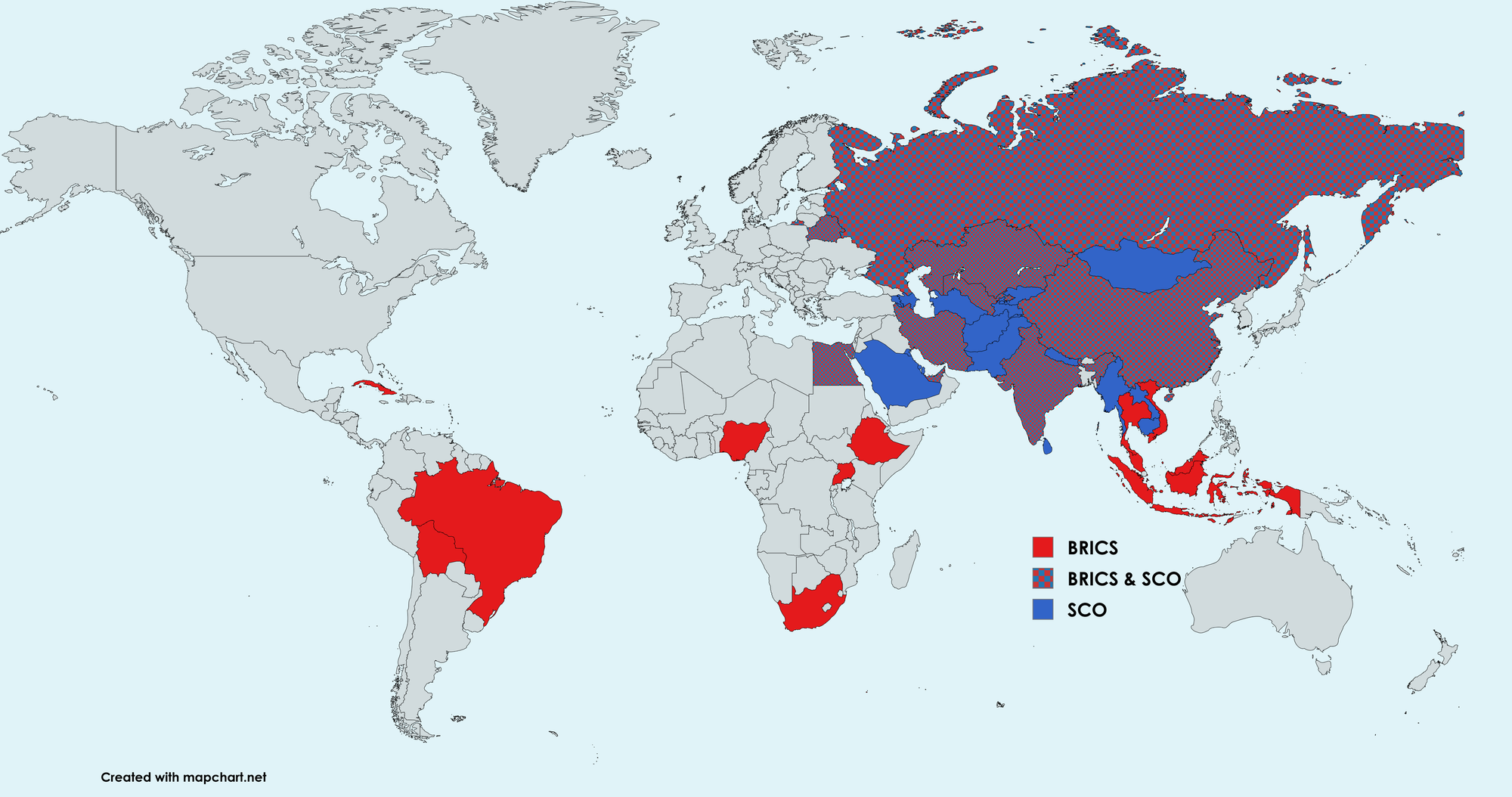
This is progress. Back in July 2014, a little over a decade ago, the BRICS held their groundbreaking VI Summit in Fortaleza, Brazil, whose achievements EIR welcomed with a report headlined “Half of Humanity Launches a New World Economic Order.” Today, the BRICS has 20 nations that are members or partners, and the SCO has 27 (see Map 1). Nine of those countries are in both groupings. Together, the 38 nations have a population of nearly 6 billion, about 75% of the planet’s 8 billion inhabitants.
The Arctic, the Next Frontier
The center of world economic development has decisively shifted to the Asia-Pacific region and to the Arctic, as Lyndon LaRouche forecast it would. In his Sept. 9, 2013 “Project Space: The Thesis,” LaRouche expressed his vision for mankind:
The immediately intended scope of the core of the newly projected project, reaches, primarily, from the area immediately west of the Mississippi, to the Pacific, and north to the Arctic; but also leads into great internal regions of East Asia. The scope and effect of this development will be enabled, not for warfare, but, by the means of peaceful uses of the set of intended thermonuclear-fusion programs which had been then, implicitly awaiting something like this present venture, since approximately the 1970s. The result will include the greatest, and most beneficial achievement in the expression of great works which had been ever achieved by mankind on planet Earth thus far.
The Arctic region, for LaRouche, is far more than a location with enormous deposits of natural resources, including oil, gas, rare earths, and so on.
Proximity to the Earth’s magnetic pole and the geomagnetic fields define the Arctic as the junction between the Earth and galactic radiation, an ideal place for exploring the causes of climate and weather, and meeting the challenges of cosmic radiation in its dynamic interaction with our planet. The Arctic has been called “Earth’s window to space,” the location where mankind most directly intersects the galactic forces shaping our existence on planet Earth. For LaRouche, the building of a tunnel under the Bering Strait to connect the United States and Russia with high-speed rail communication is only the centerpiece of urgently needed, broader scientific cooperation between the two countries, along with China, India, and other leading nations.
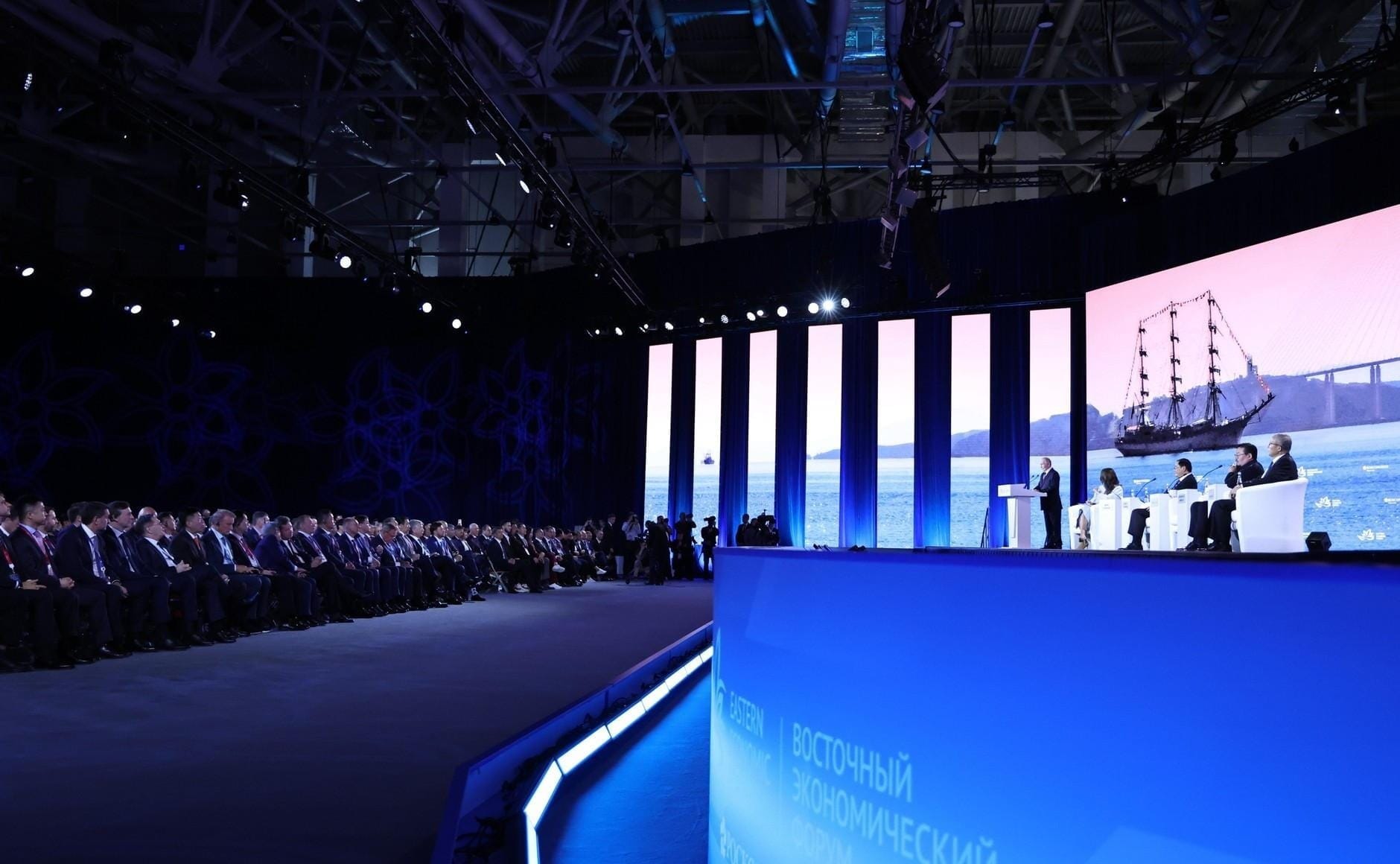
Russian President Vladimir Putin presented a proposal for the development of the Trans-Arctic Transport Corridor (see Map 2) which is fully consonant with this perspective, in the course of his remarks to the plenary session of the Vladivostok Eastern Economic Forum on Sept. 5.
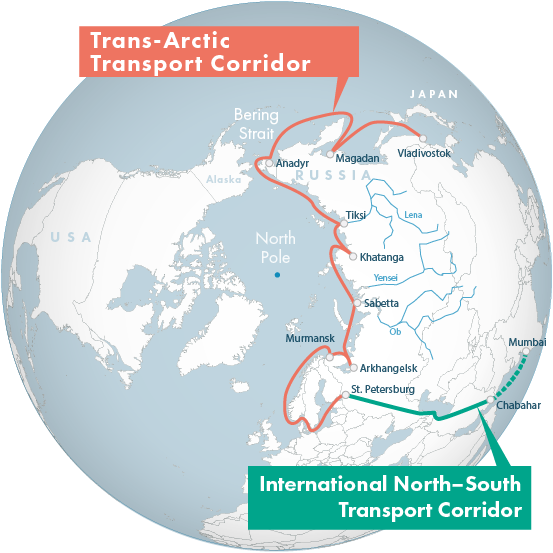
Of course, a particularly significant topic for the Far East, for our entire country, and for the whole Eurasian continent is the development of the Trans-Arctic Transport Corridor,” Putin began. “It runs from St. Petersburg through Murmansk, Arkhangelsk, and the Northern Sea Route, all the way to Vladivostok.
We will develop the Trans-Arctic Corridor.” Putin continued. “We often speak about the Northern Sea Route. But if you have noticed, I specifically said—and continue to say—Trans-Arctic Corridor, because we have concluded that we need to operate on a larger scale, and that this artery must function as part of a complex system with all the territories adjoining the Northern Sea Route and their capacities.
So, this is a comprehensive system that should integrate maritime, rail and road transport. It will allow us to use the potential of our largest rivers, such as the Ob, Yenisei, and Lena. Everything must work as a single, unified system.
Our task is not only to establish reliable and safe sea routes in the Arctic and enable year-round operation of the Trans-Arctic Corridor. There is also work, as they say, onshore: developing communications and navigation, ship servicing systems, and emergency and rescue infrastructure. And, of course, this includes modernizing seaports in the Arctic and the Far East.
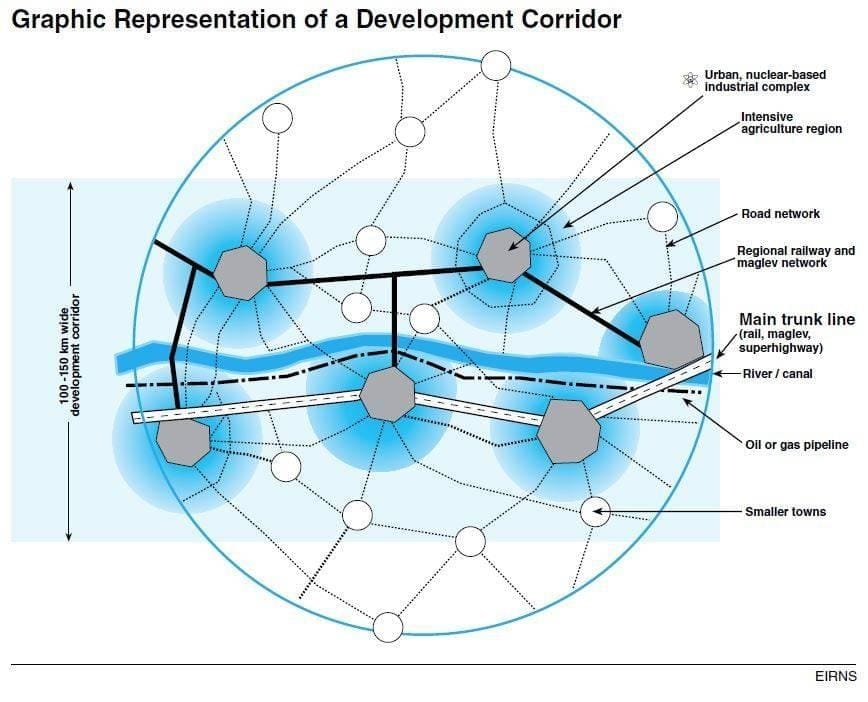
Readers will note the similarity of this approach with that proposed by Lyndon LaRouche for the World Land-Bridge’s “development corridors,” which would extend 50 km on each side of high-speed rail lines and include power lines, fiber-optic lines, freshwater pipelines, nuclear-powered industrial centers, and so on.
Putin also stressed the role of science and technology: “There are other opportunities for applying modern technologies across these vast territories. This is precisely where they should be deployed.” In his discussion with U.S. President Donald Trump in Anchorage, Alaska on Aug. 15, Putin made the same point, albeit more poetically: “We see that Arctic cooperation is also very possible, in our international context…. It is symbolic that, not far away from here, the border between Russia and the U.S., there was a so-called International Date Line. I think you can step over, literally, from yesterday into tomorrow, and I hope that we will succeed in that, in the political sphere.”
Although the Trans-Arctic Transport Corridor, and its included Northern Sea Route, are still in their infancy, their importance for global productivity is stunning. In addition to fully integrating the vastness of Russia and its 11 time zones with the scientific and technological engine of China, the shipping distance from Asia to Europe will be cut by about a third. For example, the distance from Yokohama to Hamburg through the Suez Canal is 23,200 km; through the Northern Sea Route it is 14,280 km.
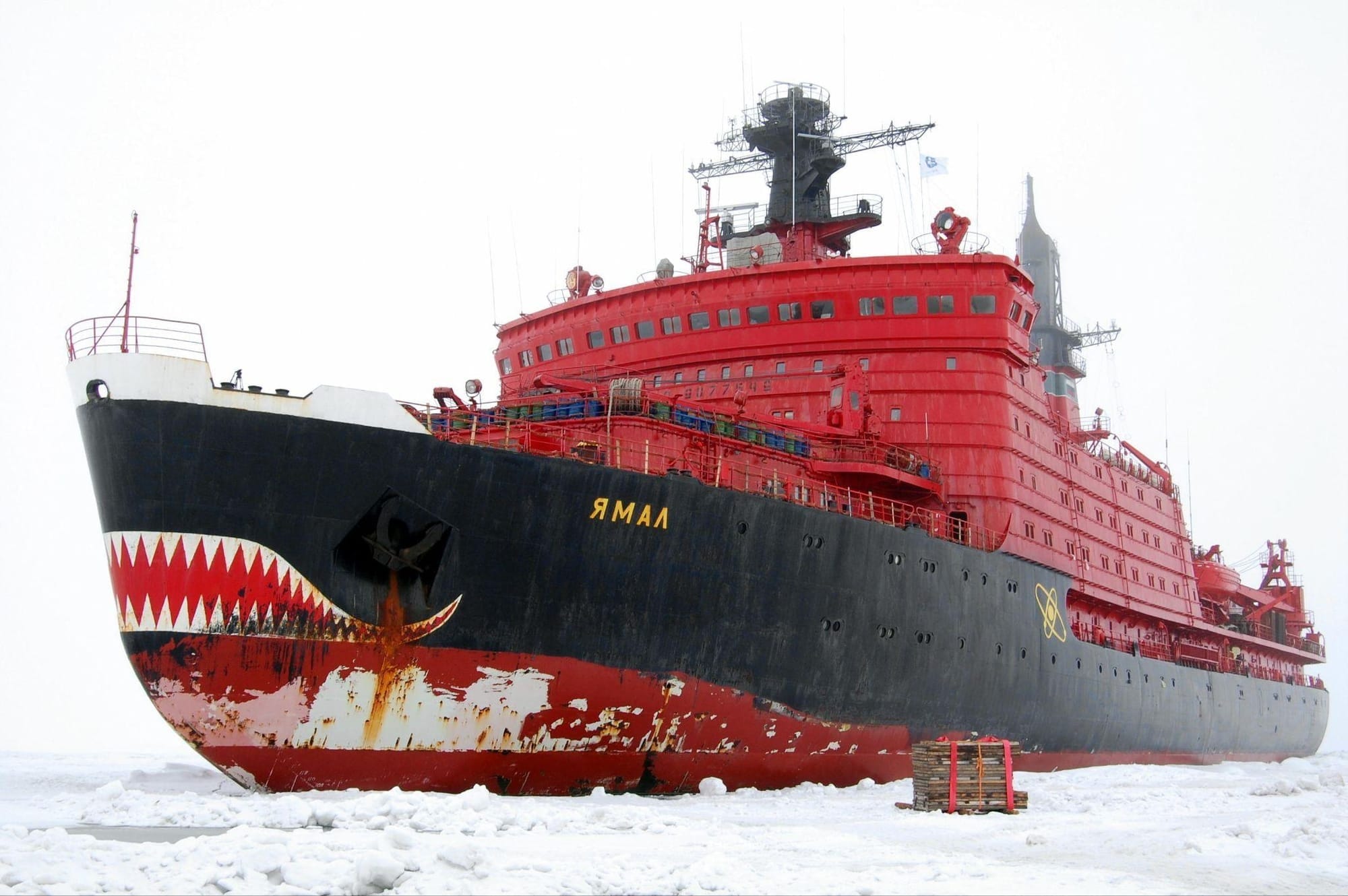
Although the Northern Sea Route is still closed to regular shipping for more than half the year, due to ice, Russia is in the process of building a robust fleet of nuclear-powered icebreakers capable of keeping the shipping lanes open for most of the year. In 2014, only 3.7 million tons of cargo were shipped on the route. A decade later, the volume had increased ten-fold, to 37.9 million tons. Current projections are for a near tripling to 109 million tons by 2030.
Putin Proposes International Cooperation
China and India have both expressed great interest in the Northern Sea Corridor. In his remarks in Vladivostok, Putin made it clear that the entire Arctic should be a zone of international cooperation: “Much is being done in the Far East and the Arctic, and a lot more will need to be accomplished. Importantly, and I want our foreign friends to hear me, we are open to everyone who is willing to take part in this work.” Putin specified China, India and the United States by name:
We are discussing cooperation in the Asia-Pacific region. You keep bringing me back to cooperation, say, with our friends and allies in the People’s Republic of China. We have not yet talked about India: there are many plans there, too. But the Asia-Pacific region also includes, say, the United States. And there are many interested parties there who want to resume or begin new work with us….
We have received excellent proposals for working with U.S. companies in Alaska: they have resources there, and we have technologies for extracting and liquifying gas that are much more effective than those that some of our American partners have. They know this, and at the level of economic players, companies are ready for cooperation. It does not depend on us. We are also ready, but if any political decisions are made there, we will move in this direction, and we can work together in the Arctic, too.
By the way, we have already discussed possible work in a trilateral format on some of our Arctic fields with our Chinese friends. In fact, all these options are being discussed, they are on the table. We only need a political decision. This is possible, and cooperation in both gas and oil would be mutually beneficial.
The International North-South Transport Corridor
Let us turn to review some of the key features of the updated World Land-Bridge, incorporating some of the developments of the first week of September 2025. Many of the great infrastructure projects we indicate below are well underway; others are still waiting in the wings. The reader is urged to think of the Pacific-centered portion of the planet as a unified physical-economic space, stretching from the International North-South Transport Corridor (INSTC) in the west, to South America’s Chancay Port and bi-oceanic rail corridor in the east—all pivoted on the Arctic (see Map 3).
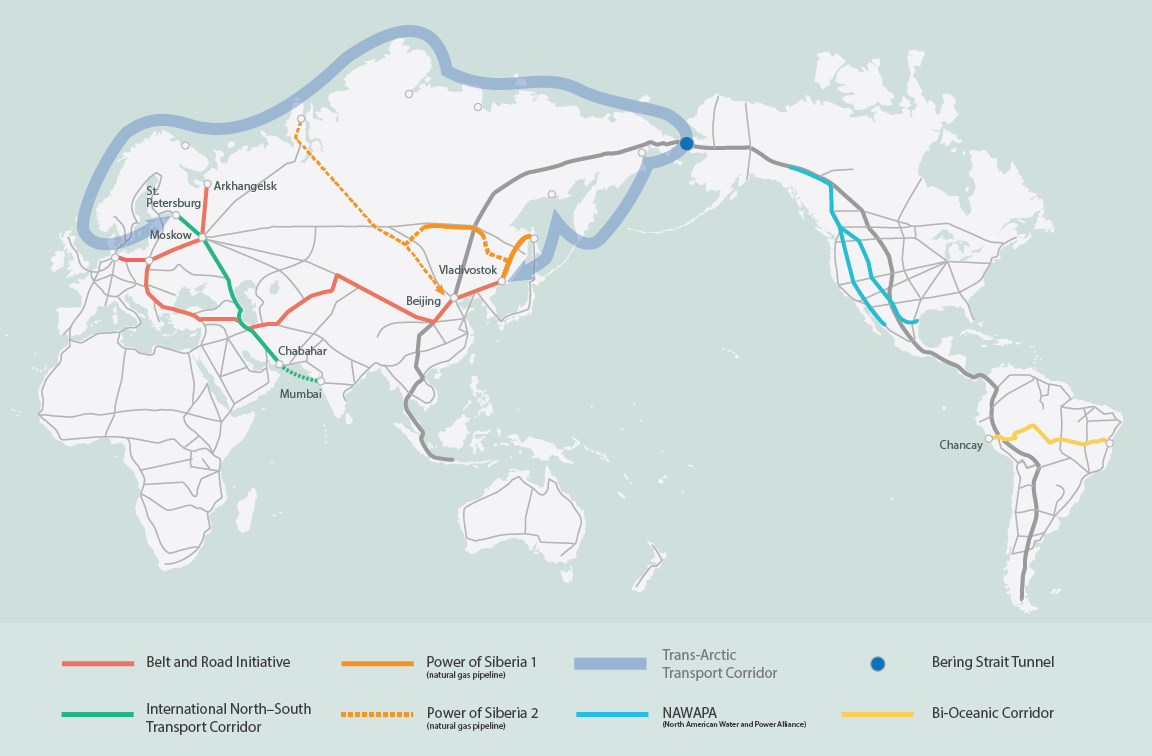
Russia’s Trans-Arctic Transport Corridor is often referred to as the “springboard” for the INSTC, since the city of St. Petersburg is both the westernmost part of the Arctic corridor as well as the northernmost terminus of the INSTC. The INSTC is a nearly complete multi-modal transport network running some 7,200 km (4,500 miles), linking India’s port of Mumbai with Iran’s port of Chabahar, and connecting from there with a rail line that runs northwest through Iran along the western edge of the Caspian Sea, through Azerbaijan, and into southern Russia. From there it connects to Moscow and St. Petersburg. The rail link is complete, except for a 75 km stretch in Iran from Qazvin to Rasht, which runs through a mountain pass to bring the trade route to the southwestern corner of the Caspian Sea. Despite that gap, the INSTC is functional today by transporting goods by ship over the Caspian Sea from Iran to Russia.
Power of Siberia 2 Gas Pipeline
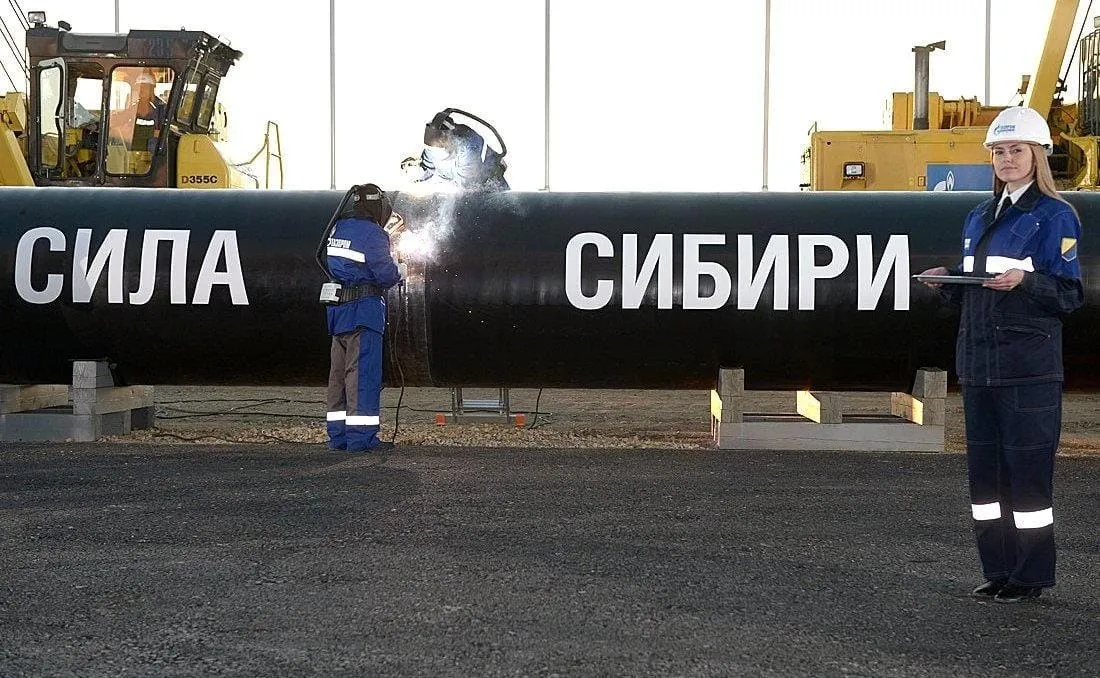
One of the stunning announcements made on the sidelines of the SCO summit, was a legally-binding agreement between Russia, Mongolia, and China to build the Power of Siberia 2 gas pipeline. Under intense discussion for years, the pipeline will now be built, carrying up to 50 billion cubic meters of natural gas per year from the huge gas deposits in Russia’s Yamal peninsula on the Arctic Ocean (and thus part of the Trans-Arctic Trade Corridor) south to China. Previously, Yamal’s gas was a primary source of Russia’s gas exports to Europe—but no more, because of the West’s suicidal sanctions policy.
Added to the gas already flowing through the Power of Siberia 1 pipeline, Russia will be exporting some 100 bcm of gas per year to China, about half its total needs. Russian news agency RT captured the scope of the project:
In a single deal signed in Beijing, Russia has permanently redirected energy flows that had run westward for 50 years—straight to China. The groundbreaking Power of Siberia 2 pipeline will carry 50 billion cubic meters of natural gas annually, tapping the very same Arctic reserves that once powered German industry. This isn’t just a new pipeline; it’s a historic strategic shift that marks the end of an era for Europe, closing the chapter on cheap Siberian gas and hard-wiring China as Russia’s anchor market. For Brussels and Berlin, it’s more than a supply loss—it’s a structural break with the past….
What does this seismic redirection mean for global energy and geopolitics? China will soon import over 100 bcm of Russian gas each year—volumes comparable to what once sustained Europe’s industrial base—locking in a long-term supply far from U.S. interference or Middle Eastern volatility. Meanwhile, the EU has been left dependent on expensive LNG imports.…
More broadly, the Yamal gas deal is only one of the many tectonic shifts underway in world physical trade flows, as a result of the West’s suicidal sanctions and tariff policies. Another example of such a dramatic reorganization of world trade is the importation of oil by India (which relies on imports for 87% of its domestic consumption): prior to 2022, less than 1% of India’s oil imports came from Russia; by June 2025, the Russian share had risen to over 43%. Many more such shifts will occur in the months and years ahead.
Bering Strait Tunnel
The Bering Strait Tunnel project has been studied and promoted over decades by leading scientific and political figures in the United States and Russia. It would link the two countries with a tunnel covering 100 km or so, using the two Diomede Islands in the strait as “stepping stones.” The intention would be to link up the expanding high-speed rail network of China and the Belt and Road Initiative (BRI), with a similar network to be built in the Americas—ultimately running south through the United States, Mexico, Central America and crossing the Darien Gap into South America. As Helga Zepp-LaRouche put it in an open letter to Presidents Trump and Putin prior to their Aug. 15 meeting in Alaska, urging them to discuss building the Bering Strait Tunnel:
In the not-so-distant future, one could then travel by high-speed railroad around the world, from the most southern tips of Argentina and Chile in Ushuaia and Puerto Williams, all the way through the Americas, then through the Bering Strait, across Eurasia, then with a tunnel under the Strait of Gibraltar, travel all the way through the African continent to the Cape of Good Hope.
One of the leading Russian experts promoting the tunnel project, Dr. Victor Razbegin, Director of the Interdepartmental Center for Integrated Regional Transport Projects at the Russian Ministry of Economic Development, recently told an interviewer that a feasibility study for the long-proposed project is ready to go and that “the project is only waiting for a political decision from the Russian and U.S. authorities.” He added that connecting Eurasia and the Americas through the Bering Strait will join 85% of the Earth’s landmass and more than 90% of the world’s population. “Construction will take from 5.5 to 10 years. It will be necessary to build 6,000 km of access roads, of which 4,000 km will be in Russia. The project will cost $50-60 billion and will pay for itself in 15 years in freight transportation alone. The new railway will be 3-4,000 km shorter than the sea route, and with the use of new technologies, the speed of passenger trains can be more than 1,000 km per hour. Freight transportation will provide access to Alaska’s resources and will allow the development of remote areas of Russia. China, Japan and both Koreas are interested in creating the crossing and can finance the construction.”
NAWAPA
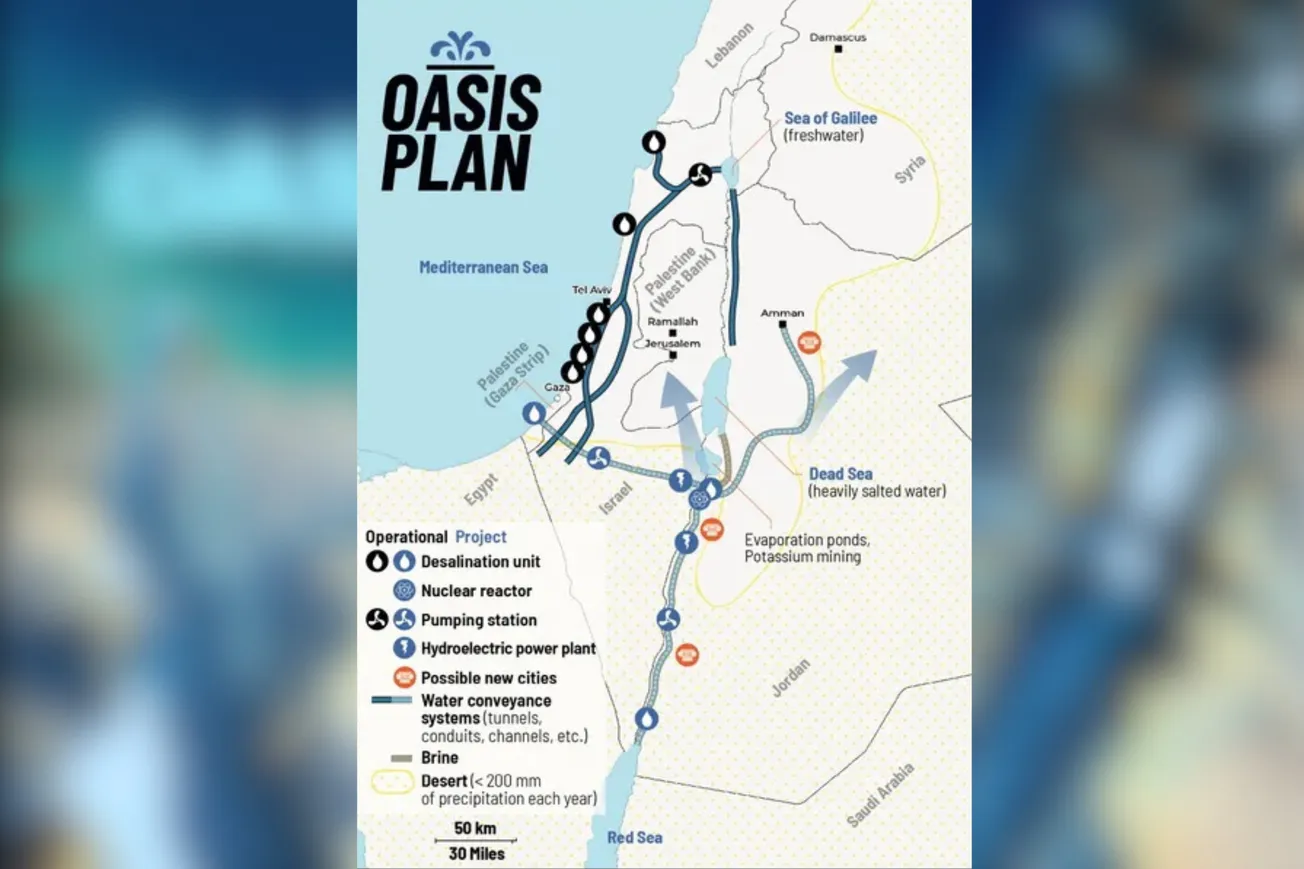
The biosphere is a wondrous thing, but—as Vladimir Vernadsky was quick to point out—it has left much work to be done by the noösphere, i.e., by man’s creative intervention to improve the biosphere. Take the case of the planet’s deserts, which unnecessarily cover about one third of the Earth’s land surface. What if water could be transferred by canals, pumps and dams from where it is abundant—e.g., the rivers flowing north into the Arctic Ocean in both North America and Asia—to where it is desperately needed in the Great American Desert and the Central Asian deserts? What if we could supplement that by manufacturing great quantities of fresh water with nuclear desalination and other modern technologies? Both are possible, and both need to be done.
The premier such project in the Western Hemisphere is the North American Water and Power Alliance (NAWAPA), whose basic design dates back to the John F. Kennedy Presidency but which has never been built. NAWAPA will divert some 15% of run-off now flowing toward the Arctic in the Mackenzie and Alaska River Basins, taking it southward to the dry southwest of the continent. This will make irrigation possible from the Canadian Prairies all the way to western Mexico. Recent studies indicate that NAWAPA will create 6-7 million new productive American jobs over a decade—construction workers, tunnel drillers, heavy equipment makers, civil and heavy construction engineers, and on and on. Irrigated agriculture in the Southwest could expand from 22 million to 41 million acres through the NAWAPA infrastructure project.
Chancay Port and South America’s Bi-oceanic Corridor
The Chancay Port complex in Peru was inaugurated on Nov. 14, 2024, the first major connectivity project to begin functioning in the Americas from the Belt and Road Initiative. Built jointly by China’s COSCO Shipping Co. and Peru’s Volcan Mining Co., the port is designed to serve as the “gateway between South America and Asia.” Estimates are that it will cut transit times from South America to ports all over Asia by 10-20 days, depending on the destinations.
When fully completed in 2030, this multipurpose port, able to handle bulk cargo, general cargo and containers alike, will provide berth to today’s mammoth 24,000 TEU-equivalent container ships (“Ultra Large Container Vessels,” or ULCV’s)—the only port on the Pacific coast of the Americas besides Long Beach, California which can do so. Already, with direct shipping from Chancay to Shanghai, China is cutting days off shipping from various South American countries to China. Storage yards, warehouses, multi-purpose logistics centers and an industrial park are to be built around the port to make full use of the opportunities offered by this new shipping hub.
To be fully efficient, Chancay will have to be linked with a “bi-oceanic” or “trans-oceanic” rail line, linking the Pacific and Atlantic coasts of South America—something which does not exist today. To that end, in April 2025 the governments of China and Brazil signed a memorandum of understanding to proceed with feasibility studies to determine the best route for a bi-oceanic rail corridor. This will open up the entire interior of the South American continent to serious industrial development—for the first time ever.
Fusion Power Is the Face of the Future
In all of these projects and many more not mentioned here, the peaceful use of nuclear energy—first fission, and quickly thereafter fusion—is a critical area of cooperation among Russia, China, India, the United States and other nations. President Putin, in remarks to an Aug. 22 meeting of young workers in the Russian nuclear industry, insisted that nuclear fusion and space exploration are the key to the future, and are priority areas of international cooperation:
“We must set ambitious goals and strive to take a qualitative leap in developing our economy and indeed, civilization as a whole,” Putin stated. “First and foremost, this includes work in controlled thermonuclear fusion…. Equally fruitful collaboration is needed for another large-scale project: the creation of a space system with a special power plant and a so-called space tug based on a nuclear power unit.”
Lyndon LaRouche is widely acknowledged to be the West’s most vocal proponent of fusion power. In the fourth of his 2014 Four Laws, LaRouche wrote:
(4) Adopt a Fusion-Driver ‘Crash Program.’ …V.I. Vernadsky’s systemic principle of human nature, is a universal principle…. [M]ankind is enabled to evolve upward, and that categorically, by those voluntarily noëtic powers of the human individual will. …[We require a] society which is increasing the powers of its productive abilities for progress, to an ever-higher level of per-capita existence…. A Fusion economy, is the presently urgent next step, and standard, for man’s gains of power within the Solar system, and, later, beyond.