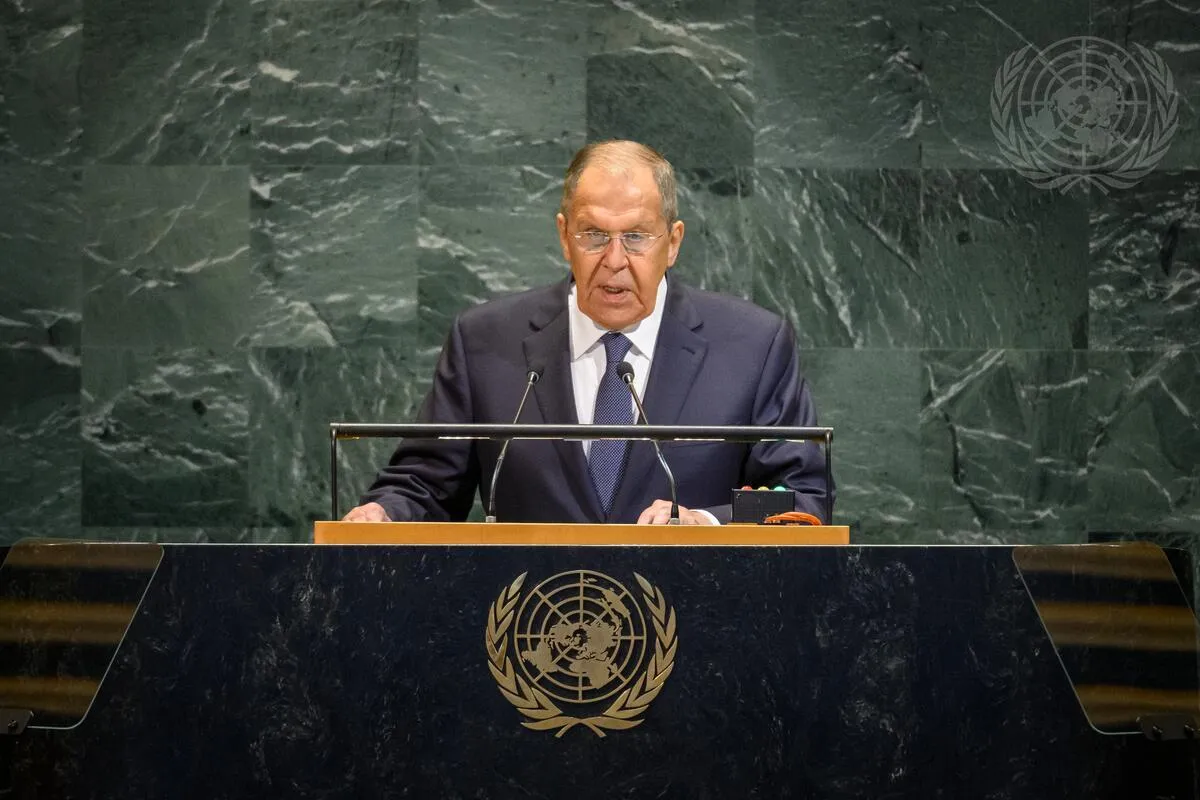
In a sharp speech to the UN General Assembly on Sept. 27, Russian Foreign Minister Sergey Lavrov developed the theme of the principles at the root of the United Nations Charter—most importantly the sovereign equality of states—and that the refusal of certain Member States to adhere to those principles is the root of the problems facing the world today.
“Widespread gross violations of the principle of the sovereign equality of states are undermining faith in justice itself and leading to crises and conflicts,” Lavrov said. “The root of the problem lies in the incessant attempts to divide the world into us, and them into democracy, and autocracy, into a blooming garden and a jungle. Those who are at the table and those who are on the menu, and to the chosen ones who are allowed everything and the rest, who for some reason are obliged to serve the interests of the golden billion.”
Lavrov was adamant about the situation in Gaza: “There is no justification for the brutal killings of the civilian population of Palestine or for terrorist attacks. There was also no justification for the collective punishment of Palestinians in the Gaza Strip, where Palestinian children are dying from bombing and starvation…. There is no justification for plans to annex the West Bank.”
Taking aim at the hypocrisy of the several Western nations which only recently recognized a Palestinian state, Lavrov said: “We are essentially dealing with an attempt at a kind of coup d'état aimed at burying UN decisions on the creation of a Palestinian state…. The question then arises why did they wait so long? It seems that they had hoped that soon, by the time the General Assembly session was convened, there would be nothing and no one left.”
Lavrov then outlined several more examples of the West’s undermining of the sovereignty and prosperity of other nations, including Cuba, Venezuela, and Iran, harshly attacking the sabotage of the JCPOA and other diplomatic efforts in favor of “its desire to extract unilateral concessions from Tehran through blackmail and pressure.”
On the Kiev regime, “which seized power as a result of an Anti-Constitutional coup organized by the West in 2014,” Lavrov pointed to the violations of Article 1 of the UN Charter, which “states the need for respect for human rights and fundamental freedoms for all without distinction as to race, sex, language or religion.” He pointed out that Ukraine is the only country which has legislatively banned a language used by almost half of the country’s population. “Arabic is not banned in Israel, and Hebrew is not banned in Arab countries and Iran. But Russian is banned in Ukraine.… Europe remains silent on this issue, obsessed as it is with the utopian goal of inflicting a strategic defeat on Russia.”
Turning to the theme of ending colonialism, Lavrov cited the right of nations to self-determination, which he likened to “the principle enshrined in the 1776 Declaration of Independence and subsequently reaffirmed by many American presidents, put into practice the following principle: Governments derive their just powers from the consent of the governed.” He described the world as it exists now, in which “the Global Majority is loudly asserting its rights,” with “the Shanghai Cooperation Organization and the BRICS playing a special role as mechanisms for coordinating the interests of the countries of the Global South and East.”
Returning to his opening theme, Lavrov ended by calling on Member States to “strictly adhere to all of the principles of the UN Charter, without exception, without double standards.”