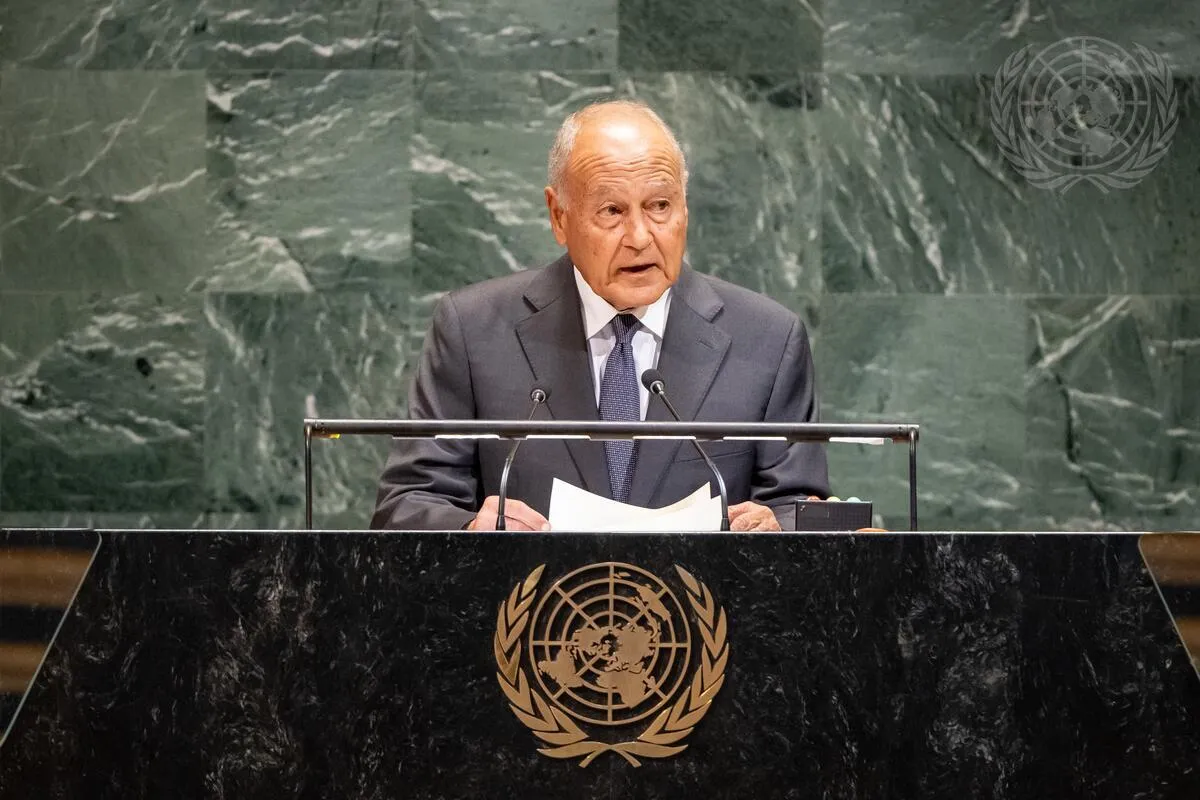
The United Nations General Assembly held its session today to discuss the matter of two states for Palestine and Israel, a deliberation mandated by the UNGA in 2024, under the auspices of France and Saudi Arabia. As of today 150 nations have expressed their backing for statehood for Palestine. Yesterday, on the eve of the meeting, Australia, Canada, the U.K., and Portugal announced support; France made its announcement today. The world community overwhelmingly has expressed support for Palestinian statehood, with many speaking out passionately today for Israel to stop the mass killing in Gaza.
Representatives of the United States, Germany, and a few other nations, however, spoke against statehood for Palestine. Tomorrow, the first day of the annual UNGA High-Level General Debate by national leaders, U.S. President Donald Trump is scheduled to speak, and will be in an outstanding minority. Israeli Ambassador to the UN Danny Danon, who did not attend the UNGA today, denounced the session as “theater” and “a circus” in a BBC interview outside the UN. Danon declared that acting Israeli Prime Minister Benjamin Netanyahu will “strongly” defend what Israel is doing on Sept. 26 at the UNGA, after personally meeting with President Trump beforehand.
French President Emmanuel Macron co-presided in person over today’s session, the latest phase of a process titled, “High-Level International Conference for the Peaceful Settlement of the Question of Palestine and the Implementation of the Two-State Solution.” Saudi Foreign Minister Faisal bin Farhan Al Saud, who co-chaired with Macron, called on all countries to take the “historic step” of supporting efforts towards implementation of the two-state solution.” He said there must be “a new reality.”
The first half of the 3.5-hour session received reports from the leaders of the working groups of 16 nations and the Arab League that produced “The New York Declaration” backing Palestinian statehood, whose text was completed in July, and overwhelmingly approved in a UNGA vote on Sept. 12.
In the second part of today’s session, high-level representatives from dozens of countries, including many heads of state and government, spoke in favor of the proposal, including Brazil, South Africa, Türkiye, Australia, Spain, Egypt, Ireland, Canada, Norway, and many others.
Brazil’s President Lula da Silva gave a very passionate speech in support of the Palestinians. Indonesia gave its support, and promised that, if Israel agreed to a negotiated solution, Indonesia would recognize the State of Israel and would even assist Israel in maintaining its security.
South Africa’s President Cyril Ramaphosa again condemned the death and destruction in Gaza, labeling Israel’s policy as genocide. Palestinian President Mahmoud Abbas spoke by videoconference, having been refused a U.S. visa to attend in person. The UNGA on Sept. 19 overwhelmingly voted its permission for Abbas to participate by remote connection, which had been opposed by the United States and Israel. President Abbas said that the Palestinian Authority would be willing to take control in Gaza and that Hamas would have no political influence there.
Egyptian Prime Minister Mostafa Madbouly condemned Israel’s bombing of Qatar, and announced Egypt’s intention to hold a reconstruction conference for Gaza, as soon as there is a peace agreement. The President of Ireland pointed to the success of the peace process in Northern Ireland as an example of the benefits of a negotiated solution to political conflict.
While the heads of state and government had been given five minutes each, and other ministers two minutes, a number of speakers who went over their time, found their mikes cut off after that period, finishing their speeches to the benefit of those within earshot. Even the old warmongers like Ursula van der Leyen and Annalena Baerbock, UNGA President, had to don the cloak of “peacemakers” for an instant.
It was an impressive line-up, but still untested is the willingness of these nations in fighting to bring their wishes to fruition.