
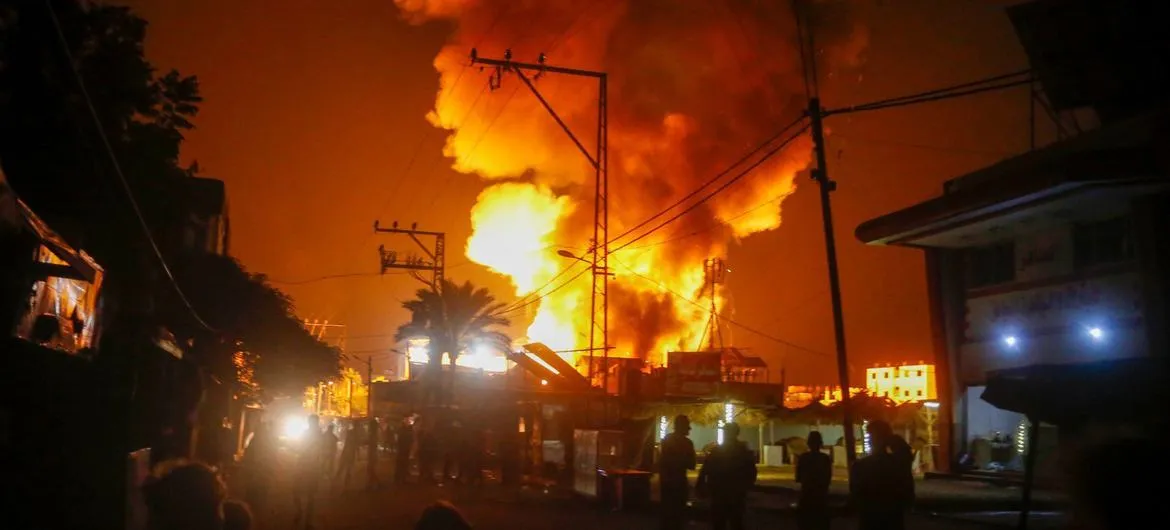
Upon being informed that they were pulling out of Gaza City, on the evening of Oct. 9, IDF soldiers launched an arson spree, reported Drop Site News. They set fire to homes in Gaza City and also the last remaining sanitation plant.
The homes that were still standing were apparently buildings the occupying soldiers had taken over. Soldiers posted on social media how they used olive oil in the homes to saturate anything flammable, such as a couch. One Israeli soldier from the Kfir Brigade posted a photo on Oct. 12, showing himself standing in front of a set of burning wooden pallets. His caption read: “On Friday, just before departure. Burning food so that it won’t reach the Gazans, may their names be erased.”
This was in line with the publicly expressed positions of various Israeli officials. For example, Israeli Science and Technology Minister Gila Gamliel told Channel 7 News in September: “We have already completely annihilated 75% of the entire [Gaza] Strip. There remains 25%, which, as you know, it too … we are now taking over Gaza [City]—there will be nothing left there that would really [have] the potential to be habitable.”
The Sheikh Ajlin Sewage Treatment Station, a central component of Gaza City’s sanitation network, was also destroyed. A photo was posted on social media of Israeli soldiers in front of the plant while it burned, with the message “[One] last memory.”
Monther Shoblaq, Director General of the Coastal Municipalities Water Utility, which manages the facility, said the attack is a blow that could push Gaza City’s wastewater system “to point zero.” He added that the plant is “one of Gaza’s oldest” and warned that its destruction will set back planned reconstruction efforts by years. “I mean, they signed a ceasefire,” Shoblaq declared. “Why set it on fire?”
Sheikh Ajlin Sewage Treatment Station was the sole remaining facility that was capable of providing sewerage to Gaza City after the 2024 Israeli attacks destroyed the Central Gaza Wastewater Treatment Plant, which Israel claimed was necessary to establish the “buffer zone” around Gaza’s perimeter. UN bodies have assessed the buffer zone to be “part of a widespread and systematic attack directed against the civilian population in Gaza” and “a crime against humanity.” Shoblaq explained: “But without Sheikh Ajlin, raw sewage will have to be dumped directly into the sea. Remediation could take years and would cause massive contamination. You are talking about Gaza without sewage treatment, shorelines covered with waste, groundwater at risk, and untreated sewage flooding the streets, if pipes and pumps are not repaired after this assault.”
For over a year, some senior Israeli officials have advocated for wastewater treatment plants in Gaza to be rendered inoperable. In March 2024, current Israeli Minister of Foreign Affairs Gideon Sa’ar criticized the government for permitting repair works on the Central Gaza Wastewater Treatment Plant by Gazan authorities. Earlier this year, National Security Minister Itamar Ben-Gvir, in the course of congratulating the government for imposing an electricity blackout on Gaza, added: “The only thing left in Gaza for [Israel’s] The Electricity Company to disconnect now is the wastewater treatment plant.”