
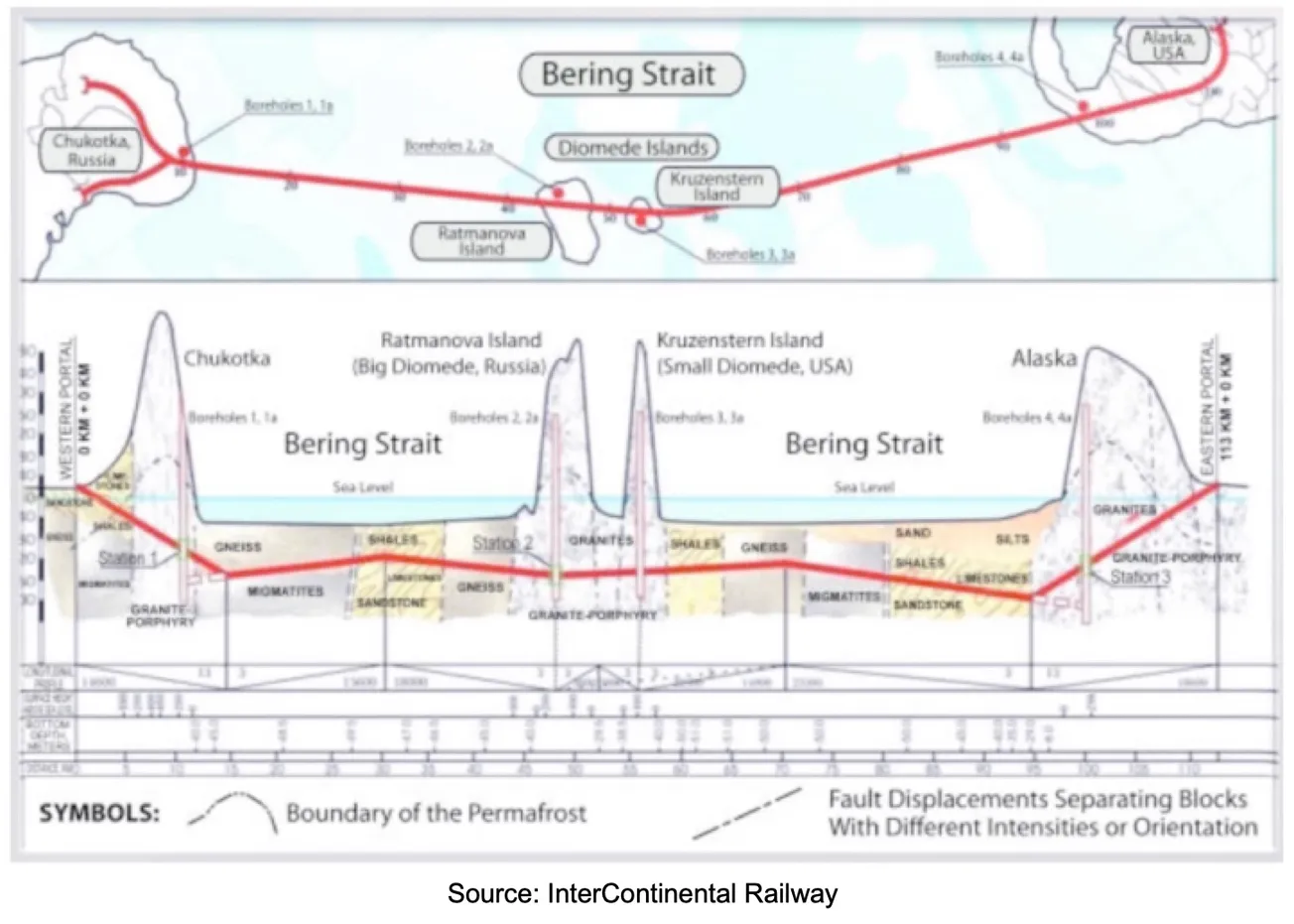
Discussions of the Bering Strait Tunnel connecting Russia and the United States are heating up.
The Russian news service TASS has published an interview with Schiller Institute founder Helga Zepp-LaRouche, who described the project as a symbol of “peace through development.” She noted, “It is obvious to President Trump that the normalization of U.S.-Russian relations will open tremendous prospects for the development of the economic cooperation between the two countries. Most spectacular will be the ‘Putin-Trump Tunnel,’ which connects the Americas through a 70-mile link through the Bering Strait with Afro-Eurasia, as Kirill Dmitriev posted on X.”
As EIR prepares for its October 22 morning event on the project, it has interviewed rail consultant Scott Spencer of Intercontinental Railway, who emphasizes the vast economic and cultural potential of the undertaking. The tunnel would require 5,500 miles of new connecting rail in Russia, Alaska, and Canada to form a continuous international development corridor. This 21st-century “Panama Canal” could advance “peace, progress, and prosperity” on a scale unseen in recent decades. The estimated cost of the project, between $100 and $200 billion, is a modest investment compared to the trillions spent on perpetual conflict. For a fraction of those costs, we could build not only a physical bridge between continents, but also a moral bridge between civilizations.
The expected meeting between U.S. President Donald Trump and Russian President Vladimir Putin in Hungary will provide a format for discussing the proposal.
Before that meeting, Trump may meet with his Chinese counterpart President Xi Jinping in South Korea at the Oct. 31-Nov. 1 APEC summit. South Korea has proudly announced that both leaders will be making state visits, raising hopes of their having a bilateral meeting.
But the potential for collaboration clashes with the old habits of confrontation. The counterproductive U.S. antagonism toward China, encouraged by an Anglo-American elite intent on preserving dominance, is imposing mounting economic costs and strategic uncertainty worldwide. Nvidia CEO Jensen Huang recently spoke about the effect of chip export bans on his business: Nvidia went from having 95% of the market in advanced chips in China, to zero. And in the Netherlands, government authorities seized control of Chinese-owned chipmaker Nexperia, provoking retaliatory export restrictions that now threaten automotive supply chains across both the U.S. and Europe.
Meanwhile, Kuomintang party members in Taiwan have elected Cheng Li-wun as its new chairwoman on a platform of peaceful, self-directed development rather than geopolitical entanglements. “Taiwan must not be a sacrificial lamb on the altar of politics,” she declared, adding that peace across the Taiwan Strait “is not only the highest hope and blessing for the people on both sides of the straits, but it is a responsibility we have to the region and even to help humanity avert war.”
The challenge before us is not to manage competition, but to transcend it. We must end geopolitics and usher in a new era defined by the scientific, technological, and cultural development that characterizes our species as distinct from all other forms of life. Engaging people in such a mission offers the chance to contribute something of enduring value to human history. What could be more natural for human beings than developing fusion, increasing our mastery over nearby space, and establishing cultural institutions and traditions that bring out the best in people, rather than base instincts?
The Bering Strait Tunnel represents more than an engineering feat. It is an emblem of a new era in which security is secured not by dominance, but by mutual advancement. To develop fusion power, explore nearby space, and nurture cultural achievements worthy of our species—these are the pursuits natural to human beings. Building bridges, not barriers, is the true measure of civilization.