
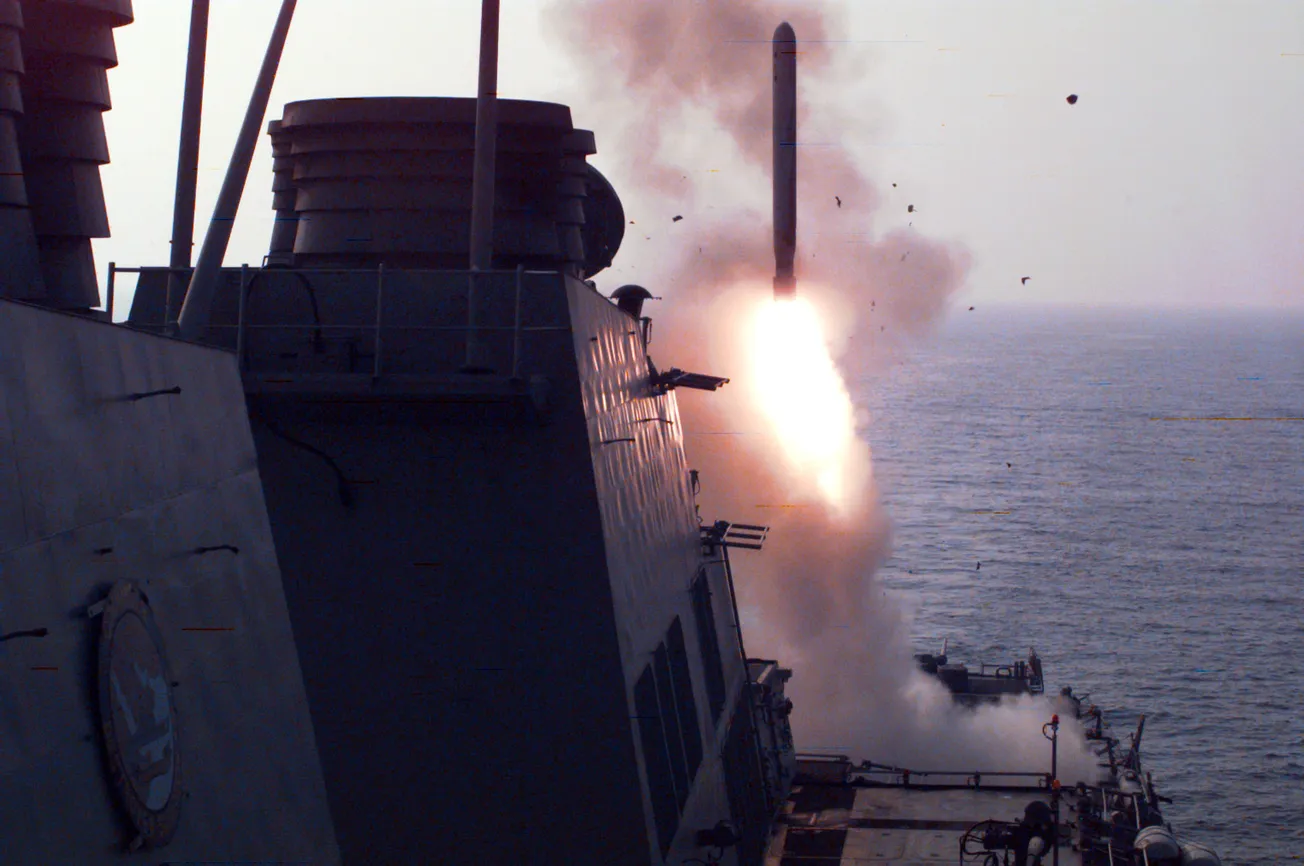
The months’ long Europe-instigated “pause” in negotiations over Ukraine, that U.S. President Donald Trump and Russian President Vladimir Putin began, is now over for the worse, because of the Western warhawks’ push for the U.S. to sell Tomahawk missiles to Europe for supplying to Ukraine. These missiles, with a range of 2,500 km (1,550 miles), can reach well into European Russia, need U.S. technical skill to be fired, and despite their age are reliably lethal. They are capable of carrying nuclear warheads. If they are installed in Ukraine, this will constitute warfare directly between the United States and Russia.
Ukrainian Acting President Volodymyr Zelenskyy on Sept. 26 gave the media his dissociated view, after having met with President Trump in New York on the sidelines of the UN General Assembly that week, that should Ukraine have long-range missiles, it would “force” Russia to peace talks—the same argument as the European Coalition of the Willing suicidalists.
On Oct. 6 President Trump answered a reporter at the White House about whether the United States will send Tomahawks to Ukraine, with a characteristic prevarication, answering neither “yes” nor “no.” He said that he has “sort of made a decision” on the Tomahawks, but he wants to know what the Ukrainians plan to do with them before he supplies them. “‘Where are they sending them?’ I guess I will have to ask that question. I would ask some questions. I am not looking to see an escalation.”
Kremlin spokesman Dmitry Peskov, when asked on Oct. 7 about President Trump’s remarks, responded carefully, “We understand that we need to wait, probably, for clearer statements, if any come.” But he added with stark realism, that “if we abstract from various nuances, we’re talking about missiles that could also be nuclear-capable. Therefore, this is truly a serious escalation.”
Two days ago, on Oct. 5, President Putin himself made his view known. He said that the relationship between Moscow and Washington would be destroyed if the United States supplied the Tomahawks to Ukraine for long-range strikes on Russia, according to a video released by Times News.
The choice is either diplomacy for resolution of conflict, leading to peace, or for escalation of conflict to the point of all-out warfare, leading to nuclear holocaust. This reality was put forward in the statement by Schiller Institute leader Helga Zepp-LaRouche, distributed at the mass demonstrations Oct. 3 in Berlin and Stuttgart for German Unity Day. Calling for a “Peace Order,” her statement began: “Just a few more steps in the escalation, and we could end up in an irreversible catastrophe—a global nuclear war that destroys all life on Earth. In many places throughout the world, we see the international legal order disintegrate and trust between states disappear. Military strikes are carried out even as diplomatic negotiations are underway, such as the Israeli and U.S. attack on Iran or Israel’s air strike against Qatar….”
Zepp-LaRouche’s statement went on to identify immediate requirements to end genocide in Gaza and to establish a peace order in Southwest Asia. Central to this diplomacy—and in every conflict—is to spell out the overview for how to provide mutual benefit. The Oasis Plan is the sure way for this throughout the region, supplying essential conditions of economic life for all peoples and nations.
In an Oct. 7 interview on Pakistani TV about the Oasis Plan, Zepp-LaRouche said: “The Schiller Institute has been promoting something which we call the Oasis Plan. This is an economic development plan not only for the reconstruction of the Gaza Strip, but to actually develop the entire region economically by development of lots of fresh, new water.
“By the beginning of the development of canals—one through the Dead Sea and Red Sea—another canal between those, then branching out, eventually creating artificial new rivers through desalination of large amounts of ocean water, greening the desert.” She went on to give her vision of the thriving of the entire region from North Africa to India.
Diplomacy, with the principle of economic development as the basis for peace, can overcome all divisions. Plan to discuss that further at the next session—#123, on Friday, Oct. 10—of the International Peace Coalition, a weekly internet meeting.
The alternative is deadly, as former UN weapons inspector and U.S. Marine Major and intelligence officer Scott Ritter made clear in an interview he gave to commentator Glenn Diesen, headlined “Tomahawks, End of NATO & Coming Nuclear War.” Ritter provided a thorough briefing on the current strategic emergency, including on the variants of the Tomahawk missile, the differing long-range missile characteristics and the history of arms control, up through what we must do today. Among Ritter’s fundamental points of diplomacy, Ritter declared, “Russia is not going to engage in strategic arms control with a nation that seeks the strategic defeat of Russia.”