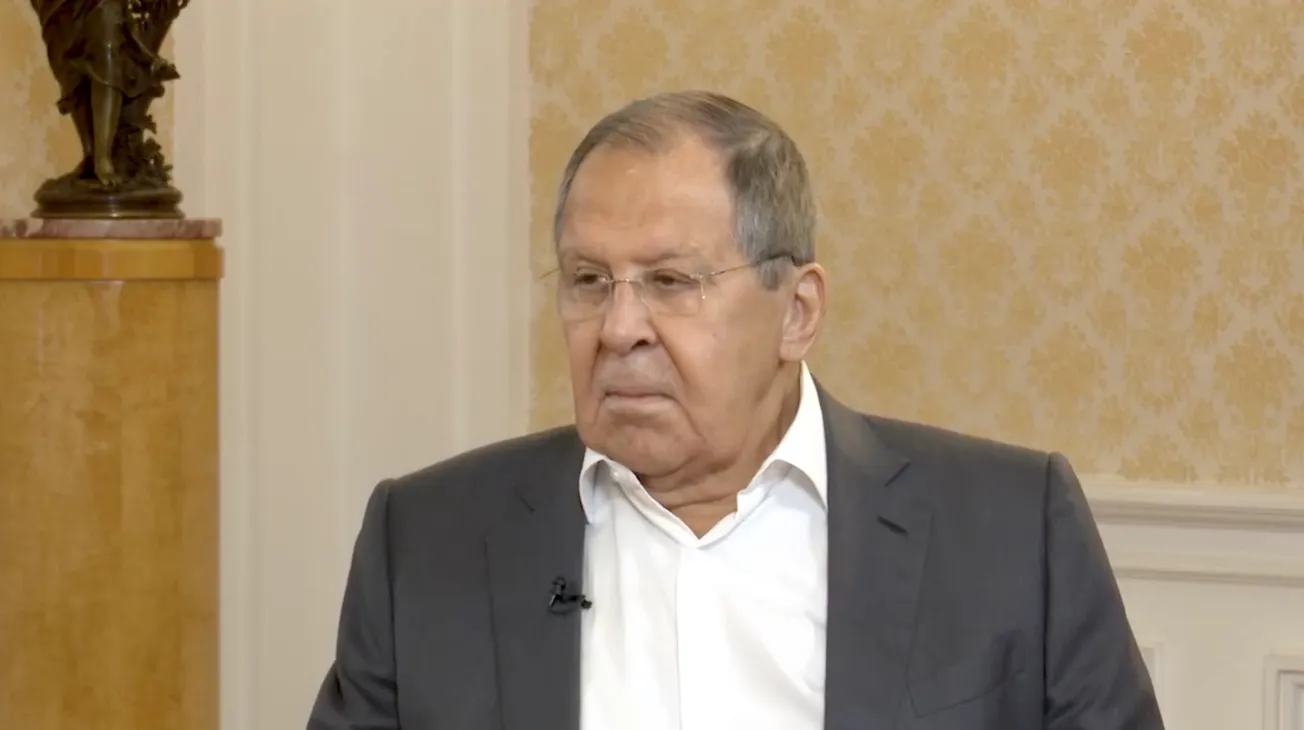
The agreement between U.S. President Donald Trump and Russian President Vladimir Putin made at the Alaska summit on Aug. 25 has been the basis of Moscow’s discussions with Washington, and on Oct. 26, Russian Foreign Minister Sergey Lavrov reviewed, in English, what has transpired since then, including last week’s new delay in preparations for a potential meeting, which had been discussed for Budapest. Lavrov was interviewed in Moscow by a Hungarian YouTube channel Ultrahang and the full transcript was posted on his Foreign Ministry website. Lavrov started by discussing his Oct. 20 phone call with Rubio:
“Rubio called me. We had a conversation, very specific, where I reconfirmed our full adherence to what was discussed in Alaska and to what clear understandings the presidents reached at that time. As you know, President Trump praised the Alaska meeting repeatedly, that this was a very good meeting, that it set the stage, laid the foundation….
“After we talked with Marco Rubio regarding following up on the results of Alaska, he did not mention any new meetings or conversations. And I did not raise the issue, because the entire initiative was coming from the United States. And we would be ready to move as the Americans feel comfortable for themselves.
“Then the State Department issued the communiqué about our phone conversation, if I remember right, which said that we had a productive discussion with Marco Rubio. And at this stage, there is no need in a personal meeting between the Secretary of State and the Foreign Minister of Russia. So I concluded that the meeting was really good if they made such a comment.” This was because of “the clarity with which we discussed the necessary steps together with Marco Rubio, steps which the Russian Federation and the United States can take to implement very clear, very blunt understandings reached in Alaska.”
Lavrov reported that, at Alaska, “Putin repeated each and every element of the concept” that had been brought to Moscow earlier by Steven Witkoff, and was asking him “at the discussions in Anchorage, is that right? Is that right? Everything was confirmed. And then President Putin said that we are ready to accept your concept. And that’s how we believe we can move in specific terms on the basis of what you proposed.”
However: “Then there was no direct response. They agreed that they should take some time to think about it….
“So from the diplomatic point of view, we don’t want to interfere in their internal considerations. We don’t want to create some discomfort for the United States, which is under huge, unbelievable pressure from the European ‘hawks,’ from Zelenskyy, and others who don’t want to have any American-Russian cooperation on anything.” Then, a month ago in New York, “I reminded Marco Rubio about this sequence of events. He said, yes, we are still considering. We are trying. We are interested.”
Lavrov reviewed various Trump statements, in which he “said that you could never have NATO involved with Ukraine. If Russia has NATO right on its borders, it cannot tolerate it, and I could understand their feelings about that.... Zelenskyy and Ukraine must understand ... no getting back Obama-given Crimea, and no going into NATO by Ukraine....” Trump recognized Russia saying about NATO, “we don’t want them on our borders, and they were right. And everybody knew, you can’t. You just can’t do that.”
Then the day after the Alaska summit, Lavrov quoted Trump stating, “A great and very successful day in Alaska. It was determined by all that the best way to end the horrific war between Russia and Ukraine is to go directly to a peace agreement, which would end the war, and not a mere ceasefire agreement.” Lavrov said, “This is key.” The ones pushing for a “strategic defeat” of Russia had retrenched the demand for an unconditional ceasefire, and Trump had answered them.
Finally, when Trump said that “we are not talking about a two-year peace, and then we end up in this mess again,” that told Moscow that there would not be a repeat of the Minsk Accord peace of 2015, which, Lavrov stated, had been “sabotaged in a very big way.” He cited the “signatories, like Angela Merkel, François Hollande, and the former Ukrainian President Poroshenko, they said, we never intended to implement them. We needed to buy time to rearm Ukraine, so that Ukraine is able to continue to fight Russia.”
He went on to characterize having the “defeat Russia” crowd as those who saw “a chance to implement the very old dream which Zbigniew Brzezinski expressed a couple of times, and some other American politicians, when they said, Russia with Ukraine is an empire. Russia without Ukraine is a mid-level player ... in international affairs.” Brzezinski acolytes are following “the same divide and rule logic, colonial desire to undermine alliances which would not be ruled by you.... So when people now say, ceasefire, we know that they want just to buy some time again.”
Now, with the latest postponement, Moscow remains “ready to move into specific terms on the basis of what was proposed to them.”