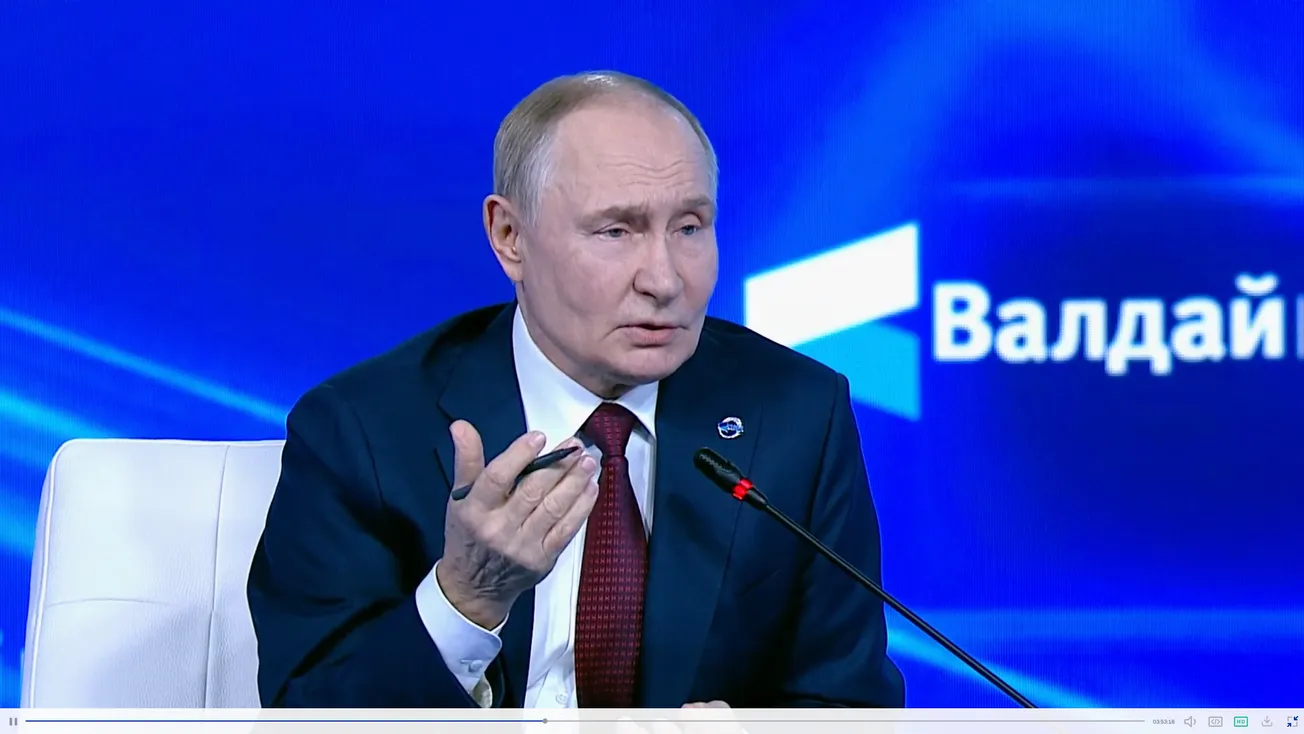

The questions to Russian President Vladimir Putin in the Oct. 2 plenary session of the Valdai Club Annual Discussion began with moderator Fyodor Lukyanov commenting that “a truly polycentric, multipolar world is still only beginning to be described,” because it “is so complex that we can only grasp parts of it, like in an old parable where everyone touches a part of the elephant and thinks it is the whole, but in reality it is just one part.”
Putin responded that the issue is not how to describe these new sets of relations, but how to put them into action. “These are not just words. I was speaking from practice. I am often faced with very specific issues that need to be addressed in one part of the world or another. In the past, during the Soviet Union, it was one bloc versus another: you agreed within your bloc, and off you went.
“I will be honest with you: more than once I have had to weigh a decision—to do this or that. But my next thought was: no, I can’t do that because it will affect someone; it would be better to do something else. But then: no, that would hurt someone else. That is the reality. Truth to tell, there were a few cases where I decided that we won’t do anything at all. Because the damage from acting would be greater than from simply showing restraint and patience.
“This is the reality of today. I did not invent anything—it is just how things are in real life, in practice.”
Later, he elaborated on the same principle, when explaining how new institutions, such as the Shanghai Cooperation Organization (SCO), the BRICS, and the different regional organizations came into being to replace the institutions of the post-war international order which had failed because of the attempt to impose a unipolar world order after the Soviet Union collapsed.
“There is and was no alternative to seeking consensus-based solutions,” Putin insisted. “We gradually came to realize that we needed to create institutions where issues are resolved not as our Western colleagues attempted to resolve them, but genuinely based on consensus, genuinely based on aligning positions.”
The SCO in 2001 grew out of “the need to regulate border relations between countries—former Soviet republics and the People’s Republic of China. It worked very well, indeed. We began expanding its scope of activity. And it took off! You see?”
So, too, with the BRICS. Russia, India, China agreed “that: a) we would meet; and b) we would expand this platform for our foreign ministers to work. And it took off. Why? Because all participants immediately saw, despite some rough edges between them, that it was a good platform overall—there was no desire to push oneself forward, to advance one’s own interests at any cost. Instead, everyone understood that balance must be sought.”
Brazil and South Africa then asked to join, and the BRICS emerged as “partners, united by a common idea of how to build relations to find mutually acceptable solutions…. The same began happening worldwide.”
The growing authority of these organizations, regional ones included, “is the key to ensuring that the new complex multipolar world nevertheless has a chance to be stable,” Putin argued.