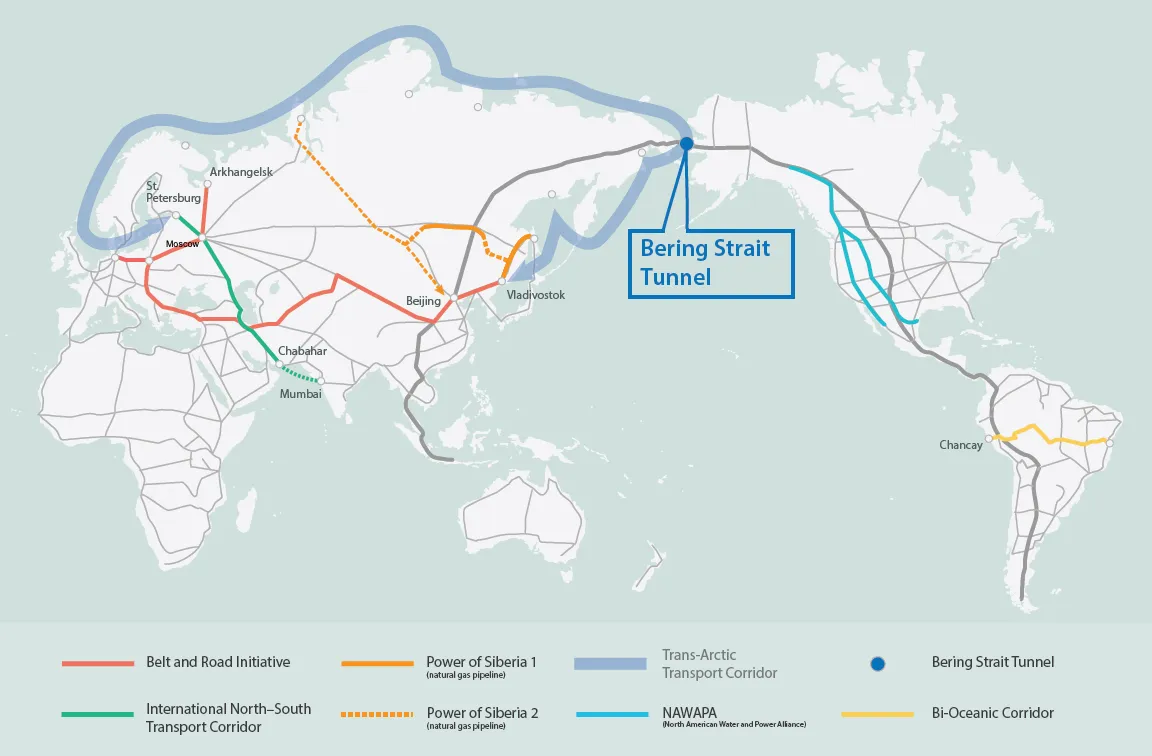
As the world veers toward either geopolitical division or the promise of cooperative development, the Bering Strait Tunnel stands as a potential bridge, not only between continents, but between civilizations. Joining Eurasia to the Americas through a Russia-Alaska connection has electrified the minds of thinkers for over a century, even receiving direct approval by Czar Nicholas II in 1906. The principles behind the Bering project transcend concrete, steel, and rails. It is a vision of peace through development: nations connected by purpose, not separated by rivalry.
The tunnel would anchor a World Land-Bridge, linking New York to Shanghai, Paris to Buenos Aires, Dakar to Moscow, by continuous rail and development corridors. And it could catalyze a moral revolution in international relations, replacing zero-sum competition with shared progress. The project, in conjunction with a global Glass-Steagall approach, would shift global investment toward productive development, reversing the deindustrialization now seen across much of Europe and North America.
In April 2007, several hundred people gathered in Moscow for a conference called “Megaprojects of Russia’s East: A Transcontinental Eurasia-America Transport Link via the Bering Strait.” Two Americans who had seriously promoted the project, former U.S. Secretary of the Interior and Governor of Alaska Walter J. Hickel and Lyndon LaRouche, who called for the crossing since no later than 1978, participated. Hickel addressed the conference in person, and Lyndon LaRouche’s written remarks were delivered by a spokesman in person. A report on the conference appears in the Spring/Summer 2007 issue of 21st Century Science & Technology.
As the idea re-enters public debate, (EIR) will be holding a seminar at 10 a.m. ET (14:00 UTC) on Oct. 22 with experts from the fields of engineering, economics, and diplomacy. Details available here.
Kirill Dmitriev’s viral call for creative engagement, Elon Musk’s remarks on the proximity of Alaska and Russia, along with renewed interest in earlier feasibility assessments by German tunnel builder firm Herrenknecht and the Chinese Academy of Engineering, have rekindled public enthusiasm. Herrenknecht, whose tunnel boring machines connected Europe and Asia through the Bosphorus (Eurasia Tunnel, opened in 2016)—confirmed that the project is “entirely feasible with today’s technology.” Coming from the firm currently responsible for Europe’s most ambitious tunneling projects, including the Brenner Base Tunnel and the planned Gibraltar link to Morocco, that judgment carries weight. But feasibility is no longer the most important question. What matters now is whether nations have the courage to act on it.
This discussion cannot stay confined to engineers, investors, and politicians. The Bering Strait Tunnel challenges us all to think differently about humanity overall: Our species is unique among life through our capacity to discover, build and connect, not to dominate.
In the same week that countries at the United Nations are reviving the fight to end colonialism in all its forms, and when German industry is calling for a new development partnership with Africa, the Bering project offers a concrete way forward.
The tunnel and development corridors are physical and moral infrastructure, a platform for building a truly human future.