
In the midst of a very fast moving and increasingly tense and dangerous global strategic situation, Helga Zepp-LaRouche focused her international webcast of Oct. 29 on the importance of the Oct. 25 address by Pope Leo XIV in which he singled out the revolutionary contributions of Cardinal Nicholas of Cusa, especially Cusa’s concept of the Coincidence of Opposites. In those Oct. 25 remarks to tens of thousands in St. Peter’s Square, the Pope said that Cusa lived in “another troubled age, the 15th century,” when “many of his contemporaries lived in fear, others took up arms…” but Cusa “believed in humanity. He understood that there are opposites which must be held together.”
“I think it is, in my view, probably the most important strategic intervention,” Zepp-LaRouche said, “because what the Pope does is he elevates the discussion to a plane where a solution is possible.”
Zepp-LaRouche, one of the foremost scholars of Cusa’s ideas, not merely in theory but in practice, highlighted Cusa’s method of the Coincidence of Opposites as “a method of thinking, how you [can avoid getting] get stuck in the nitty-gritties of this problem or that problem, but how you can train your mind to think the one. This is extremely important. The Pope applies it very clearly to the political situation, because, obviously, if you look at every conflict in the world today, if you look at the situation in the Middle East or Ukraine or the Caribbean, if you only look at the facts, the history of the crisis, the tensions and the personalities involved, you will never find an adequate solution. But if you start totally the other way around, if you think the one first, in this case the one humanity—that which unites us all—and then from that elevated point of view look at the concrete crisis, you can always find a solution…. You can apply that method to any problem, to politics, economics, military issues, social issues, cultural issues, because it is a way of conflict resolution which does exactly that: that the hope of synthesizing the next step of the evolution of the development of mankind, you can see something that does not exist but which can be brought about by people of good will by concerted efforts. So, this is a very beautiful intervention….”
Beautiful and timely. As was observed by Russian Foreign Minister Sergey Lavrov in remarks to the 3rd Minsk International Conference on Eurasian Security: “The militarization of European countries is gaining momentum: military-industrial funding is being increased, large-scale exercises are being conducted, and logistics for the transfer of troops to the ‘eastern front’ are being improved, utilizing the infrastructure of countries not part of the North Atlantic Alliance.” The logical ending of the policy of the NATO warmongers, infected with the ideology of geopolitics, is nuclear war. In the International Peace Coalition meeting of Oct. 24, Professor Ted Postol laid out in terrifyingly stark terms what would happen to the human population in the event of a nuclear war. The momentum of the current system must not be allowed to carry humanity toward such a final destination.
What must enter instead is a vision of a different kind of future for humankind, one cut from a completely different cloth than today’s failed system. Today, Oct. 30, President Donald Trump will meet with President Xi Jinping, a dialogue which the Chinese Foreign Ministry spokesman identified as decisive for relations between the two nations: “Heads-of-state diplomacy plays an irreplaceable role in providing strategic guidance for China-U.S. relations.” Such meetings between heads of state, as was seen in the August summit in Alaska between Presidents Trump and Vladimir Putin, can set processes in motion which are not a logical outgrowth of current policy.
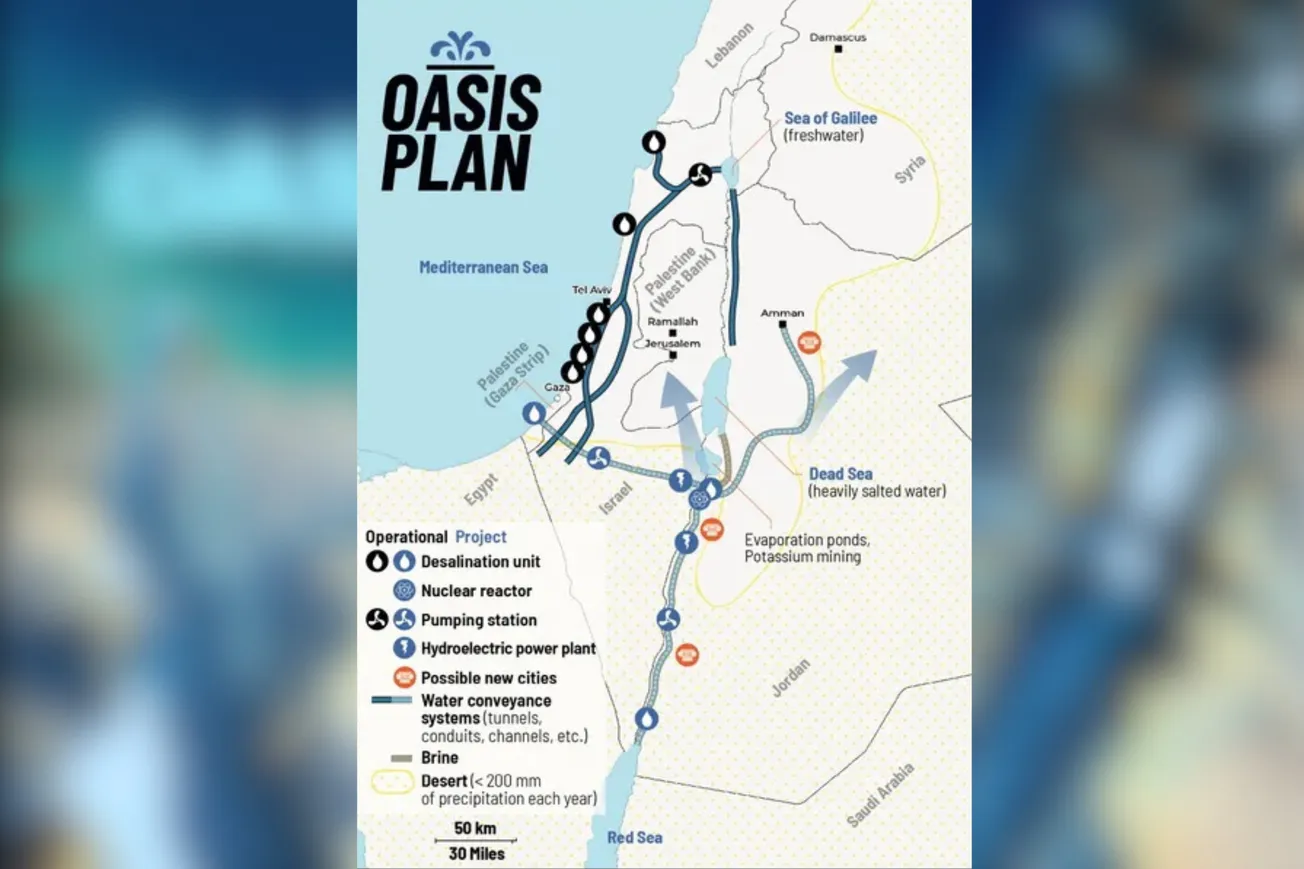
Civilizations collapse—or not—based on whether a culture, a people, is capable of discarding its flawed, sometimes tragic axioms of belief, and adopting a solution which was seemingly impossible before. Solutions are on the table. An agreement between Russia, China, and the United States to build the Bering Strait tunnel could fundamentally shift the strategic landscape and create an opening for lasting peace. The Oasis Plan, centered in Palestine and Israel, could provide a viable and beautiful future for the entire Southwest Asia region. We today must seize the opportunity of the strategic intervention of Cusa’s Coincidence of Opposites to shift the political dialogue to that higher “one,” the destiny of humankind over the next millennium—the higher plane on which the solutions to today’s extraordinarily perilous situation reside.