
EIR sponsored a Roundtable Discussion on Oct. 22 titled “The Bering Strait Tunnel Project Can Open a New Era of Peace Through Development,” with experts on engineering, rail development, finance, and diplomacy from the U.S., Russia, Italy, and Germany. The event was initiated by Helga Zepp-LaRouche, the Editor In Chief of EIR, who expressed her joy about the fact that the idea of this great project, for which she and her late husband, Lyndon H. LaRouche, have been deeply involved since the 1970s, has now re-emerged on the world scene, while Presidents Trump and Putin have scheduled to meet in the coming weeks. She said that the adoption of this project would mark a “new chapter in the history of mankind,” both in the enormous economic impact and in forging a peaceful connection between the U.S. and Russia, as well as others, at a moment of extreme danger of global war.
Zepp-LaRouche emphasized that the notion of “development corridors” is crucial here, as a means of connecting both nations and continents, while also provoking the development of less-developed regions of the world. She said that the question of “who pays” misses the point, that such huge infrastructure development pays for itself in such expanded development. In addition to the advantages of the project for the U.S. and Russia, nations and companies around the world can get involved in the enormous potential of developing the Russian Far East. She said that she has tremendous optimism that this project could happen and contribute to a new paradigm for the human race.
The first speaker was Scott Spencer, the Chief Project Advisor to the U.S. firm InterContinental Railway. He said that the signs of a potential end to the war in Ukraine will be benefitted by the launching of the Bering Strait Tunnel project, such that the joint development costs would be a fraction of the costs of that war. Russia, he said, is enthusiastic, as expressed by the multiple statements by Kirill Dmitriev, CEO of the Russian Direct Investment Fund, and by the fact that he, Spencer, has been called upon by the Russian news agency TASS, twice to discuss the project. He asserted that the project “will be built,” but the question is “by whom, and when?” This is a project which will bring “peace, progress and prosperity.” The costs could be $100-200 billion, but it would have a life of 150-200 years. He said that the U.S. and Russia would need to work closely together, and that we need an “Intercontinental Railroad Treaty.” His firm has created a video, “The Strait Guys,” which he encourages everyone to watch.
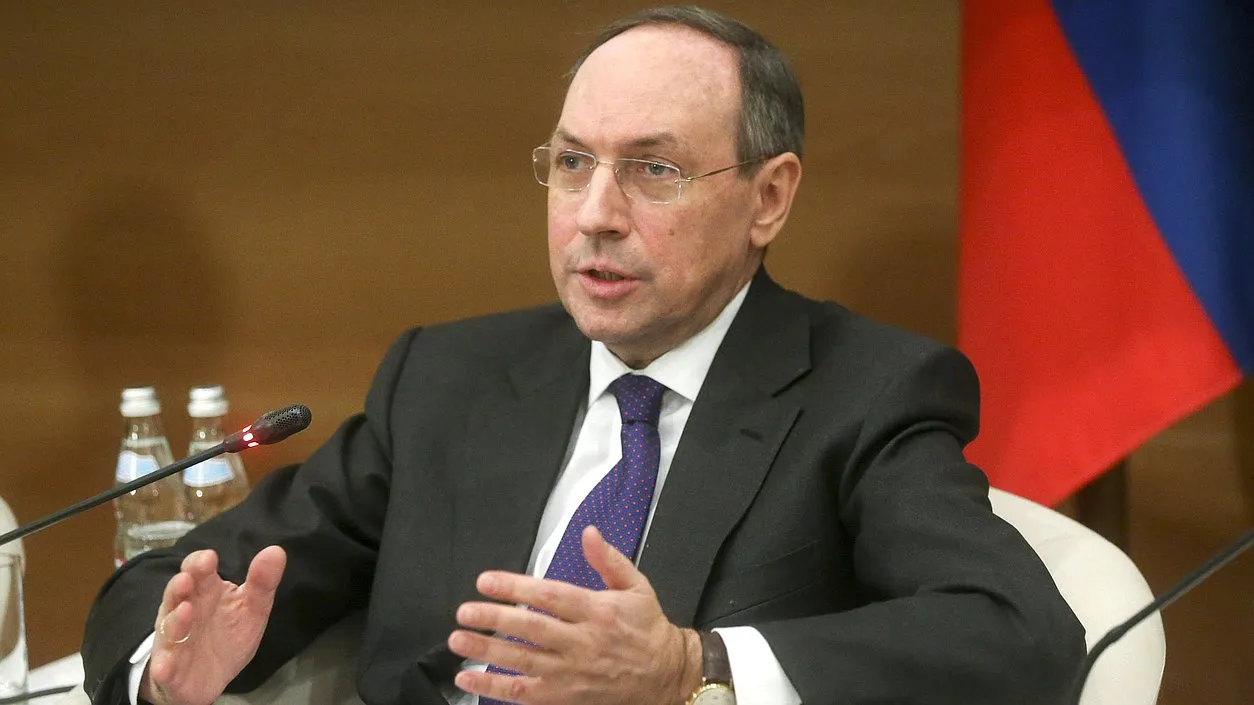
Dr. Victor Razbegin, a Russian economist and engineer, Vice-President, Chairman of the Russian Branch of the “Interhemispheric Bering Strait Tunnel & Railroad Group” (since 1993), and former Vice-Chairman of the Russian State Council for the Study of Productive Forces (SOPS), has studied and worked on the Bering Strait Tunnel concept for over 30 years. A significant number of studies and proposals are already completed, he said, including the substantial rail links required to Irkutsk in Russia, to China, and similar rail connections on the U.S. and Canadian side. The project would take about 10-15 years to complete, he said. He emphasized that the result of ending the intense crisis between the U.S. and Russia would be a primary result of this great project.
Zepp-LaRouche added that she and Lyndon LaRouche attended meetings on the Bering Strait Tunnel in Russia in 1996. A video of LaRouche speaking at a meeting at that time focused on the fact that the measure of progress must be man himself—the measure of man’s ability to transform nature, the increase in man’s power over nature, which can be calculated by the advance of life expectancy and the increase in productivity. The Bering Strait Tunnel, and the enhanced transportation capacity into Siberia and beyond to China, is crucial to this measure.
Azer Manedov, the First Deputy CEO of the Russian Direct Investment Fund (under CEO of the Fund Kirill Dmitriev, who has publicized the Bering Strait Tunnel plans), said that the idea has been under study for a long time. He said that he appreciated the role of EIR in organizing this event.
Italian Professor Enzo Siviero (Italy), Rector of the eCampus University and Vice-President of the Structural Engineering World Congress, and former Professor of Bridge Building at the University of Venice, said he was an expert on bridges, but that tunnels should be considered a type of underwater bridge, since they also connect nations and people, but also connect hearts. He spoke of love as a crucial aspect of the need for infrastructure development, connecting people’s hearts and minds, as well as the physical connection. This idea was picked up by others in the forum. He had been involved in the planning for the Messina Bridge, connecting the Italian mainland to Sicily with the world’s longest suspension bridge, and also had done planning for the Gibraltar to Africa Tunnel, emphasizing the importance of connecting to Africa, which will soon be the center of global development. Such great development projects, he added, require a “change in the mentality of the people.” He said he is a “bit of a poet, knowing that we must make dreams come true, and that the future belongs to us.”
Dr. Alexander Bobrov, the head of the Diplomatic Studies Division at the Institute of Strategic Studies in Russia, addressed the political and diplomatic issues of the Bering Strait Tunnel, that it is a symbol of cooperation between the U.S. and Russia. He pointed to the fact that the proposal for a “JFK-Khrushchev tunnel,” as it was called at the time, came immediately after the Cuban Missile Crisis, in which the world came close to global nuclear war, but was stopped through the diplomatic contacts between the U.S. and U.S.S.R. governments. He worried that the European leaders are trying to sabotage the diplomatic ties between Presidents Trump and Putin, while the Democratic Party in the U.S., which gave us the war in Ukraine under President Joe Biden, is trying to subvert the Trump-Putin meeting. He said that the debate over the Bering Strait Tunnel will also impact potential discussions on arms control, business investments, and concerns over terrorism.
In the discussion period, Scott Spencer noted that the U.S.-U.S.S.R. cooperation gave us the ISS space station, which cost $100 billion. It will be decommissioned in 2030, while the Bering Strait Tunnel will last for many generations.