
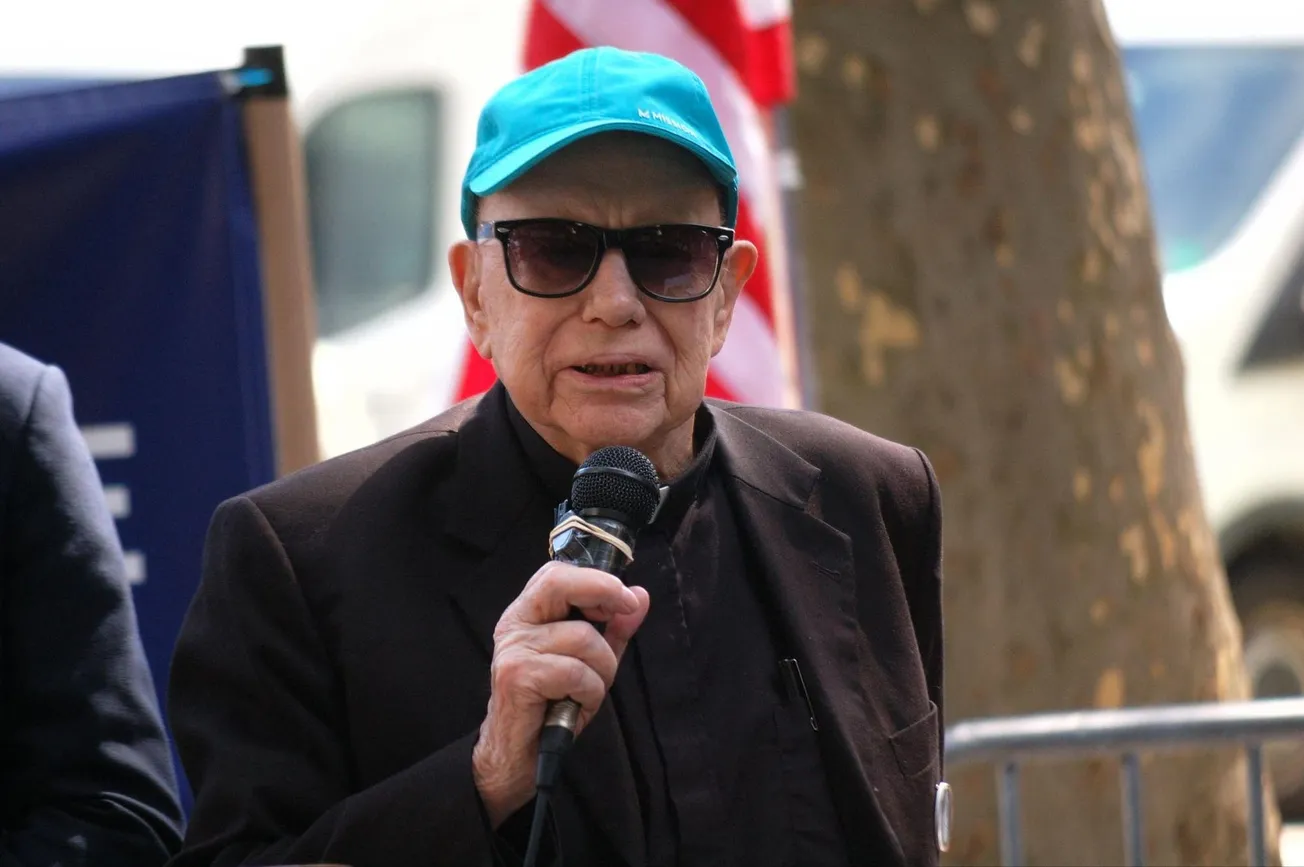
The following are excerpted remarks delivered by Father Harry Bury on Oct. 31 to the 126th consecutive weekly meeting of the International Peace Coalition. He was introduced by moderator Anastasia Battle, who noted that Father Bury has been a Catholic priest for some 70 years, is a lifelong peace activist, and a leader of Pax Christi.
Father Harry Bury: Thank you so much, Anastasia. I really feel honored and grateful that I have a chance to share with you and build upon what has been said today. It’s been really significant and helpful to most of us, and I hope the Schiller Institute continues to do what we’ve been doing every Friday morning. This is really significant, and it’s going to make a big change.
I’d like to build, if I can, on what Helga [Zepp-LaRouche] and you others have said. As she mentioned, last Saturday Pope Leo was celebrating the Jubilee of Education. So, the emphasis was on the intellectual life. Pope Leo spoke of Nicholas of Cusa in a most positive way. Nicholas of Cusa was a cardinal in the Church, when there were challenges like we are facing today, in Europe particularly. Nicholas of Cusa was a catalyst of the beginning Renaissance; and it’s my opinion that Nicholas of Cusa—it’s only opinion now, of course—but that Nicholas of Cusa was for the 15th Century what Lyndon LaRouche was and is for the 20th and 21st Centuries.
Lyndon LaRouche was also a renaissance man. Both he and Nicholas of Cusa were geniuses and contributed to the world’s intellectual, financial, and human development of us humans. Both believed in the unity of humanity; that we are all one. That means that what’s good for you needs to be good for me and vice versa, or it’s not any good.
Both believed in the unity of humanity; that we are all one and are united. So, both believed in the potential of humanity, and the goodness of humanity. Too many people today think that there are evil people in the world. Helga has pointed out many times, and the Schiller Institute has taught, that there are no evil people in the world; there are only good people who do evil things because they don’t know any better. That’s what Jesus said from the Cross. Of the very people who were crucifying him, he said, “Forgive them, Father, for they know not what they do.” If those soldiers who were crucifying Jesus knew he was the Son of God, they would never have crucified him. They didn’t know any better.
So, both Nicholas of Cusa and Lyndon LaRouche believed in humanity. They believed that the potential of humanity is to overcome life’s challenges. In this sense, they both were apostles of hope. Both presented new ways of thinking; new ways of perceiving reality. Both taught that humanity doesn’t know absolute truth; what we know is probability, and that’s why we keep discovering. Discovering more and more truth, but we never arrive. That’s why the intellectual life that Pope Leo was attempting to point out to us is so significant and important.
Both Nicholas of Cusa and Lyndon LaRouche believed in the significant potential of humanity; that we have the capability of making change for the better. As I say, they really are apostles of hope. Both presented new ways of thinking; new ways of perceiving reality. Both taught that no one knows absolute truth, so we can learn. We need to learn, and we have the capability of learning. That’s our challenge. We all are in the process of discovering truth, but we never arrive. So, nobody can be absolutely certain about what they think; not if they understand what Nicholas of Cusa and Lyndon LaRouche were saying. We can all learn; we can all grow; we can all change. There is hope for the human race.
Both of them encouraged people to think outside the box; to think differently. And so, they had enemies. The enemies spoke up and convinced people that Nicholas of Cusa, a cardinal, was really not a good person. They slandered him. So, he never was canonized a saint by the Church. And Lyndon LaRouche experienced the same thing. He was slandered and they lied about him. It led people to believe that he was evil. So, he went to prison. They both suffered a great deal, but they weren’t discouraged. Despite what they went through, both of them had hope. Both of them saw that humanity could make changes for the good. So, they bring hope to the world, and we’re to carry that on now—what both Nicholas of Cusa and Lyndon LaRouche have passed on. It’s our opportunity; it’s the grace of God for us to follow in their footsteps and think and come up with ways of contributing to the peace of this world. We can do it! That’s what both of them said; we can do it. We, humanity, can do it.
So, let’s do it! Let’s be peacemakers like Cardinal Nicholas of Cusa and the dear friend of many of you, Lyndon LaRouche. They can be our inspiration; they can increase our hope. And that’s what I perceive and expect to see happening; because of them, and also because of you, all of you. We’re going to make a difference. We are making a difference. We are not discouraged; we are filled with hope. Thank you very much.
Helga Zepp-LaRouche: I just want to thank you, Father Bury. In my view, the speech you just gave is probably one of the most important speeches ever given in the history of the United States. Thank you very much.