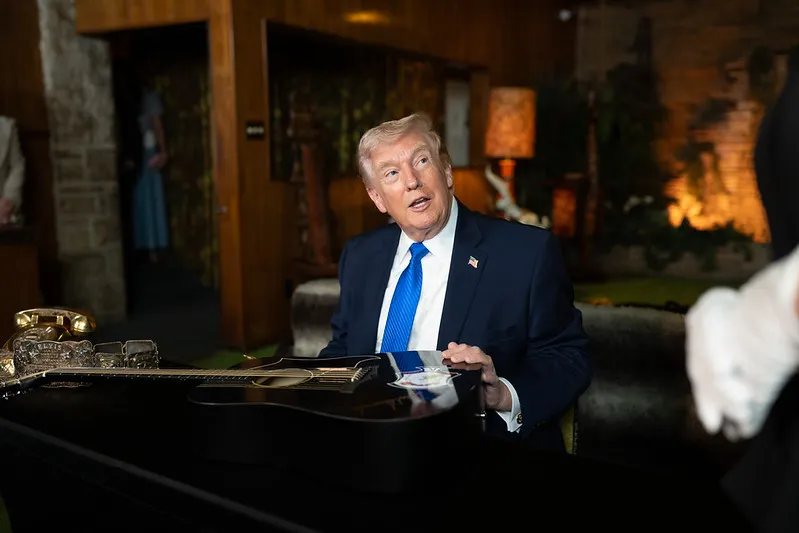
Less than a half-hour after U.S. President Donald Trump announced on Nov. 25 that the next step in his peace effort would involve sending Special Envoy Steve Witkoff to Moscow and the Secretary of the Army Dan Driscoll to Kiev, Bloomberg dropped the “Russiagate 2.0” bomb on the White House. Trump had just blown to smithereens that great hope of the “Coalition of the Willing” war party, to have a Zelenskyy-Yermak transformation of Trump’s 28-point peace plan be the basis for Zelenskyy and Trump to work from, with an imminent visit to the White House by Zelenskyy. Trump instead stated his refusal to meet with Zelenskyy. Further, he seems to have deliberately chosen tough-talking Driscoll to deal with Kiev, rather than his Secretary of State Marco Rubio. Last week, Driscoll had reportedly beat Kiev over the head regarding the reality on the front lines, while Rubio had allowed Kiev to trash any hope for an actual settlement. Perhaps it is all a coincidence of timing, but the distinct impression is that if Trump had endorsed the Zelenskyy-Rubio path, Bloomberg would have kept their ammunition dry.
Bloomberg claims they have recordings of an Oct. 14 conversation between Wittkof and Yuri Ushakov, Putin’s top adviser, and of an Oct. 29 conversation between Ushakov and Kirill Dmitriev, Witkoff’s negotiating counterpart. They published what they claim is an accurate transcript of the first recording, in which Ushakov suggested Putin and Trump talk and Witkoff suggested how Putin should butter up Trump with praise for the 20-point Gaza Peace plan. Witkoff suggests a similar 20-point program for settling the Ukraine conflict. Then Witkoff suggests the two presidents talk before Trump meets with Zelenskyy on Oct.17. The Russiagate 2.0 narrative is that the Trump-Putin call on Oct. 16, the Witkoff extended negotiations in Florida the next week, and the present 28-point plan are all the fruit of devious Russian manipulation, with Witkoff serving as either a dupe or a witting agent of Moscow.
Last night, on Air Force One, when reporters confronted Trump with the “gotcha” moment, he found the supposed scandal to be a “nothingburger.” He dismissed it, saying: “That’s a standard thing. He’s got to sell this to Ukraine, he’s got to sell Ukraine to Russia. That’s what a dealmaker does.... I haven’t heard it, but I heard it was standard negotiation. And I would imagine he’s saying the same thing to Ukraine, because each party has to give and take.”
Dmitriev simply posted a one-word rebuttal, “fake,” while Ushakov, speaking to a Russian state media interviewer, said that he “often speaks” with Witkoff and suggested that the publication aimed to hinder improving U.S.-Russia relations. Asked whether the transcript was accurate, he said: “The substance of the conversations is confidential; I won’t comment. No one should comment.” Asked where journalists got the information, Ushakov replied: “Someone’s leaking, someone’s eavesdropping—but not us.”
Kremlin spokesman Dmitry Peskov said on Nov. 26: “First of all, there is nothing particularly alarming about this…. Probably, the calls advocating for Witkoff’s dismissal are primarily aimed at sabotaging the ongoing efforts for a peace resolution.” He added: “Of course, many people will stop at nothing in attempts to disrupt this process.” And Deputy Foreign Minister Sergei Ryabkov stated: “Now is precisely the time, the moment when we must not succumb to provocations.... Over the past few days, we have seen numerous information leaks, attacks, and assaults through the U.K. media and social networks on the very idea of reaching an agreement, an agreement that would address the root causes of this conflict.”
Russia’s Foreign Intelligence Service had only stated the morning of Nov. 25 that the U.K. was preparing to “bring down Trump’s mood for resolving the conflict” with a fake narrative of a Russian plot to manipulate Trump, along the lines of the “fake ‘dossiers’ of former British intelligence officer [Christopher] Steele.”
One example from the Bloomberg version has Witkoff telling Ushakov: “Now, me to you, I know what it’s going to take to get a peace deal done: Donetsk and maybe a land swap somewhere.” This is meant to suggest that Russia’s insistence upon ending NATO’s advance upon their borders and a first-strike nuclear war is just talking points so as to settle for grabbing the Donetsk region. However, were Witkoff to think this, he would never say it. But, in fact, Witkoff knows full well that Moscow is dead serious, not about grabbing land, but about ending the untenable situation they have faced for at least two decades.
Today’s coverage of the Bloomberg “leak” in Meduza provided a good example of the spinoff “Moscow Fooled Trump” narrative. They explained: “After speaking with Putin on Oct. 16, Trump announced: ‘President Putin congratulated me and the United States on the Great Accomplishment of Peace in the Middle East.’ Ushakov himself later told reporters that Putin ‘opened the conversation by congratulating Donald Trump on his success in helping stabilize the situation in Gaza.’ After that call, Witkoff met in the United States with Russian Direct Investment Fund CEO Kirill Dmitriev. (Dmitriev confirmed that he spent three days in Miami starting on Oct. 24.) On Oct. 29, Dmitriev and Ushakov spoke by phone and discussed how forcefully Moscow should press its demands in a prospective peace deal, according to another recording reviewed by Bloomberg.”
Expect the next transcript out imminently if Trump doesn’t take seriously Russiagate 2.0.