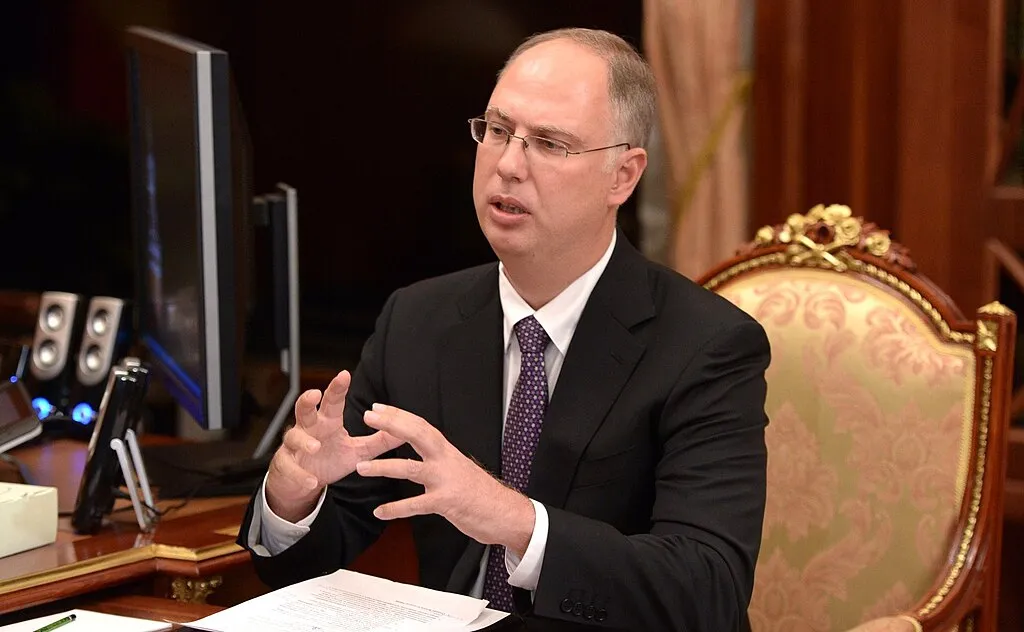
Ukraine’s acting president, Volodymyr Zelenskyy, on Nov. 9 imposed sanctions on Kirill Dmitriev, the head of the Russian Direct Investment Fund and the Special Envoy whom Russian President Vladimir Putin has deployed to negotiate with Washington. Among Dmitriev’s recent initiatives is his proposal and advocacy for the “Trump-Putin Tunnel” to connect the U.S. and Russia across the Bering Sea. U.S. President Donald Trump took note of that Bering Strait Tunnel Project, much to Zelenskyy’s dislike.
Zelenskyy signed on to a decision by his National Security and Defense Council which identified eight individuals “involved in crimes against Ukraine and Ukrainians”—including “those who ... conduct information operations against our state” and those who “introduce Russian educational standards with anti-Ukrainian narratives in the temporarily occupied territories of Ukraine.” (The latter involved imposing sanctions, calling for a banning of the books of five Russian publication houses that are publishing educational material for Crimea and the other four regions that voted to re-join Russia.) One of the eight involved in crimes, according to Zelenskyy’s proclamation, is “Kirill Dmitriev, a close associate of the Russian leader involved in spreading propaganda and attracting Russian investments into key sectors of foreign economies, as well as individuals who justify Russia’s armed aggression.”
The charge of “spreading propaganda” is a well-used, very broad one, for anyone who says anything publicly with which Kiev doesn’t agree. The other, “attracting Russian investments into sectors of foreign economies,” not only wasn’t listed as a crime by the NSDC, but it seems new, and as of now unique to the case of Dmitriev. It seems clear that the Bering Strait proposal, inclusive of the joint U.S.-Russian development of both Siberian (energy and mineral) resources and the Arctic region, has struck a chord—and not a pleasant one for Kiev and its geopolitical partners amongst Europe’s de-industrialization party.
The NSDC’s Center for Countering Disinformation (CCD) had taken offense to Dmitriev’s Oct. 24-26 three-day trip to Washington, and his meeting with White House officials from U.S. Special Envoy Steve Witkoff’s team. The CCD’s “Information Threat Forecast for Beginning of November 2025” (which refuses to use capitalization when referring to Russian proper names, places, etc.) in warning of Russian attempts to convince the U.S. that Europe’s “Coalition of the Willing” was against a peaceful settlement, stated:
“Part of this campaign was the visit of kirill dmitriev, head of the russian direct investment fund, to the U.S., which propaganda will attempt to present as a supposed continuation of ‘constructive dialogue’ between moscow and washington. russian media portray this visit as a ‘peace mission’ and a ‘diplomatic breakthrough’ intended to demonstrate the kremlin’s readiness to negotiate, although in reality dmitriev held no significant meetings and his trip effectively ended in failure. russian propaganda nonetheless seeks to use the visit to create the illusion that the U.S. supposedly ‘acknowledges’ the need for direct dialogue with moscow. In this way the kremlin intends to hide diplomatic isolation, shift responsibility for the collapse of talks off itself, and advance the narrative that only russia stands ‘for peace,’ while the West ‘sabotages agreements.’”