Luiz Inácio Lula da Silva, President of South America’s largest nation, Brazil, has warned his U.S. counterpart that wars start easily, but no one knows how they will end. Lula was asked by reporters after the G20 Summit on Nov. 23, if he was worried about the danger of a military conflict in the Caribbean, given the U.S. military forces assembling off the coast of Venezuela. “Very concerned,” Lula replied, “and I intend to talk to President Trump about it.”
“South America is considered a zone of peace. We are a continent that has no nuclear weapons, no atomic bombs, nothing. Our business there is to work to develop and grow,” he said. “Brazil has a responsibility in South America. Brazil borders Venezuela, and that is no small thing. I think it makes no sense to have a war now.” U.S. President Donald Trump should not “repeat the mistake that happened in the war between Russia and Ukraine. In other words, to start, all it takes is one shot. To finish, no one knows how it will end. So it’s important that we try to find a solution before we start.”
U.S. military dominance in the Caribbean continues to build. Joint Chiefs Chairman Gen. Dan Caine visited Trinidad and Tobago on Nov. 25; Prime Minister Kamla Persad-Bissessar assured reporters after they met, with little credibility, that Venezuela was not discussed.
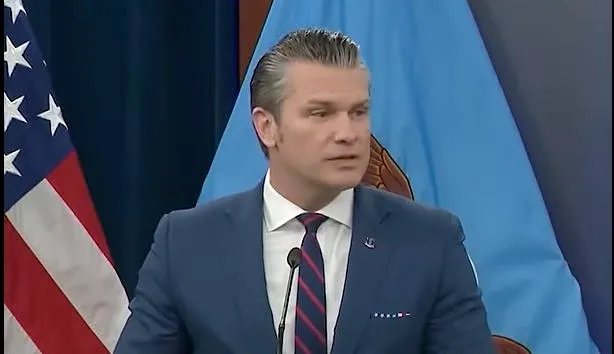
On Nov. 26, Secretary “of War” Pete Hegseth extracted approval from Dominican Republic President Luis Abinader for the U.S. military to operate out of the country’s international airport and one of its two airbases. Abinader called the agreement “technical, limited, and temporary,” in their joint press conference at which no questions were allowed. Permitting U.S. military forces to operate out of the Dominican Republic again is not a popular move. The United States invaded and occupied the D.R. twice in the last century (1916-1924 and 1965-1966).
Meanwhile, President Trump continues to play games as to his intentions. On Nov. 25, Trump said he “might” talk to Venezuelan President Nicolás Maduro. Two days later, on Thanksgiving, he told U.S. servicemen that strikes on land against “Venezuelan drug traffickers … [are] going to start very soon,” asserting that land operations are “easier.”
Today, citing “multiple people” as their source, the New York Times reported that Trump had spoken by phone with Maduro at the end of last week, with Secretary of State Marco Rubio on the line, to discuss “a possible meeting” between Trump and Maduro which would take place “in the United States.”
Maduro is no fool. Why should he visit the United States where he faces an indictment issued in 2020 on hoked-up drug-trafficking charges? Furthermore, Rubio had announced in advance that as of Nov. 24, the State Department’s designation of the (non-existent) “Cartel de los Soles” as a “Foreign Terrorist Organization” would go into effect, with all the legal implications that entails, and the U.S. asserts (without proof) that Maduro heads that (non-existent) cartel.