The following are the slightly edited remarks by EIR Ibero-American Editor Dennis Small to the Nov. 20, 2025 EIR Emergency Roundtable, “President Trump: Don’t Do It! An Alternative American Policy for the Caribbean,” which will also appear in an upcoming issue of EIR magazine.
We need to propose a positive policy of what’s required for the Caribbean, because it is not enough to simply say: “President Trump, don’t do it!” We have to say what should be done as well.
But before that, let’s just be clear: This does not have anything to do with drugs. Drugs is a $1 trillion yearly business run by an international cartel which we have called Dope, Inc. It’s not the Cali cartel; it’s not the Sinaloa cartel. It is the City of London and the Wall Street financial cartel, and It’s a $1 trillion a year business. It’s the major banks. If you want to stop drugs, you have to stop drug money laundering, which is at the heart of the whole thing.
Secondly, some basic facts. The quantity of drugs that flow from Venezuela into the U.S. are not the problem. This is a map (see Fig. 1) produced in 2019 by the UNODC, the United Nations Organization for Drugs and Crime, which is the international grouping following the drug trade. DEA statistics indicate the same thing. Looking at the trafficking of cocaine, which is the main drug trafficked from the Andean countries to the United States, 74% went through the eastern Pacific vector into Mexico, and a very small percentage, 8%, went from Venezuela. Do some drugs leave from Venezuela? Of course; there’s not a country in the world where this doesn’t happen. But that is not the center of the problem. In case you think that this is an old map, the latest one from the UNODC, from 2024, indicates the same (see Fig. 2).
So it’s nonsense to talk about the drug problem in that way, centered on Venezuela.
Secondly, most of the drugs do not enter the United States by illegal migrants swimming across the Rio Grand or by fast boats dashing across the Caribbean. It’s not true. According to the DEA’s own statistics and the CBP (Customs and Border Patrol), 90% of the heroin seized coming into the United States, 88% of the cocaine seized coming into the United States, and 84% of the seized methamphetamine coming into the United States comes across the official border crossings, the Ports of Entry, in tractor-trailers, in buses, in trucks, in cars, in big rigs. Those are the official numbers from the DEA and the CBP itself.
So, the real issue in Venezuela is certainly not drugs.
I would also like to say that I don’t think that the issue is primarily oil. It is an issue, but it’s a secondary issue. The financial Establishment definitely would like to have control of Venezuela’s oil, not even so much to use it, but to securitize it as the basis for a new financial bubble. And the best example of that was stated explicitly by Maria Corina Machado, the so-called Nobel Peace Prize winner who is slated, if there is an invasion and Marco Rubio has his way, to be the next president of Venezuela. She stated in a Nov. 19 article in The Economist magazine of London: Hey, we have $1.7 trillion of wealth in Venezuela that could help you guys over a 15-year period. And this has already led to a rally of Venezuelan bonds on the international markets, with the expectation that the USS Gerald R. Ford aircraft carrier will help bail out the crashing bond market. That’s where the oil question really lies.
The Real Issue: Stopping China’s Belt and Road Initiative
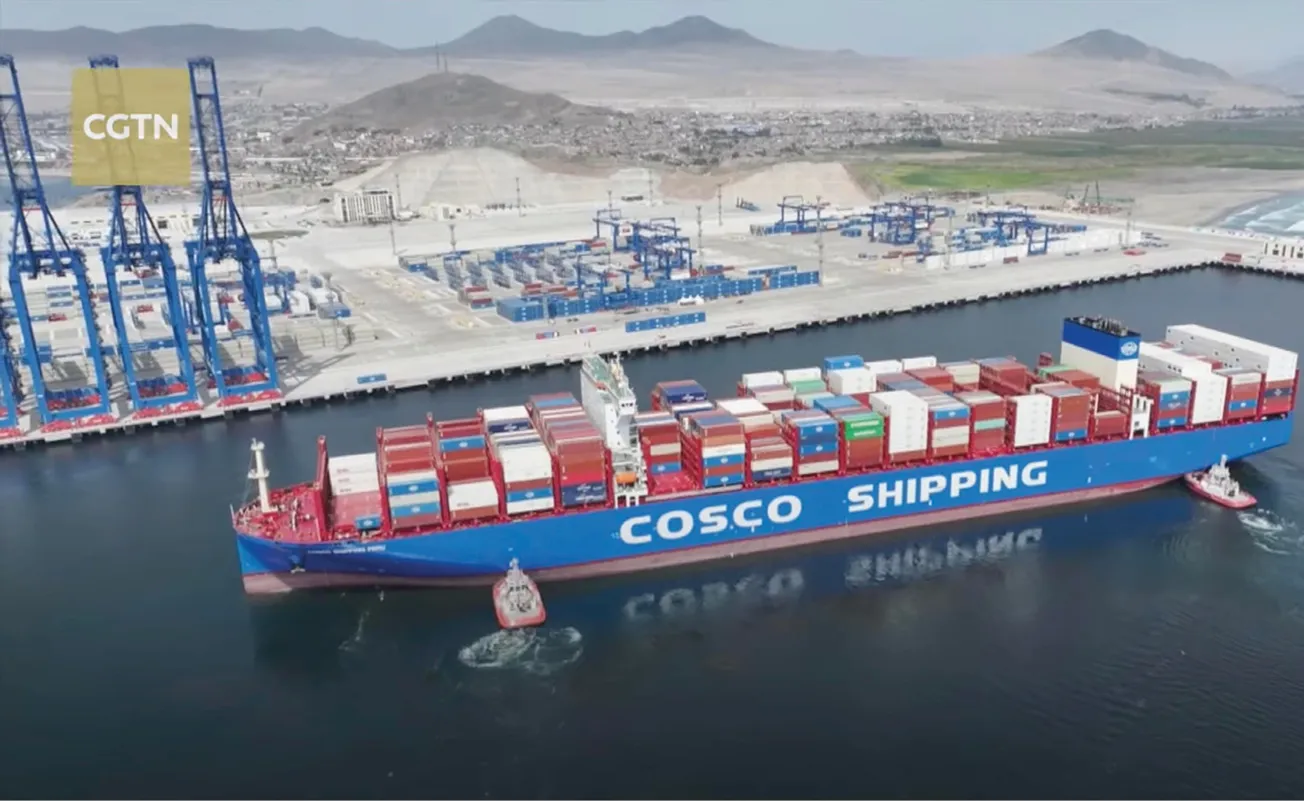
So, what is the real issue here? The real issue is not what is happening in Venezuela, but what’s happening about 1,675 miles to the south of Caracas, or some 2,700 km: The construction of the Chancay port in Peru by China and Peru working together, which is the most modern mega-port on the entire Pacific coast of the Americas, Long Beach included, which can handle the very largest of container ships in the world, in the range of 24,000 TEUs. The distance and the cost of direct shipping now from Peru (and through that, the rest of South America) over to Shanghai in China has now been reduced by 10 to 15% (see Fig. 3).
For the Chancay port to function fully, the construction of a bi-oceanic rail corridor running across the South American landmass, from the Atlantic to the Pacific, is needed. One of the main routes under discussion would run from the Brazilian port of Ilhéus on the Atlantic, across the Amazon region, and on to Chancay on the Pacific, which would open up the entire interior of South America to industrial development and trade with Asia.
These kinds of infrastructure projects are what the BRICS is talking about. They are what the Belt and Road Initiative is building. This is what every single country in South America, and their populations, urgently need. And it is not a threat to the United States, nor should it be conceived as such. And yet the reaction coming from policymakers in the neoconservative crowd in Washington, and in London in particular, is one of absolute terror and fear.
There are statements coming from Foreign Affairs of the Council on Foreign Relations; from Admiral Holsey of the U.S. Southern Command; from Laura Richardson, the former head of SOUTHCOM; from Evan Ellis of the National Defense University; from experts of the Atlantic Council. They all say the U.S. strategic objective in the region is that China must be expelled from the Western Hemisphere, because China constitutes a war danger to the United States. That is the actual issue at stake in Venezuela.
So what needs to be done?
Caribbean Basin Belt and Road
Let’s look back up northwards by 1,675 miles, and focus on what the potential is of the Caribbean Basin. We only have time to a bare sketch of the potential here, but let’s consider three aspects of this map (see Fig. 4), which EIR produced a few years ago to show what the possibilities are for cooperation and development in the Caribbean Basin—including Venezuela, Brazil, Guyana, Cuba, Mexico, and it definitely includes the United States of America.
First, let’s look at the railroads. The green lines indicate rail lines that exist today. Many of them are pretty shabby, but they do exist. The red lines are proposed lines to be constructed: rail connections across the entire northern route of South America, connecting from Brazil through French Guiana, through Surinam into Guyana, then into Venezuela and across the Darien Gap. The Chinese have already proposed to build high-speed rail lines through Panama, and then all the way up through Central America into Mexico, across the United States, Canada, and then through the Bering Strait tunnel, which is in fact the centerpiece of what a proper relationship should be between the United States and Russia—as was raised around the Alaska summit between Presidents Trump and Putin. Massive rail reconstruction is needed in the United States as well; we have to get back to our own industrial reconstruction.
Second, look at the blue dotted lines: These are the maritime sea routes of the Silk Road. What needs to be done is increase maritime cargo not only through the Panama Canal, which has been expanded, but also by construction the Nicaraguan Grand Canal, a sea-level canal that is absolutely necessary for expanded trade. This will help build up the entire region, along with the railroads, so that the population in these areas, like Central America and Mexico, can have development and lead a decent life. We can end poverty, so that they’re not driven into the waiting arms of the drug trade—which is run by the big Wall Street banks—and so they have no need to migrate.
If you want to stop migration, if you want to stop the drug problem, which are very real problems in the United States, then develop the Caribbean Basin region, bring industrial development to the region. And for that, these maritime sea routes are extremely important.
You will notice that one such sea route is drawn from São Luís in Brazil, which is important because that’s near the Carajás iron ore mine in Brazil, one of the biggest in the world. We also propose to develop major deep-water industrial ports in Ponce, Puerto Rico, where there are already plans for the same. This would be very advantageous for the United States, since Puerto Rico is part of the U.S., and there could be trans-shipment of cargo to Gulf Coast ports such as New Orleans and to Atlantic Coast ports in the U.S. A similar deep-water industrial port should be developed in Mariel, Cuba, which has been proposed in detail by the Cuban government as part of an entire development plan for Cuba. We urge that another major port be built at Fort-Liberté on the northern coast of Haiti to help save that country from the Gaza-like process of devastation which it has been enduring for decades, if not centuries.
Science-Driven Development
The third and final element I want to point out for the development of the Caribbean Basin is where you see stars on the map. One is in Alcântara in Brazil and the second is in Kourou in French Guiana. These are space launch centers: Kourou is the center used by the European Union, and Alcântara is the location in Brazil where its space science is centered—although it is much diminished of late. These centers must be revived and developed with the most advanced technologies for the purpose of training and developing a skilled labor force for the entire region.
The labor force of the Caribbean Basin and South America must not simply produce raw materials for export, functioning as slave labor to generate foreign with which the foreign debt is then paid. They can and must achieve maximum development, with a standard of living worthy of human beings and where you can have advanced science and technology available to the entire population.
I end by emphasizing one central point. President Trump, not only “don’t do that” regarding an attack on Venezuela. What you should do is implement this policy, one where the United States works with China and with Russia, where the United States works with the approach presented by the American Pope, Leo XIV, in his recent discussion of Nicholas of Cusa. The U.S. should return to working with the sovereign nations of Ibero-America, and in that way return to its own true roots of the American Revolution against the British colonial policy. If we do that, we will find throughout the world cheering support and cooperation. The only unhappy people will be the Wall Street crowd, the City of London crowd, the people who are actually behind the Jeffrey Epstein operation.
………..
The Monroe Doctrine vs. the Roosevelt Corollary
In the discussion period of the EIR roundtable, Small responded to a comment about the Monroe Doctrine:
A number of people have asked, including in the chat here: “Are they really that crazy to do something like this, to attack Venezuela?” The answer is that that’s not the correct question. The proper question is: “Are they that desperate?” And I think the answer to that question is: Yes. I’m not forecasting that there will be an invasion of Venezuela. I’m simply saying the international financial Establishment is extraordinarily desperate because they are facing the bankruptcy collapse of the entire transatlantic financial system, with its $2 quadrillion of derivatives and other speculative assets. People always ask: “How much is that?” It’s a 2, followed by 15 zeros. It’s a lot. It can’t be paid. It’s a speculative bubble. Everything they’re doing is designed to try to maintain that system.
Back in 2012, the U.S. Senate Permanent Subcommittee on Investigations released a 335-page case history report on a bank called HSBC, formerly the HongKong and Shanghai Banking Corporation, and they documented that they had been involved up to their eyeballs in laundering drug money from the Sinaloa cartel.
That’s just a small part of it. The entire financial system is addicted to drug money, as Antonio Maria Costa, the former head of the UNODC said, as have others. In fact, when Obama’s Attorney General, Eric Holder, was asked about this, asked why don’t you impose serious sanctions on these drug banks? Holder responded in a written letter to congressmen: No, we can’t do that or the entire financial system would come crashing down. That’s known as the Holder Doctrine or the Holder Letter.
They cannot go after this, because their system depends on it. They not only can’t go after it, they don’t want to go after it. The invasion of Panama in 1999 is often mentioned as an example of how easy it would supposedly be to decapitate the Venezuelan government and put in a head of state, as they did with Panama. People might want to recall that when Manuel Noriega was removed by Bush—who, by the way, is one of the role models of Secretary of State Marco Rubio—the person who they put in to replace him as President of Panama was Guillermo Endara. Endara named as prominent members of his cabinet three individuals who sat on the board of directors of First Interamericas Bank, owned by Cali Cartel chief Gilberto Rodríguez Orejuela. Endara himself was a business partner of Carlos Eleta Almarán, a leader of Panama’s former opposition who was caught red-handed in the dope trade.
So the president who was installed in Panama after the U.S. invasion was in bed with drug runners—and they knew it. In fact, it is arguably the case that that’s why they did it. So it’s not a question of “are they that crazy”; they are. But more importantly, they are that desperate because their financial system is thoroughly bankrupt.
Now I have to take up one other point, which is the issue of the Monroe Doctrine. I think people, especially in Ibero-America, but also in the United States, should be more precise, because what they are referring to, or should be referring to, is the Roosevelt Corollary to the Monroe Doctrine. That is, the so-called Teddy Roosevelt Corollary to the Monroe Doctrine, which was declared in 1905 by President Teddy Roosevelt to justify military intervention throughout the region.
The original Monroe Doctrine was the exact opposite. And I am addressing this because it is not only historically important, but also because it is crucial to understand the nature of the United States and the possibilities for changing current policy.
The Monroe Doctrine was not written by President James Monroe in 1823; It was written by his Secretary of State John Quincy Adams, who went on to become the sixth President of the United States. John Quincy Adams was, among other things, one of the most avid opponents of slavery, whose yearly speeches in Congress against slavery in the middle of the 19th century became one of the bedrocks of Abraham Lincoln’s later Emancipation Proclamation of 1863. Quincy Adams is also famous for saying that the U.S. “goes not abroad in search of monsters to destroy,” and that if she did that “she might become the dictatress of the world. She would be no longer the ruler of her own spirit.”
What Monroe, through John Quincy Adams, was saying in 1823 is that British colonialism must be expelled from the Americas, and the nations of the region had the right to sovereignty and their own defense. That was John Quincy Adams’ policy.
The most significant first time the actual Monroe Doctrine was applied—and I’ll bet most people in this meeting don’t know this—was in 1865 in defense of Benito Juárez in Mexico against the French-imposed Emperor Maxmilian of Hapsburg. And it was applied by President Andrew Johnson right after Lincoln had been assassinated, but he was acting in the Lincoln tradition. It was used to defend Mexico and its besieged President against a foreign invasion.
So I agree with the criticisms of the policy of the Big Stick. But let’s call it by its proper name of the Roosevelt Corollary, because the opposite policy of John Quincy Adams is precisely the policy which the United States should return to today.