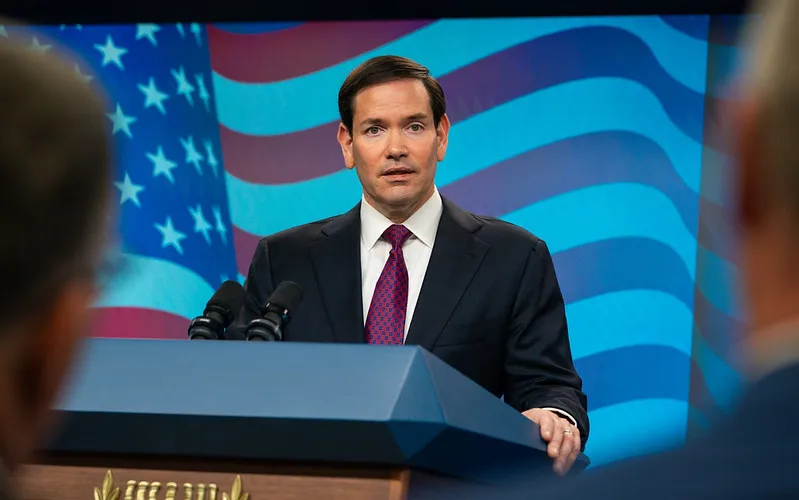
U.S. Secretary of State Marco Rubio has reportedly hatched plans to “encircle” Brazil and limit President Lula da Silva’s clout as a regional leader, for which Rubio has enlisted Argentina’s lunatic President Javier Milei. Milei is seen as such an asset that Deputy Secretary of State Christopher Landau now refers to the Argentine as a “hemispheric rockstar,” predicting that with new Bolivian President Rodrigo Paz Pereira, the “United States and Argentina can work together to help countries like Bolivia forge a new path,” the daily El Destape [reported Oct. 10.]
During Milei’s last bilateral meeting with U.S. President Donald Trump, Rubio reportedly gave him the mission of consolidating the network of right-wing Ibero-American Presidents—Daniel Noboa of Ecuador, Santiago Peña of Paraguay, with the goal of enlisting Paz Pereira, and hoping for an electoral victory by Chile’s ultra-rightwing candidate José Antonio Kast in the Nov. 16 elections. As Paz Pereira is still something of a question mark, the squeeze is on to pin down his pro-U.S. loyalties. Rubio’s plan, of course, ignores such realities as Paraguay’s close economic and trade ties with Brazil and the two nations’ relationship within the Mercosur bloc. The whole region is in economic and political turbulence and polarization as well, with a possible U.S. invasion or other armed attack against Venezuela looming.
Paz Pereira was inaugurated just on Nov. 8, and Milei was apparently a star of the affair, receiving wild applause at the inaugural ceremony itself. But whatever else he is, Paz is not another Milei, and he has stated that he’s not only not interested in picking a fight with Lula, but rather wants to work with him, especially as part of Mercosur. According to the Bolivian daily El País, during the campaign, Paz referenced Brazil’s role as an international leader, not only as Bolivia’s “historic and strategic partner,” but also as a key leader within the BRICS. Lula has already invited Paz to visit Brazil for further discussion on deepening their bilateral relationship.
Paz, who was the candidate of the Christian Democratic party, claims that he wants Bolivia to “open to the world,” but emphasizes that his foreign policy will be “pragmatic” and not one of automatic alignment. China is Bolivia’s main trade partner, and Paz has already had a friendly meeting with the Chinese ambassador. The leverage the U.S. has here is on the Bolivian economy, which is in dire straits, with severe shortages of fuel and dollars, plus high inflation. Paz is desperate to address those problems. For the inauguration, Washington deployed big guns: a 10-person delegation led by Christopher Landau, also including the head of the U.S. Exim Bank, the head of the Development Finance Corporation, and a top advisor to U.S. Treasury Secretary Scott Bessent. During Paz’s first trip to Washington, he met with Rubio, not with Trump, and then held talks with the IMF, Inter-American Development Bank, and other multilateral lenders. He’s open to making a deal with the IMF.
The U.S. is emphasizing the need to “stabilize” Bolivia’s economy, claiming that it has suffered terribly from “20 years of mismanagement” under former Presidents Evo Morales and Luis Arce. Bolivia has never had “the development it deserves,” Landau intoned. This is false. As EIR has documented in detail, under Evo Morales Bolivia was transformed from the poorest nation in Ibero-America to one of the fastest growing, with impressive rates of poverty reduction, development of high-technology, nuclear power, and even discussion of developing fusion power. This was done in collaboration with Russia and with China’s Belt and Road Initiative. See EIR “Bolivia Sets Its Sights on Fusion Energy and Reducing Poverty!”