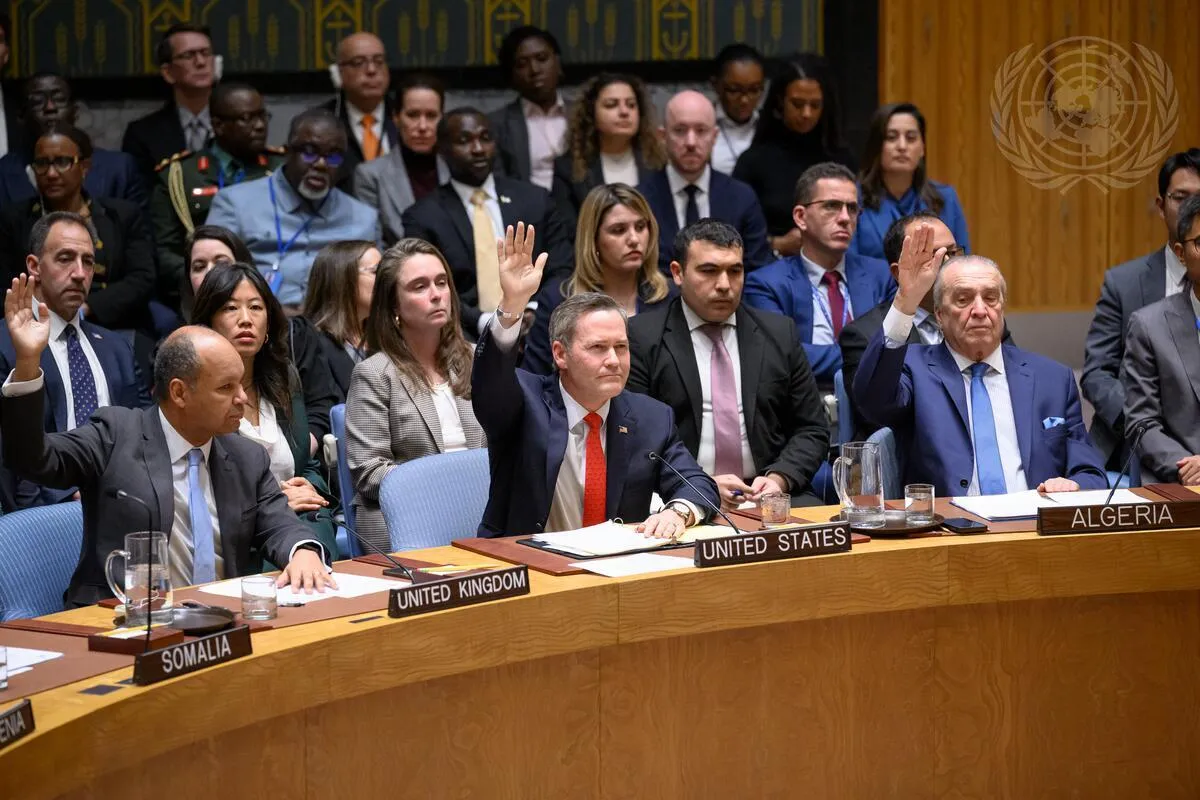
The UN Security Council this evening, Nov. 17, voted 13-0, with Russia and China abstaining, to approve the U.S.-drafted resolution on plans to administer and reconstruct Gaza. The resolution approves of what is referred to as the “Trump plan” for an international stabilization force. UN Ambassador Mike Waltz, expressing appreciation for the vote afterwards, said that the Board of Peace would be set up, with U.S. President Donald Trump as chairman. It is to be a transitional structure, running through 2027.
Note that on Nov. 14, Egypt, Saudi Arabia, Qatar, the U.A.E., Jordan, Türkiye, Pakistan, and Indonesia released a joint statement backing the American proposal.
Among the speeches after the vote by representatives of many nations, China’s representative explained that his country was “deeply disappointed” at the lack of cooperation among Security Council members on this for some time, but that China abstained in the voting, out of consideration for the fragility in Gaza, and in respect of the imperative to maintaining a ceasefire.
The Chinese representative gave four points of concern against the resolution. First, it is “skimpy” in details. Secondly, there is no firm support for “Palestinian ownership” of the process, nor of the two state imperative. Thirdly, there is no oversight mechanism for the United Nations or otherwise. There are no arrangements for this, beyond the stipulation that there must be “annual reports.” Fourthly, the draft resolution is not a product of full deliberation among Council members.
President Trump on social media this evening, Nov. 17, described the vote as, “one of the biggest approvals in the history of the United Nations,” and said it “will lead to further peace all over the world.”
Hamas, which is excluded from any governance role in Gaza, has criticized the resolution for not meeting Palestinians’ “political and humanitarian demands and rights.”
Israeli Prime Minister Benjamin Netanyahu has repeated his government’s staunch opposition to a Palestinian state, which the resolution is open toward, even though vague.