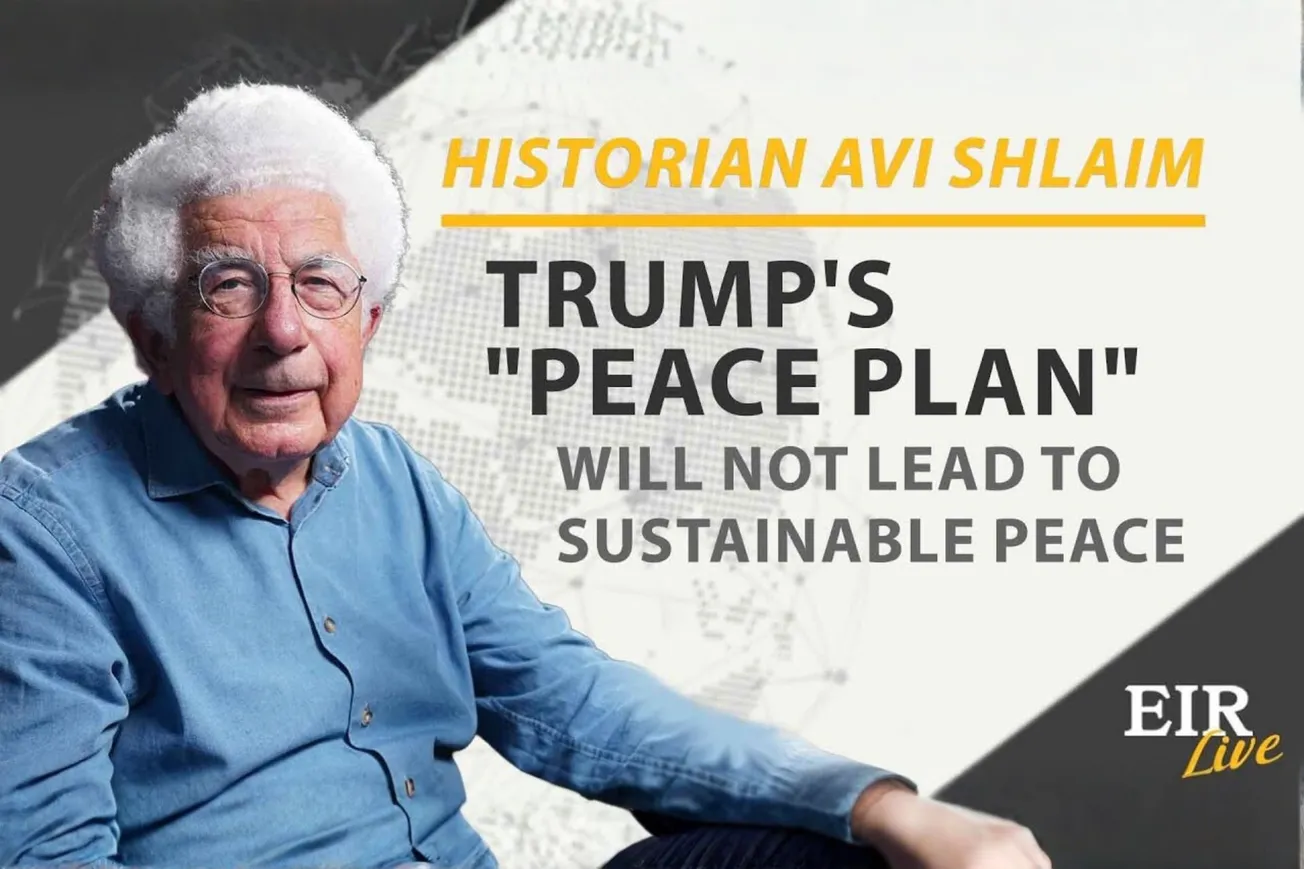
Historian Avi Shlaim presented his views on the prospects for peace, and the impediments to peace in Southwest Asia, in an interview with The Executive Intelligence Review's Harley Schlanger on November 21.
From the opening, when he described what changed his view on whether Israel's attacks on Gaza were a case of genocide, to his concluding warning that Netanyahu will not accept the existence of a Palestinian state, he presented a concise overview of what he believes is the underlying problem: That from the beginning, under the British Mandate, a Zionist state was established as a "settler colonial" movement, intitially under British protection, then under the USA after 1948. Unless this is addressed, there will be no peace,
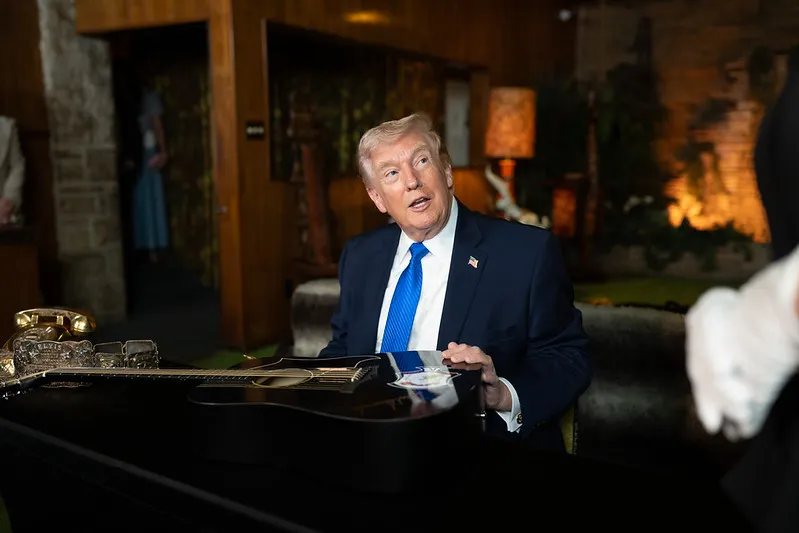
He called the "Trump Peace Plan" a "very welcome initiative," but one which offers only "vague" provisions for the future. Instead, he described it as a "colonial plan to help Israel maintain permanent security control over Gaza."
The Messianic element of supporters of "Greater Israel", who dominate Israeli politics today, are "overtly racist" and supremacist. He described Netanyahu as not being a prisoner of their fanaticism, but "an extremist himself."
As for an alternative, he pointed to Yitzhak Rabin as one who was willing to talk to Palestinians about trading "Land for Peace," but his assassination shut down further discussion. On LaRouche's "Oasis Plan", he described it as "an imaginative idea, of economic cooperation leading to a political solution," but one blocked by Netanyahu.
Shlaim, a professor at Oxford University for many years, has written several books which provide an in-depth understanding of war and peace in the region, with The Iron Wall and his autobiography, Three Worlds: Memoirs of an Arab Jew recommended reading to better understand the dynamics of the region.
Harley Schlanger: Welcome to the Executive Intelligence Review News channel. We, as you know, have started a new platform of interviews. And I’m delighted to be able to speak today with Avi Shlaim, a renowned historian and author. Avi, welcome to our program.
Avi Shlaim: It’s a pleasure to be here and to be talking to you.
Schlanger: Now, just to give people a sense of who you are, I’m going to reference your three books that I think are the most crucial for understanding the current situation in Southwest Asia. You wrote a book, The Iron Wall, which actually looks at the whole history of the security situation surrounding the State of Israel. Your second book that I will mention is called Three Worlds: Memoirs of an Arab Jew, which is sort of a journey from Baghdad to Oxford, a very insightful example of how autobiography can be real history. And then your most recent is called Genocide in Gaza. Now, I’d like to start with that, because you wrote in the preface that you were reluctant to call what was going on in Gaza a genocide. What changed your view?
Shlaim: Even after the Hamas attack on the 7th of October and Israel’s ferocious response to that attack, I was very reluctant to use the term genocide. Genocide is a very big word. And genocide is usually associated with the Nazi genocide of the Jews. So, it seemed almost perverse to accuse the Jewish state of perpetrating genocide. And in my autobiography, which you just mentioned, Three Worlds: Memoirs of an Arab Jew, I’m very critical of the Zionist movement, especially of its attitude towards the Jews of the Arab lands, of Arab Jews, like my family and myself. But I write that for all its sins, Israel has never been guilty of genocide. After the 7th of October, I was forced to change my mind.
It’s not that I changed my views, but the facts changed, and therefore I had to reassess my position. And the turning point for me was when Israel suspended all humanitarian aid to the civilian population of Gaza. This constituted the use of starvation as a weapon of war. And if you are depriving civilians of water and food and fuel and medical supplies, you are trying to kill them. If that’s not genocide, I don’t know what is. So, I changed my mind. I think Israel is guilty of genocide. And that’s why my last book, the collection of essays, has genocide in the title. It’s called Genocide in Gaza, Israel’s Long War on Palestine. If you like, I can also talk about the definition of genocide. Shall I do that?
Schlanger: Sure. Why don’t you give us a brief sense of your view of it.
Shlaim: In 1948, the Convention on the Prevention and Punishment of the Crime of Genocide was signed. It was concluded in order to stop what happened to the Jews under Nazi Germany from happening again. So, the message was “never again,” not just for Jews, but for anybody; genocide was proscribed. And the definition in the convention is that genocide is acts committed with the intent of destroying, in whole or in part, a religious, ethnic, or national group. And what Israel has been doing for the last two years meets this definition.
Five Acts of Genocide
Then there is a list of five acts that constitute genocide. The first one is killing members of the group. Well, Israel has killed tens of thousands. Second is inflicting severe mental or physical suffering on the group. Well, Israel has been inflicting unbelievable mental and physical suffering in Gaza. Then, creating conditions that make life unlivable in the area, and Israel has made Gaza unlivable. A fourth criterion, or a fourth act, is preventing birth in the group, and by systematically destroying the health system and the hospitals, Israel has prevented, or limited, the birth rate in Gaza. The fifth and last is transferring children of the group to another group. Now, Israel is not guilty of transferring children from Gaza to another group. Putin is guilty of doing that in Ukraine; that’s why there is an ICC arrest warrant for him. Israel has not transferred children from the Palestinians in Gaza to another group. But what Israel has done is much, much worse. Israel has killed over 20,000 children. Israel has made 40,000 children in Gaza orphans, that is to say, they lost one or two parents. And in a very real sense, this has been a war on children. So, I conclude by saying Israel meets the definition, and Israel has carried out all five acts that constitute genocide.
Schlanger: Now, to go to the present, there’s a debate on the [U.S. President Donald] Trump peace plan. Will it work, or not work? I saw a very interesting column from Gideon Levy two days ago, where he said, this is a chance that perhaps there’ll be a change. There are many others who are saying, don’t expect a change as long as [Israeli Prime Minister Benjamin] Netanyahu, [Minster of National Security] Ben-Gvir, and others are there. What are your thoughts? Do you think the Trump peace plan can succeed?
Shlaim: The Trump peace plan is not a peace plan. It’s a very welcome initiative to stop the war in Gaza. And more specifically, it achieved three things. It brought the fighting to an end, or near end—Israel continues the bombing. Secondly, it secured an exchange of Israeli hostages for Palestinian prisoners held by Israel. And thirdly, it allowed the resumption of humanitarian aid to the civilian population. So, it’s a very positive initiative, and all of these things were urgently needed. But to call it a peace plan is not justified, because it says nothing about the future, and all the provisions are very vague. Essentially, it’s a colonial plan for the control of the Gaza Strip.
So there’s going to be an international board chaired by Donald Trump, and all the members of the board would be foreigners, foreign leaders. And under the board, there would be a committee of Palestinians who are described as non-political Palestinians, that is to say, not members of Hamas, not members of Fatah, not members of the Palestinian Authority, but individuals who are acceptable to the foreign powers. In other words, quislings handpicked by the foreign powers.
Then there’s going to be an international stabilization force, and the mandate, the task of this force, would be to disarm Hamas. Now Israel, the IDF [Israel Defense Forces], has failed to disarm Hamas after two years of relentless bombardment. So, how would this vague international stabilization force be able to do what the IDF couldn’t do? And secondly, what Arab country would agree to send troops to fight Palestinians, to fight Hamas? And one other question: What Arab country would agree to give money for the reconstruction of Gaza when Israel could destroy everything all over again? So, this so-called peace plan is not a peace plan.
A Colonial Plan, Not a Peace Plan
It’s a colonial plan to help Israel maintain control, permanent security control over Gaza. The plan doesn’t give any agency to the Palestinians. What is extreme is that it doesn’t just rule out Hamas, but it also rules out any part by the Palestinian Authority. There is no provision for elections or for democracy. Normally, after a conflict, you would expect the people to have an election and to choose a government to govern them. Here, everything is imposed on the Palestinians from above, and there is the vaguest reference to a Palestinian state. What it says is that the Palestinian Authority needs to reform. It doesn’t specify the reforms, and it doesn’t say who will decide whether the reforms are satisfactory. But if the reform takes place, then the conditions may be created for a pathway to Palestinian statehood.
So, you really couldn’t get anything vaguer than that. And what we know for a fact is that Israel is totally opposed to a Palestinian state. Trump doesn’t support a Palestinian state. And therefore, it’s inconceivable that this so-called peace plan is going to lead to an independent Palestinian state. It’s really a stitch-up between America and Israel. From the beginning, Zionism depended on external support to achieve its aims, and the State of Israel has always depended on external support, on American support. And today, Israel is isolated because of its record in Gaza and its war crimes, and America is increasingly isolated in its support for Israel.
Schlanger: Now, one of the things I’d like to take up with you is this whole question of Messianic Zionism, because, as you’re well aware, part of the problem with trusting Netanyahu is that he’s been willingly captive to the more radical, Greater Israel fanatics who essentially treat the Bible as a real estate contract for Zionists to take control of the land between the Nile, the Tigris, and the Euphrates. The question I have for you, and you took this up in the book on the Iron Wall, is the Jabotinsky current in Zionism. Is this inherent in Zionism? Is there a way that you could have a Zionist state, which is not a colonial settler movement?
Shlaim: I think not. I think that from the beginning, the Zionist movement was a colonial movement, and it was described as such. It was a movement by European Jews, for European Jews. The turning point in the history of Zionism was the Balfour Declaration of 1917, which pledged British support for a Jewish national home; in other words, a Jewish state in Palestine. In 1917, the Jews were 10%, the Palestinians were 90% of the population, and the Jews owned only 2% of the land. But Britain, in its wisdom, allocated national rights to the Jewish minority and denied them to the Arab majority. And the history of the British Mandate in Palestine is the history of how Britain stole Palestine from the Palestinians and gave it to the Zionists.
Noam Chomsky once said that settler colonialism is the most extreme and vicious form of imperialism. Settler colonialism is the most extreme and vicious form of colonialism, and for the last century, the Palestinians have been at the receiving end of Zionist settler colonialism, on the one hand, and Western imperialism on the other hand. First under Britain, and since 1948, to this day under America. The aim of the Zionist movement from the beginning, was to create a Jewish state on as much of the land, as much of the territory of historic Palestine, with as few Arabs within its borders as possible.
The Messianic Element
That’s the formula of Zionism all along. And this is the guiding principle of the present government. This explains the destruction of Gaza and the attempt to expel the population of Gaza—which was only blocked by Egyptian resistance—and the intensification of the ethnic cleansing of the West Bank. Now, Netanyahu’s extremist coalition partners introduced a new element into this Zionist program. And that is the Messianic element, the overtly racist element—the notion of Jewish supremacy, that the Jews are superior, Arabs are inferior. And God promised the whole of the land of Israel, which includes the West Bank, of course, to the Jewish people. The policy guidelines of the present government, say the Jews have an exclusive right to self-determination in the entire land of Israel. This is a stark denial of any Palestinian political, any Palestinian national right, any right to self-determination in any part of Palestine. And this is an extreme position, an uncompromising position. And it is these ministers, Bezalel Smotrich, the leader of religious Zionism, and Itamar Ben-Gvir, the leader of Jewish power—they are Messianic. They want an act to bring about the ethnic cleansing of Palestine, and their declared end-game is the formal annexation of the whole of the West Bank and Gaza.
Now, some people think that Netanyahu is a prisoner of his extremist coalition partners, and if he doesn’t do what they want, they will bring down the government. I don’t share that view. It is true that Netanyahu is dependent on the extremists to survive in power. It is true that he stands trial in Israel for serious corruption charges, and if he ceases to be Prime Minister, he would stand trial, and he will most probably end up in jail. So, he has a personal and a political stake in continuing the war in Gaza and the ethnic cleansing of the West Bank. But I think that Netanyahu is an extremist himself.
He grew up in a Revisionist Zionist home. His father was Benzion Netanyahu, who was the political secretary of Ze’ev Jabotinsky, the spiritual father of the Israeli right. So, I think that Netanyahu, apart from tactical considerations today, regards his life’s mission as to prevent the birth of a Palestinian state, and that’s what he’s been doing. And that’s why I said to you earlier that the Trump peace plan has no chance of leading to a Palestinian state or to peace, as long as Netanyahu and his company are in power in Israel.
Schlanger: You mentioned the importance of the Balfour Declaration and the British Mandate. We’ve written extensively on the fact that the Zionist movement was used by the British, the British establishment, to move into the area that was being evacuated by the Turkish, the Ottoman Empire, as a part of a British geopolitical strategy. It appears that that still exists for many people in the City of London. How do you think that became institutionalized in Israel?
Shlaim: During the First World War, Britain promised an independent Arab kingdom to Hussein, the Sharif of Mecca, in return for mounting the Arab Revolt in 1915. In 1916, Britain signed a secret agreement with France, the Sykes-Picot agreement, dividing the territories of the Ottoman Empire into French and British spheres of influence. But Palestine was excluded. It was to be put under a separate international administration. In 1917 Britain issued the Balfour Declaration, promising Palestine to Zionists. Lloyd George was very anti-French, and he reneged on the Sykes-Picot agreement, and that was his motive for issuing the Balfour Declaration, because he thought that by supporting Zionism, Britain would have an ally in Palestine, a close ally. And by its presence alongside the Zionists in Palestine, he thought, Britain would be able to control the access to the Suez Canal and the routes of the communications to the Far East.
This explains [the] geostrategic motives behind the Balfour Declaration. But the Balfour Declaration, judged from the point of view of Britain’s national interest, was a colossal strategic blunder. It created a conflict between the native population—the Arabs—and the Zionists, and this conflict originated in Britain. Britain created this conflict and Britain couldn’t resolve the conflict. So, it ended up alienating not only the Arabs, but also the Zionists. There was a falling out between Britain and the Zionists in 1948. But later, more recently, Britain resumed a very pro-Israeli position. This is especially the case under Sir Keir Starmer, who defined himself as an unconditional Zionist.
Public Opinion Shifts Against Israel
Britain continues to give Israel a lot of support—intelligence cooperation, arms sales, and diplomatic protection in the Security Council. It is not so much for geostrategic reasons, but for other reasons that Britain held such a strong pro-Israeli position under both the Tories and the current Labour government. Public opinion in Britain has been moving very, very dramatically against Israel because of the genocide. I know this from personal experience. I go with my family on pro-Palestinian marches in London. There I can see the strength of feeling, in Britain, against Israel. There is still a gap, a disconnect between the British government and the British people.
But gradually British foreign policy is catching up with popular opinion. This is also the pattern in the rest of Europe and in the United States. As you know, Jewish opinion in the United States has also been moving against Israel, and AIPAC [American Israel Public Affairs Committee], the Israel lobby, probably represents only about 30% of American Jews, and J Street, the more liberal group of young Jewish people, represents maybe 70%. So, there is still a disconnect between Western governments and the people, but it’s closing all the time. Britain and France recently recognized Palestine. That means that four permanent members of the Security Council—China, Russia, Britain, and France—recognize Palestine. America is isolated; it’s the odd one out in not recognizing Palestine. So, the trend is against Israel and in favor of the Palestinians.
Schlanger: On the British question, I’m sure you remember what Lord Palmerston said, that Britain has no permanent friends, only permanent interests. And so, I wouldn’t be surprised to see a change taking place on that. Just on the question of the change underway, the election of Zohran Mamdani [as Mayor] in New York City was a real shock to the Zionist lobby in the United States, because New York City is one of the largest concentrations of Jewish people in the world, and about one-third of the Jewish vote went to Mamdani, who was anti-Zionist and a Muslim, but not a radical, and this has caused a real shake up. Maybe we can take that up at another point.
In the time we have left, I want to go to something that you had written that struck my interest, that as part of the Iron Wall overall outlook, the Zionists have always rejected the idea of diplomacy in favor of military strength. And you said that the one attempt to shift that was Israeli Prime Minister Yitzhak Rabin and Oslo [site of negotiations on peace in 1993], where Rabin basically seemed willing to take up the question of trading land for peace, some of the occupied territory. And we know what happened after his assassination—the land-for-peace died with Rabin. Is there a way to bring that back? I know you’ve said that you no longer think a two-state solution is possible. Was Rabin and the failure of Oslo the end of the idea of two states in your opinion?
Shlaim: I looked at it from a broad historical perspective, and you mentioned my book, The Iron Wall: Israel and the Arab World, which is a history of the conflict. It’s 900 pages long, but I can summarize it for your listeners in one sentence, namely that since its birth, Israel has been ready to resort to military force, too ready to resort to brute military force, and reluctant, remarkably reluctant, to negotiate seriously on the basis of equality with the Palestinians to resolve the conflict between them. So, the problem with Israeli statecraft all along has been too much brute force and too little diplomacy. And the use of brute force reaches its climax in the war in Gaza, when Israel went beyond ethnic cleansing to genocide.
Now, Yitzhak Rabin was the first Israeli Prime Minister to go forward on the political front towards the Palestinians, and the result was the Oslo Accords. But Rabin was assassinated. The Likud came back to power under the leadership of Benjamin Netanyahu, and Netanyahu spent his first term in office, 1996 to 1999, in a systematic attempt to dismantle the Oslo Accords. So, the Oslo Accords had the seed of a two-state solution, though it didn’t explicitly mention a Palestinian state. But it was, as you said, implementing the principle of land for peace, which over time could lead to an independent Palestinian state.
Netanyahu was determined to prevent any development. So in retrospect, Oslo did not become the prelude to the emergence of an independent Palestinian state. It became a trap for the Palestinians. And this is where the Palestinians are today, in a trap, with total Israeli domination of the entire area from the river to the sea.
I used to support a two-state solution. It’s the only just, it’s the only reasonable solution. But Israel has killed this option by expanding settlements, by annexing East Jerusalem, by building the security wall which protrudes deep into the West Bank. What is left are isolated Palestinian enclaves surrounded by Israeli settlements and military bases—that’s not an adequate basis for a viable Palestinian state.
Israel destroyed the two-state solution; the two-state solution is dead, and today the choice is not between one state or two states, the choice is between the status quo, which is apartheid and ethnocracy, and brutal military occupation and bloodshed, or, one state with equal rights, one state from the river to the sea, with equal rights for all its citizens, regardless of religion and ethnicity. This is the alternative that I clearly prefer to the status quo. When I say “from the river to the sea” what I mean is that all the people who live in this space should enjoy equal rights and be able to live in freedom and dignity.
The Economic Dimension and LaRouche’s Oasis Plan
Schlanger: Let me just take a couple more minutes of your time to present to you the idea that Lyndon LaRouche came up with as a way to get out of that trap. He said that you need to have incentives for both sides to live in peace. And that those should not be in the realm of political agreements, which can be torn up very easily, but economic cooperation, with mutual benefit. And he drafted something which he called the Oasis Plan of canals between the Mediterranean and the Red Sea into Israel, where there could be desalination plants to produce fresh water to green the desert. And he said this is the way that you can create a mutual benefit that could outlast, or actually overcome, the long history of vengeance and retribution.
What do you think of that? It was obvious that there were economic accords in Oslo, but they never started moving the soil and never started building them.
Shlaim: But I think it's an imaginative idea, and a positive idea, economic cooperation leading to a political solution to the problem. And Oslo envisaged it. To start cooperation in specific fields, economic fields, and build mutual trust, and gradually increase the cooperation and the scope of the agreement. And Oslo did work for the first 2 years, and terrorism was reduced to nothing. Because 70% of Israelis and 70% of Palestinians supported those Oslo Accords. It gave them hope for the future. Between the assassination of Rabin, hope was lost, and there was nothing to replace it.
And Netanyahu never agreed to concede national rights to the Palestinians. But he did believe in giving them economic incentives. But this policy hasn't worked, and it cannot work. Because the Palestinians are not a robot—they're a nation. They are people with very advanced political consciousness. They want an end of occupation, they want independence and sovereignty. And no amount of economic incentives are going to change things.
Schlanger: Well, I wish we had more time because we didn't even get to one of the implied subjects of your memoir, that is that the clash of civilizations is a modern concept, that didn't really exist in the Baghdad that you lived in. So, I hope we can come back at another time and take that up. But I'd like to thank you for your honest and frank approach. I hope that people will share this video and go read your books. Because what's needed is in-depth understanding, and not just the profiles that are used to manipulate people.
Shlaim: Thank you very much. It's been a pleasure talking to you, and through you, I hope to have reached some of your listeners, and I'm grateful to you for giving me this opportunity.
Schlanger: Well, thank you, and I'm sure we'll be back in touch.