
Richard A. Black is the Schiller Institute Representative at the UN in New York
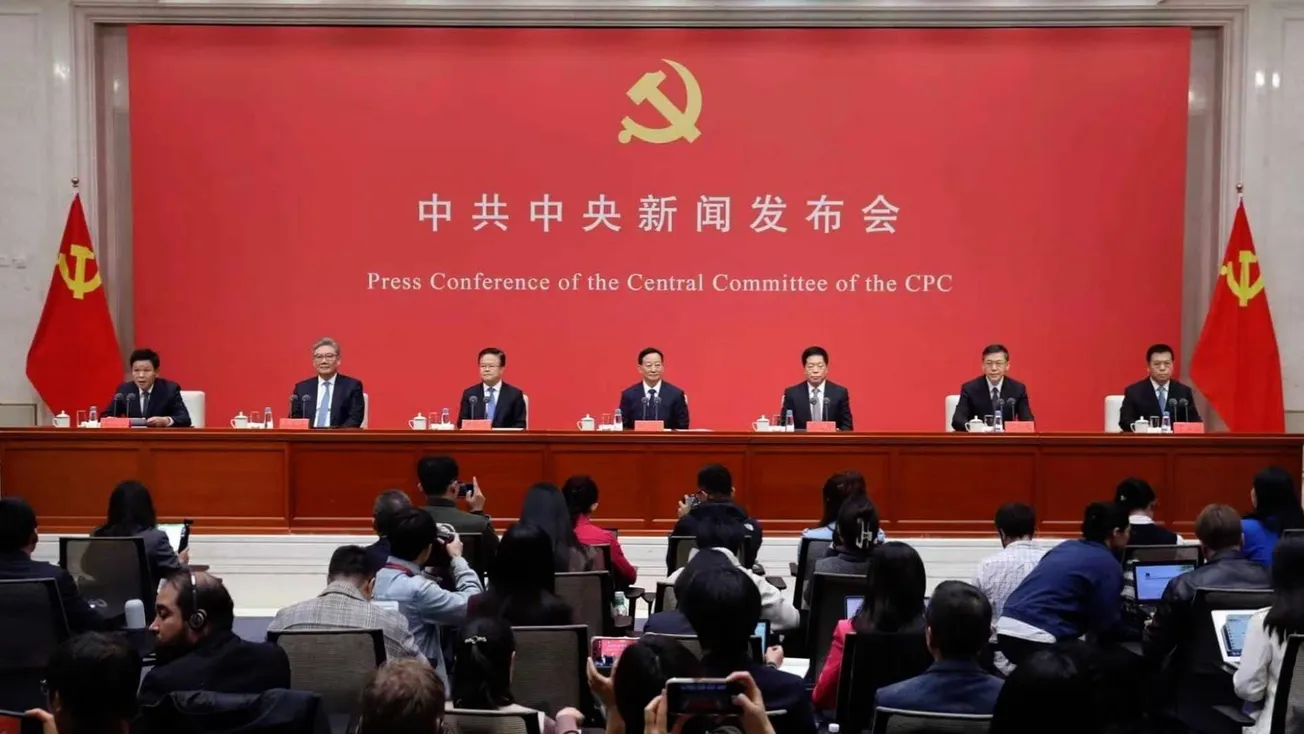
On October 28, China published the extensive “Recommendations” for the 15th Five-Year Plan, 2026-2030, which will be released in early 2026. The national policies outlined are a qualitative leap in advancing the Chinese “Economic Miracle,” and have already caused a public panic and outcry among the City of London financial vultures. It is an advance for the Global Majority nations, especially the nations of the Global South, which are in the process of launching a new monetary and trade system to end neocolonialism.
The intensity of the accelerated China advance—and its extension into the Global South—presses forward the question to the war-mad and decaying West, “Will you exchange your repeated nuclear confrontation against Russia and China for collaboration with the Global Majority?”
Formally called, “Recommendations of the Central Committee of the Communist Party of China for Formulating the 15th Five-Year Plan for National Economic and Social Development,” the Plan is outstanding for its focus on a national mission of improving original work at the frontiers of science, and the national integration of education, industry, R&D, and the development of both new technologies and the skilled labor force. These recommendations are in line with President Xi Jinping’s call during the course of the last year, for the development of “a new theory of productive forces.” It should be noted that the Five-Year Plan has the force of a national executive policy directive.
China already commands a leading position in the fields of scientific and technological advancement worldwide, a reality which its new Five-Year Plan will only accelerate. According to the anti-China Australian Strategic Policy Institute, in 2023 China had already become the leader in 57 out of the 64 “critical technologies” which it monitors. Chinese universities have also come to hold leading positions in science and technology worldwide. A recent study conducted by the Swedish Foundation for International Cooperation in Research and Higher Education found that 19 out of the top 20 universities for mathematics, computer science, physics, and engineering are in China. In addition, China’s rapid pace of progress in areas such as thermonuclear fusion, quantum computing, robotics, and space exploration, to name a few, is well known.