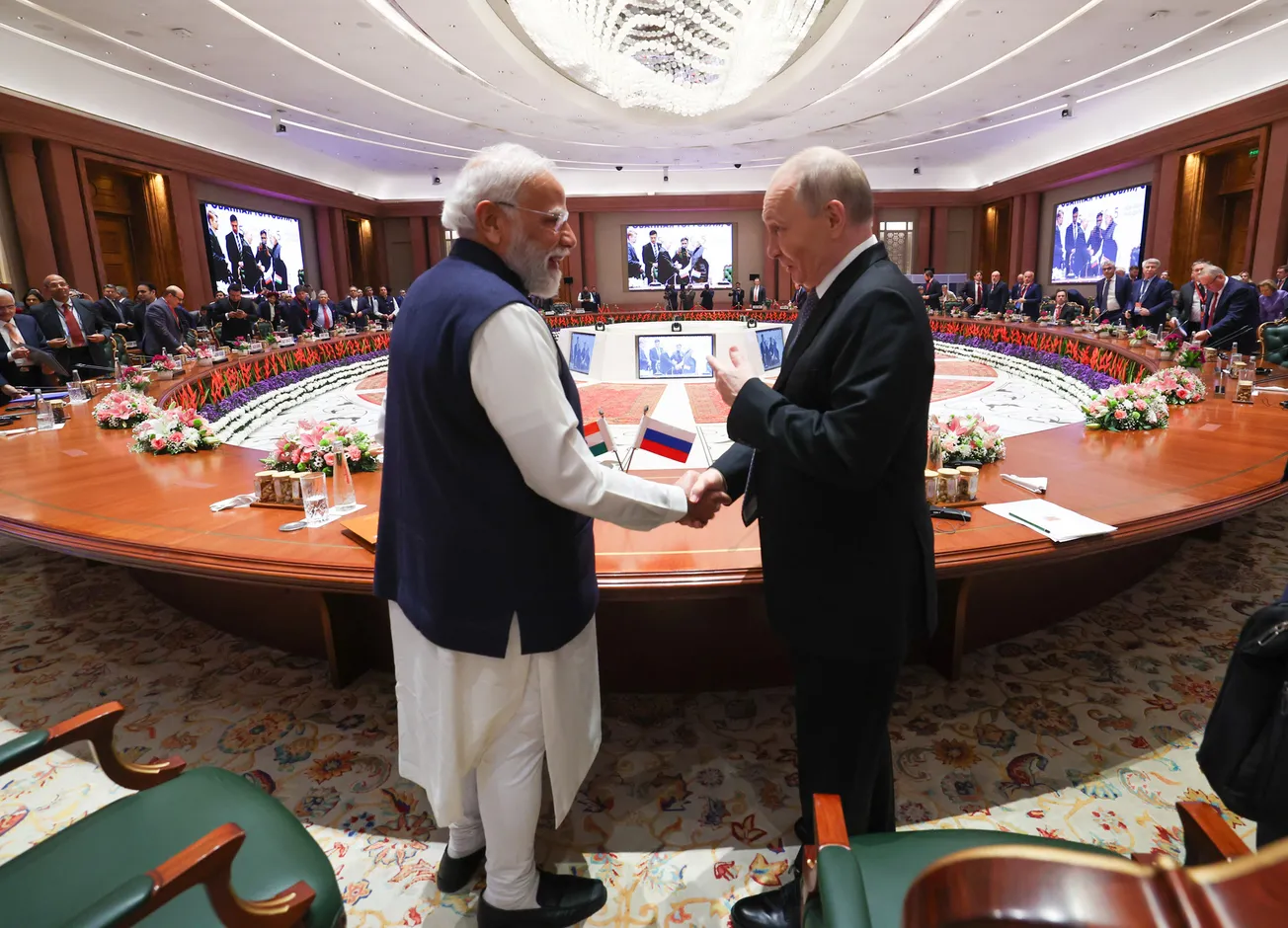
In the course of two days of extensive discussions, including a private summit meeting and a formal state banquet, India’s Prime Minister Narendra Modi and Russia’s President Vladimir Putin spoke at the India-Russia Business Forum. Putin described the agreed-upon plan for the collaboration of the two countries for the next five years. He explained: “To achieve this significant goal” of $100 billion of bilateral trade, “a program for the development of Russian-Indian economic cooperation until 2030 has been agreed upon.” Expanding beyond that, work is underway on an agreement for India to establish a free trade zone with the Eurasian Economic Union.
Putin highlighted some projects: “We are building the largest Indian nuclear power plant in India’s Kudankulam. Two of six units are already connected to the grid, and four are under construction.… We are also exploring small modular reactors, floating nuclear plants, and non-energy nuclear technologies in medicine and agriculture. A large Russian Indian pharmaceutical plant will be set up in the Kaluga region to produce high-quality anti-tumor medicines using advanced Indian technology. Russian enterprises will also participate in manufacturing under the Make in India program.”
He added: “Russia is a reliable supplier of oil, gas, coal, and everything that is required for the development of India’s energy. We are ready to continue uninterrupted shipments of fuel for the fast-growing Indian economy.… We open additional areas for cooperation, including hi-tech aircraft, space exploration and artificial intelligence.…”
Modi identified major increases planned for Indian exports to Russia in the areas of defense, pharma, agriculture, food products and consumer goods. Earlier in the day, their officials had completed the signing of a large collection of agreements spanning jobs, health, shipping, and chemicals. Modi situated the successful agreements in terms of the depth of their mutual history: “Over the past eight decades, the world has witnessed numerous ups and downs. Humanity has had to pass through many challenges and crises. And amidst all this, the India-Russia friendship has remained steadfast like a pole star.... Based on mutual respect and deep trust, these relations have always stood the test of time…. [W]e have agreed on an economic cooperation program for the period up to 2030. This will make our trade and investment more diversified, balanced, and sustainable.”
Western media tried to claim that Modi put Putin in his place regarding the Ukraine conflict, but what he actually said was simply to encourage diplomacy: “We welcome all efforts being made for a peaceful and lasting resolution of this matter. India has always been ready to contribute its part and will remain so in the future.... India has advocated for peace on the Ukraine issue from the very beginning.” Earlier, In his televised opening remarks at the summit, Modi said that “the conflict should come to an end through dialogue and diplomacy. We support a peaceful solution to the conflict.… The welfare of nations lies in the path of peace. Together, we will lead the world towards that path.” Then he endorsed the Trump-Putin efforts: “I am fully confident that with the efforts being made in recent days, the world will once again return to the direction of peace.”
In an interview with broadcaster India Today aired late on Dec. 4, Putin challenged the U.S. pressure on India not to buy Russian fuel. “If the U.S. has the right to buy our (nuclear) fuel, why shouldn’t India have the same privilege?” Then he added that he would also discuss this matter with U.S. President Donald Trump.