

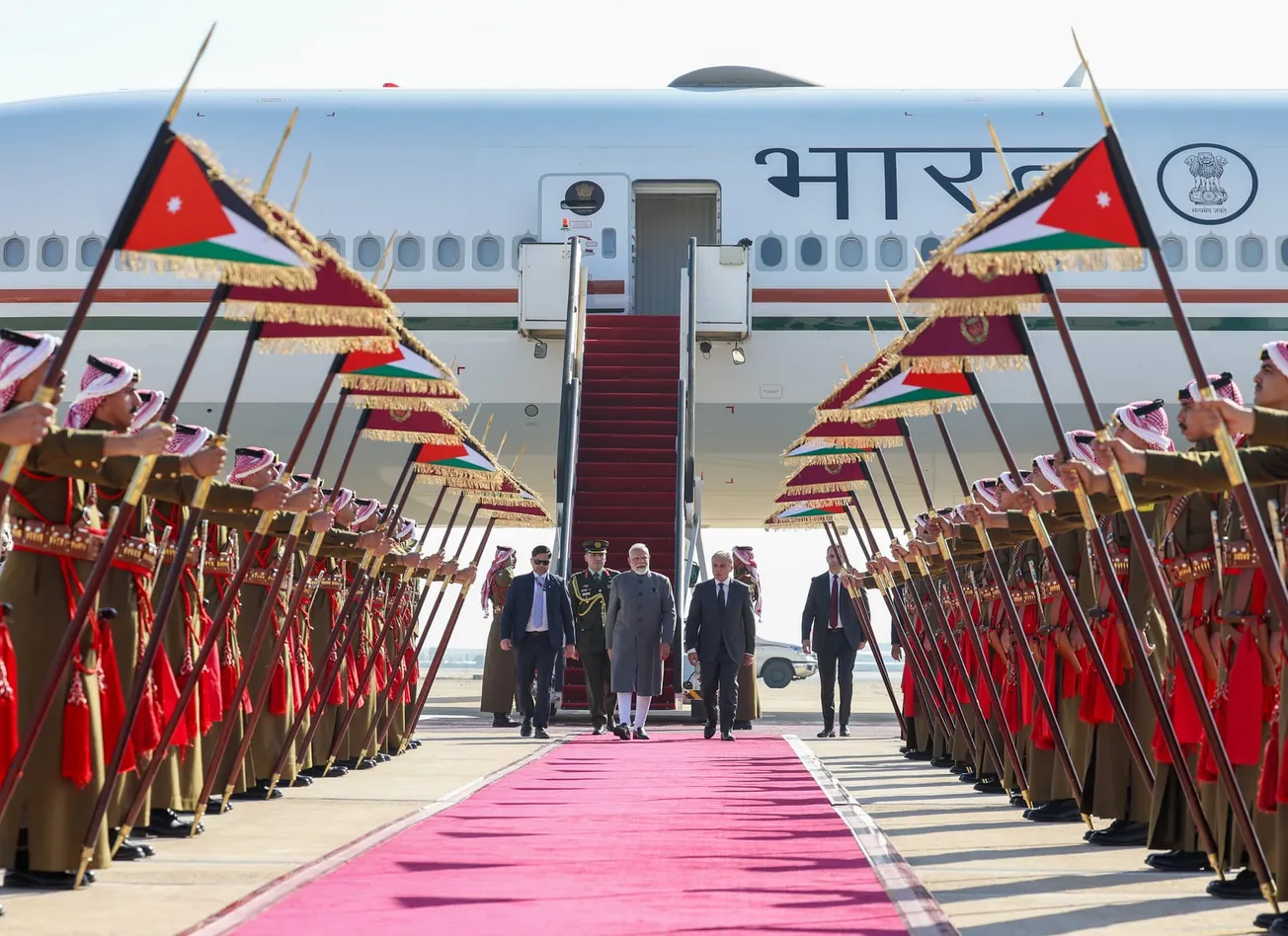
The BRICS countries are stepping up diplomatic ties with Southwest Asia. Indian Prime Minister Narendra Modi was given a warm, red-carpet reception when he landed in Amman, Jordan for a visit designed to “open broad horizons for a new phase of strategic partnership between India and Jordan,” as India’s Ambassador Manish Chauhan, told the Jordan News Agency. India has become Jordan’s third- or fourth-largest trading partner (depending on the source), and both nations are interested in increasing trade and investment between them.
India’s External Affairs Ministry reported that Modi and King Abdullah II met first in restricted and then in delegation-level formats. They discussed “ways to further deepen engagement between the two countries in the fields of trade and investment; defense and security; renewable energy; fertilizer and agriculture; innovation, IT and digital technologies; critical minerals; infrastructure; health and pharma; education and capacity; tourism and heritage; and culture and people-to-people ties"—the gamut. Naturally, they also exchanged perspectives on the ongoing developments in the region, and the “importance of restoring peace and stability in the region.”
Indian Foreign Minister S. Jaishankar is also in Southwest Asia. He participated in the U.A.E.’s annual Sir Bani Yas Forum over the weekend (meeting with Egyptian Foreign Minister Badr Abdelatty, among others, on the sidelines), and then today co-chaired the 16th Joint Commission and 5th Strategic Dialogue with U.A.E. Minister of Foreign Affairs and Deputy Prime Minister Sheikh Abdullah bin Zayed Al Nahyan. Jaishankar was to visit Israel for “bilateral consultations” with Israeli Foreign Minister Gideon Sa’ar.
Modi, for his part, will continue on to fellow-BRICS member Ethiopia, which he will visit for the first time, followed by a visit to the Sultanate of Oman, before returning to India.