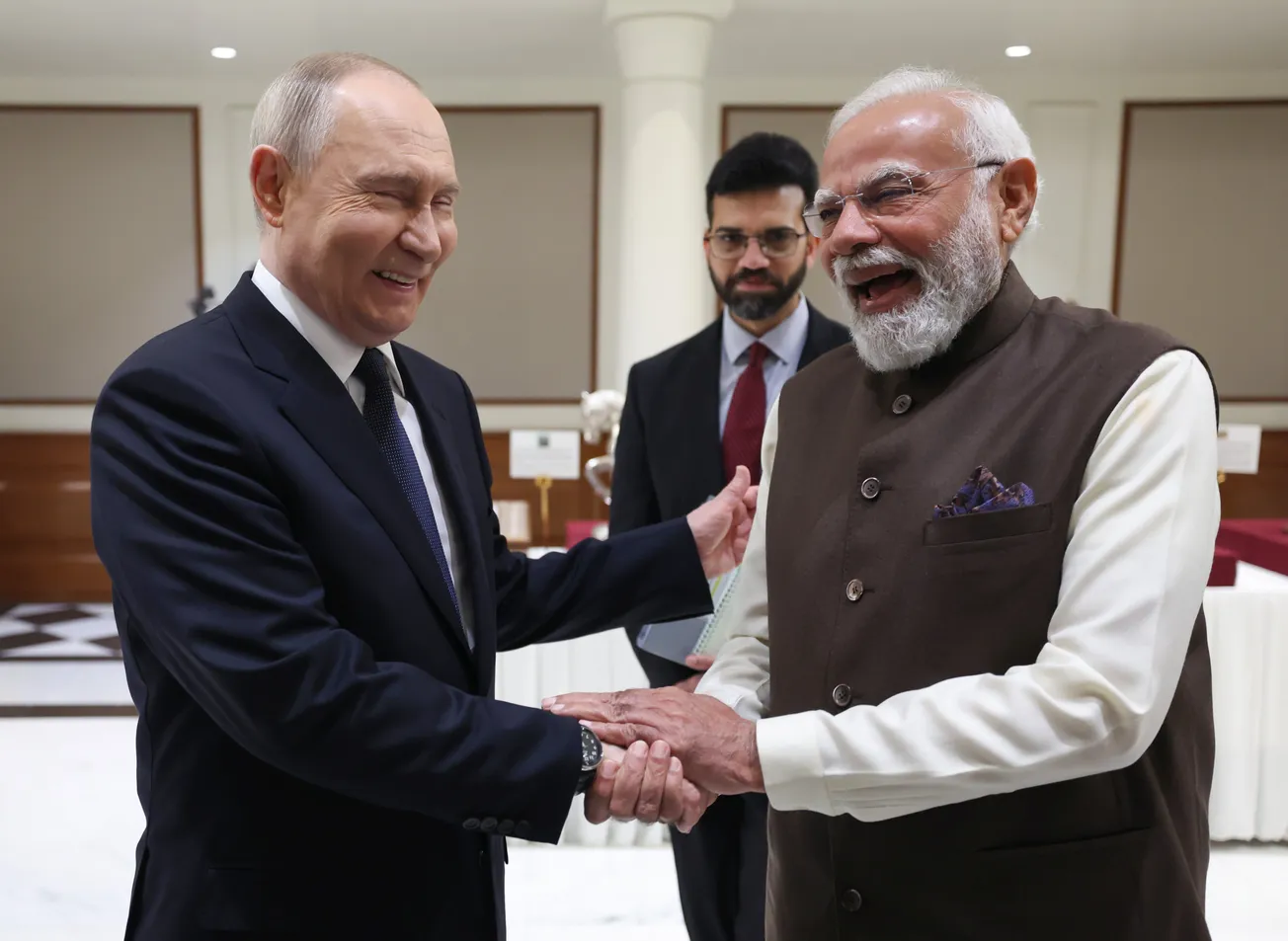
Despite countless rounds of sanctions and tariffs, Western nations still have not been able to control the changing dynamic in the world. A major target of such sanctions over the previous years has been India, which has persisted in maintaining strong trade relations with Russia. So, when Russian President Vladimir Putin received a personal greeting on the tarmac by Prime Minister Narendra Modi upon his arrival in India on Dec. 4, and was seen laughing with the Prime Minister on their way to dinner, the message was clear: Attempts to play God with the world don’t always work.
Putin reiterated this in his own way in an interview with India Today on Dec. 3. Attempts to control India’s trade relationships through sanctions won’t work, he said. “India cannot be treated the way it was treated 77 years ago. India is a great power, not a British colony, and everyone will have to take that into account.” Over the remainder of the visit, agreements are expected to be signed in the fields of defense cooperation, energy security, trade expansion, industrial cooperation, and space technologies.
In a different but no less significant way, the initial negotiations between the U.S. and Russia over a peace agreement in Ukraine indicate the same directionality. Commenting on this in his interview, Putin said that the agreement proposed by the U.S. “was based one way or another on our agreements from my meeting with President Trump in Alaska, as we discussed these issues at the meeting in Anchorage.” This is certainly the last thing that British and NATO war hawks wanted to hear.
Much else in the world remains in flux, with moments of clarity interspersed with others of absolute irrationality. For instance, the major agenda at the NATO foreign ministers meeting in Brussels this week was to keep the focus on war against Russia. NATO Secretary General Mark Rutte announced that the NATO-Russia Council had been dissolved and the NATO-Russia Founding Act, wherein the two sides agreed they were no longer enemies, had been repealed. Hungarian Foreign Minister Peter Szijjarto, speaking from the meeting in Brussels, blamed European leaders for preventing Ukraine from reaching any peace deal with Russia. “The ‘red lines’ for Ukraine are set not by the Ukrainians themselves, but by the Europeans, who dictate their terms to them and do not allow them to reach an [peace] agreement,” Szijjarto said.
Amidst this turmoil, a useful voice is emerging from Pope Leo XIV who, while traveling back from his trip to Türkiye on Dec. 2, made the surprising statement that he would next like to visit Africa. “Personally, I hope to go to Algeria to visit the places of St. Augustine, but also in order to continue the conversation of dialogue, of building bridges between the Christian world and the Muslim world,” the Pope told the shocked reporters. More such adults are needed in the room, who are willing and able to acknowledge that the oneness of mankind is the only means of “building bridges” between nations and cultures that are otherwise being pulled toward conflict.
The Friday, Dec. 5 meeting of the International Peace Coalition (No. 131) will be seeking to increase the number of such adults in the room. All are encouraged to join the discussion and put these potential openings into action.