One hundred—or one thousand—years from now, what will human society say of us and our time? Will we be unrecognizable to them? In a sense, one can only hope that today’s societies that are gripped by the inhuman ideology of geopolitics will seem strange and primitive, a relic of an underdeveloped mode of civilization. What meaning do you hope those future people ascribe to the present time? Will they say that this was the moment that humanity successfully evolved to a higher, post-colonial paradigm—forever doing away with war as a method of conflict resolution? Or, the horrific alternative, will this question be entirely moot because humanity showed itself incapable of escaping self-extinction through the logic of nuclear war?
Helga Zepp-LaRouche, in her webcast of Dec. 31, put out the subjective challenge needed to answer that question: “I think what we have to really put as a challenge for 2026: People of goodwill should do everything possible to avoid the danger of the extinction of civilization, which is the most important issue, because if that happens, everything else will be moot; and that we move to a new security and development architecture, which this time must take into account the interest of every single country on the planet, to work in the tradition of the Peace of Westphalia, and in cohesion with what President Xi Jinping has called for with the Global Governance Initiative. So, I think that that sets our task, and I call on all of you to work with the Schiller Institute to help us to accomplish that.”
Her call could not be more timely. As the New Year dawns, civilization is simultaneously and rapidly moving in two directions, one driven by the insistence of the Western elites to hold onto their crumbling control of the world system—even to the point of provoking a nuclear war—and the other driven by the natural, human tendency of nations to seek mutual cooperation and development.
The continuing efforts of the European “Coalition of the Willing” to prevent peace in Ukraine are a blatant example of the first trajectory. In a statement on the Dec. 28–29 attack carried out by Kiev against the Russian Presidential residence in Novgorod, Russian Foreign Minister Sergey Lavrov focused attention on and gave a stark warning about those who are pulling the strings and to maintain the conflict: “There is no doubt that the main goal of Brussels, Berlin, Paris, and London is to preserve the regime that dreams of being helped to survive and to continue controlling a certain territory where—contrary to every provision of international law—the Russian language and Russian-language media have been outlawed … [and] Nazi ideology and practices are cultivated…. This kind of entity on Russia’s borders is precisely what European Russophobes need in order to be able to implement their stated plans for preparing a new aggression against our country.”
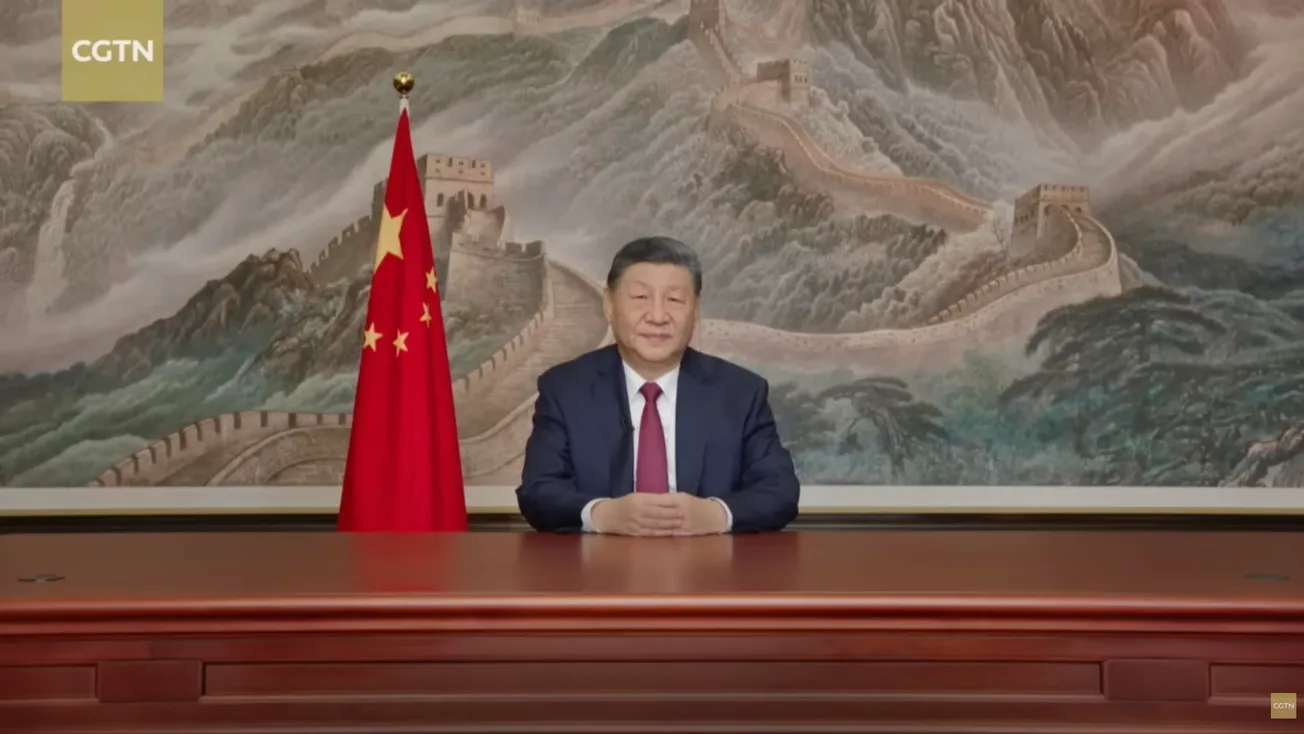
On the other hand, in Chinese President Xi Jinping’s optimistic New Year’s address, in which he outlines some of China’s achievements in 2025, one catches a glimpse of a civilization that, over the course of just 40 years, has come from widespread poverty to being the most modern and prosperous civilization on the planet—and is now exporting that model of development and poverty alleviation via the Belt and Road Initiative and other cooperative endeavors.
“People are always talking about the systemic threat coming from China,” Zepp-LaRouche said in her webcast. “Well, you can say that the systemic threat is that—it may turn out that the model which puts the image of man as the most important purpose of politics, the improvement of the living standard, the happiness of the people, if you put that first, then naturally that may be more appealing to people. And so the threat comes not from a war threat, it comes from the threat of being good! And it may be that this perspective, which appeals to the improvement of the living standard and the well-being of people, is becoming more attractive and that the systemic threat is that….
“So I think we have to really reflect on the fact that we are in an unprecedented crisis. But so far, the Western elites have been completely unwilling to look into the reasons why that is, and that the present constellation in the world is entirely their own doing. It’s a blowback of their own policies, and if we want to remedy it, we all have to go to the best traditions of our histories in Europe and in the United States, and then just look for cooperation instead of confrontation with the countries of the global majority….
“If we do not overcome geopolitics, which is … based on an Aristotelian approach, and transform our thinking to the idea of thinking the one humanity first, we will not live, because in the time of nuclear weapons, the idea of war as a means of conflict resolution will doom us as a civilization….
“If you think in terms of long-term history, we are at the point where we have to make a jump in our thinking to think the one humanity, and that jump has to be as dramatic as the overcoming of the Middle Ages and the axioms of scholasticism, witchcraft, all kinds of superstitions, to the modern age, which was accomplished through the thinking of Nicholas of Cusa and the Italian Golden Renaissance. And we are now almost 600 years later, at a point where we have to make the intellectual jump to the new era of civilization as a requirement for our own survival.”
Let that be your most important New Year’s resolution.