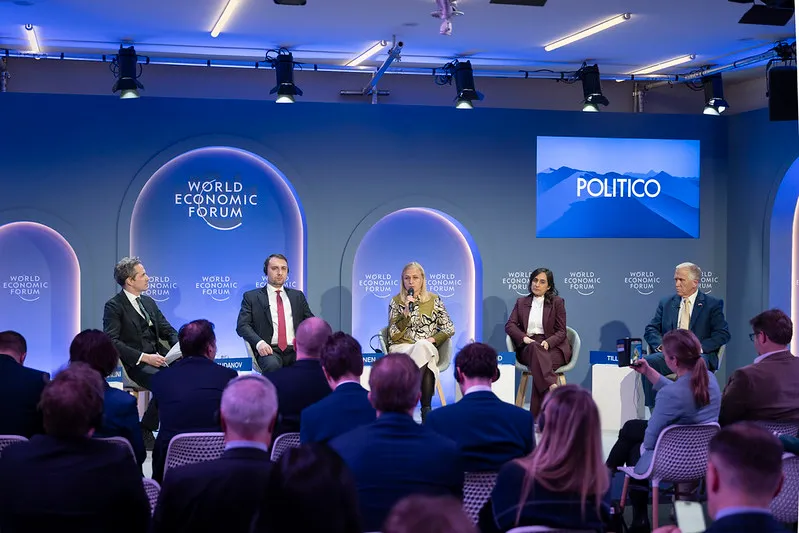
Much hemming and hawing is taking place as world leaders convene in Davos, Switzerland this week for the World Economic Forum. Clearly, the new year so far has brought a surprising rash of events, threatening to collapse what little remains of international law and norms. On the eve of scheduled talks between American and European officials over whether or not the United States will use force to seize Greenland, scheduled for Jan. 21 in Davos, NORAD sent a squadron of fighter jets to the island—further raising tensions. This is on the back of U.S. President Donald Trump’s threats to impose tariffs on European countries that do not accept his demands on the issue. The European Union and NATO in particular are being stretched to such extremes that their continued existence is increasingly in doubt.
Concerns are also rising with regard to what the seizing of Greenland would mean, and what U.S. President Trump intends by it. One indication is provided by Trump’s Jan. 17 social media post, where he noted that the U.S. acquiring Greenland is now “especially important” in order to build the Golden Dome weapon system. “This very brilliant, but highly complex system can only work at its maximum potential and efficiency, because of angles, metes, and bounds, if this Land is included in it,” Trump posted, noting that he means “both Offensive and Defensive” functions. The obvious question raised is whether such a move returns the U.S. to the stance of preemptive nuclear confrontation with Russia and China as part of its “new” strategic outlook. Former Russian space agency chief and current senator for the Zaporozhye Region Dmitry Rogozin suggested that this move is part of “a strategy to neutralize Russia’s strategic nuclear potential,” a development which would mean “a dismantling of the entire system of strategic stability in the world.”
Equally concerning is Trump’s proposed Board of Peace, an institution which seems aimed at replacing the United Nations itself. When Trump was asked by a reporter on Jan. 20 if he wants that to happen, he simply replied, “It might,” before going on to attack the UN. “The UN just hasn’t been very helpful. I’m a big fan of the UN potential, but it has never lived up to its potential,” Trump said. Dozens of heads of state from around the world have reportedly been invited to join, including Russia and China, though how many will actually decide to do so remains to be seen.
Many are asking if these and other developments spell the end of the “rules-based order” and the post-World War II system of international law itself. The answer, of course, is yes—but don’t look to Donald Trump as the sole party responsible. In fact, international law has been in the process of destruction for years, as evidenced by the toleration of genocide in Gaza, decades of blatant double standards between “the West and the rest,” enforced underdevelopment across much of the Global South, and the attempt to achieve a “strategic defeat” against the world’s largest nuclear power through the war in Ukraine—to name a few. While many may be waking up to the reality that the current system is broken, only a return to real principles of statecraft can pave the way to a lasting future.
Russian Foreign Minister Sergey Lavrov addressed this in his annual press conference on Jan. 20, noting that, while the West has talked about its rules-based order for the past decade, it is telling that “today this term has vanished from public discourse.” Trump’s unilateral assertion of a new set of rules is not new, Lavrov said, but “this time, it is not the collective West which writes these rules, but just one of its members. This came as a major shock for Europe.”
So what are the principles that must become the foundation of a new system of international law? Look to the Arctic. Over the course of the past 24 hours, a powerful geomagnetic storm engulfed the northern half of the planet, putting into perspective the common physical existence and common challenges that mankind as a whole faces. As the most immediate contact point to the vast domain of the cosmos, it would only be natural that the human species treat the Arctic as a zone of peace and shared collaboration—including the development of an advanced transportation corridor across the Bering Strait and science cities in order to advance our understanding and mastery over nature. Will we choose this path, or the path of confrontation, militarization, and first-strike nuclear war preparations? The choice is ours, and the point of decision is rapidly approaching.