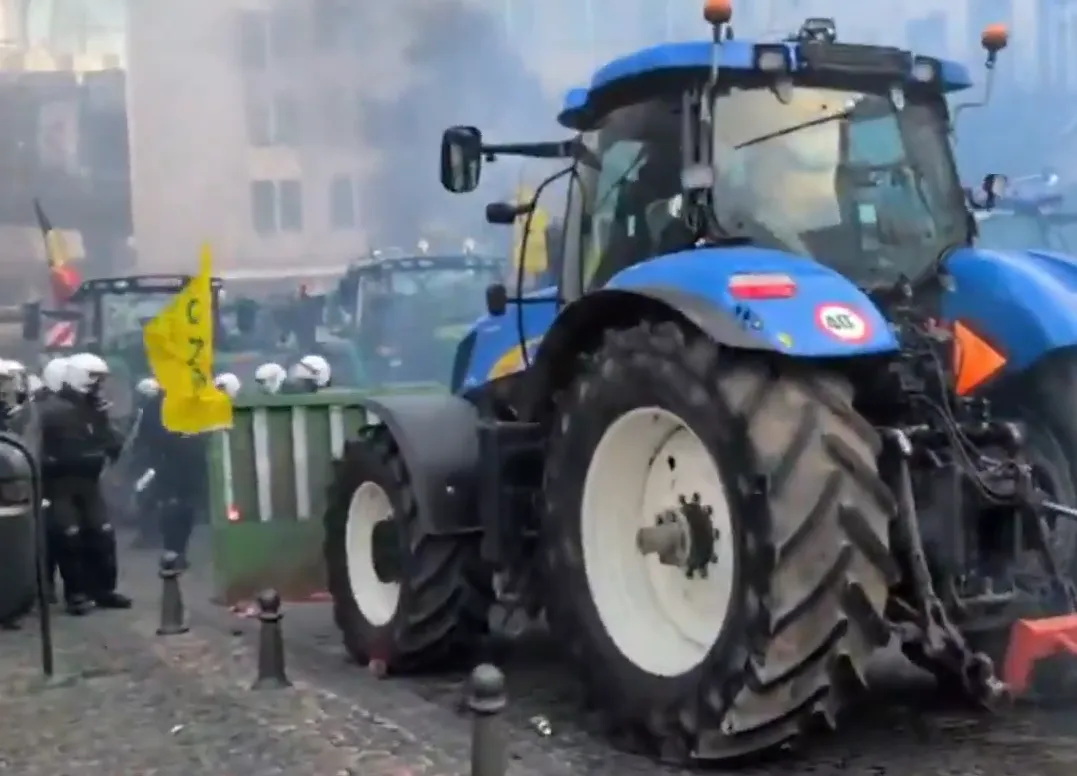
European farmers are continuing protests against the impossible conditions they face in trying to produce food, and in particular against Brussels’ attempt to conclude the rigged Mercosur-EU “free” trade deal, perhaps with an EU vote this week. On Jan. 6 EU agriculture ministers are meeting in Brussels to provide “clarification” on how the Mercosur new trade zone could be made to work without damage to European farmers—a joke. Under Mercosur, food commodities—meat, sugar, grains, citrus, and others—could come into the EU near duty-free, from the agro powerhouse countries of Brazil, Argentina, Paraguay and Uruguay.
On Jan. 9 there may be a Brussels meeting of EU ambassadors and a vote on the Mercosur deal, which has been debated off and on for 26 years. The intended vote on Dec. 18-19, 2025 was postponed after the farmers’ fierce protest in Brussels on Dec. 18, 2025. That included the Irish Farmers’ Association, which this week is part of an all-Ireland, national protest set for Jan. 10. IFA President Francie Gorman called for all farmers to turn out to the protest, warning, “The so-called ‘safeguards’ [against harm from South American imports] are only a fig leaf. They do not change the substance of this deal.”
Gorman points out in Agriland on Jan. 5 that only a “qualified majority” is needed for passage of the EU-Mercosur deal, which in practice, according to the IFA president, means that farmers must mobilize for a “blocking minority.” That means lining up “four countries that make up at least 35% of the population of the EU.” Ireland has only 1% of the EU population, so the goal is “maintaining opposition in countries such as France (circa 15%), Italy (circa 13%), Poland (circa 8%)” and Hungary and Austria with 2% each. The leaders of Spain and Germany are for the Mercosur deal.
Over Jan. 5-6 in France, meetings with farm groups and the prime minister’s office were supposed to take place, after the government issued a letter Jan. 4 pledging to take care of French farmers if imports came in from South America with use of chemicals disallowed in the EU.
Greek farmers plan a nationwide “blackout” for Jan. 8 and 9, with tractor blockades expanding beyond the previously known hubs. Blackout refers to shutting down highways with strategically located blockades. After protesting for a month, they made plans at a Jan. 4 meeting near Thessaloniki to continue their demonstrations. They demand guaranteed prices for their products, payment of subsidies due them, and relief from high fuel prices, among other demands.
The government of Prime Minister Kyriakos Mitsotakis is taking a hard line, claiming most of their demands are against European Union rules. He has warned that if the farmers do not stop their demonstration by Jan. 6, his government will take police action. But the farmers remain stalwart.