

The 138th consecutive weekly meeting of the International Peace Coalition (IPC) opened with remarks by Helga Zepp-LaRouche, Schiller Institute founder and initiator of the International Peace Coalition. She discussed the implications of U.S. President Donald Trump’s speech at Davos, during which he made clear his disdain for international law. She deplored his “typical mafioso-like” statements on Iran.
However, she said, the metaphorical glass is half-full, “maybe more than half-full,” in light of the meeting of U.S. presidential envoys Jared Kushner and Steve Witkoff with Russian President Vladimir Putin in Moscow on January 22, 2026, aimed at advancing a U.S.-backed peace plan to end the war in Ukraine. The meeting was described by the Kremlin as “useful” and “constructive.” What is important is that there is an ongoing dialogue, and that the “spirit of Anchorage” has not fallen by the wayside. “If this is continued, it really could shift the balance,” Zepp-LaRouche said.
Russia will provide $1 billion for the reconstruction of Gaza. Putin also joked about the invitation by Trump to join his “Peace Council” with a $1 billion membership fee, saying, “I will pay the one billion, and you can take it out of the [Russian] frozen assets.” Putin has since last year made the offer to extend the last arms control treaty, New START, which is due to expire in a few weeks. There has been no response yet from Trump.
Zepp-LaRouche reviewed some positive initiatives, and praised a new proposal from a French group: a petition to return to the founding charter of the UN, which will be reviewed, edited by IPC participants, and brought back for a vote next week.
‘Golden Dome’ Is a Stroke of Madness
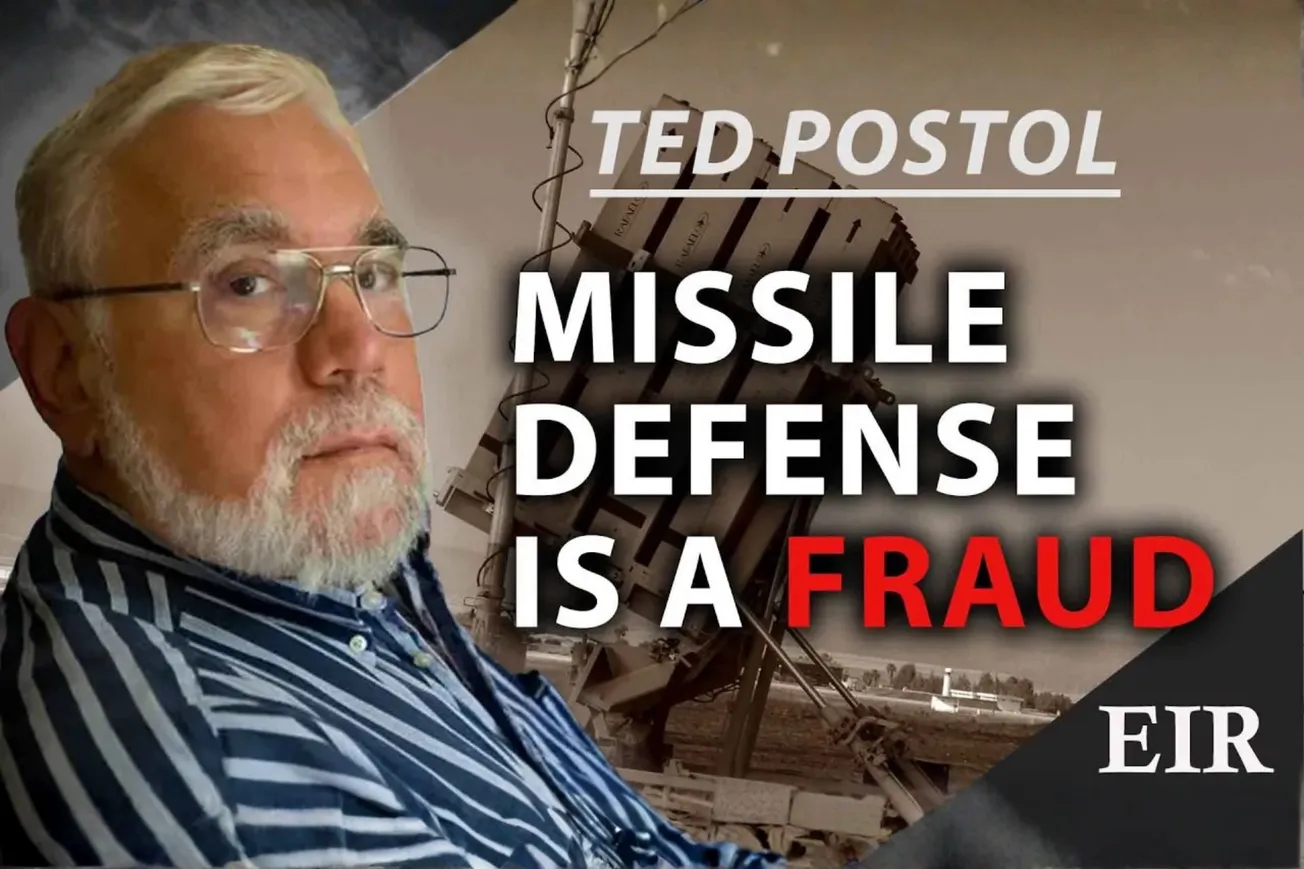
She was followed by Dr. Theodore Postol, MIT Professor Emeritus of Science, Technology and National Security at the Massachusetts Institute of Technology and one of the world’s leading experts on nuclear weapons. He analyzed “the mythical idea of Golden Dome,” Trump’s proclaimed plan for anti-missile defense. It involves orbiting satellites with interceptors to catch ICBMs in boost phase. “Implicit in this idea is understanding that the existing ground-based systems have little or no capability,” since they can’t tell the difference between warheads and the hundreds of decoys which are deployed during the descent phase. Orbiting satellites have less than three minutes to intercept in boost phase, when the missile velocity is relatively slow and no decoys have yet been released. Their orbit must be low enough to maximize that window of opportunity, which will cause atmospheric drag, reducing the lifespan of the satellite to only about six years before it falls to Earth. You would need 1,100-1,200 satellites in orbit to even think about an interception of one ICBM, Postol said. The system scales 100-to-1—for a launch of 100 missiles, 120,000 satellites. You could “punch a hole in the Golden Dome satellite constellation” with an interceptor launched from below, “and your launch would go unopposed.”
Postol expressed his concern that “something is different about Trump in the past few months … something more extreme.” He said that some people have suggested that he may have had a minor stroke. “We have a criminal government right now in control of the United States.”
In response to Postol’s demolition of the Golden Dome scheme, Zepp-LaRouche asked, why is there no one in Trump’s team that will tell him this is unworkable? Postol said that people follow orders, they don’t ask questions. There followed an exchange about the difference between Lyndon LaRouche’s conception of the Strategic Defense Initiative (SDI) based on “new physical principles,” and what Reagan’s program became under the influence of LaRouche’s opponents.
Jens Jørgen Nielsen is a former Moscow correspondent for the Danish daily Politiken, and an author of books on Russia and Ukraine, as well as being director of the Russian-Danish Dialogue and assistant professor of communication and cultural differences. He addressed the issue of Trump’s desired annexation of Greenland, stressing that Greenland has its own government and that people there are very concerned about the possibility of being occupied. Some factions there are calling for immediate independence from Denmark; what would Trump do under those circumstances? Most Danes and Greenlanders were not reassured that U.S. President Donald Trump and NATO Secretary General Mark Rutte reached an agreement over Greenland at the World Economic Forum that did not include them.
A short excerpt was presented from a video interview with Alberto Vizcarra, a leader of the National Front for Saving Mexican Agriculture. He described the dire state of agriculture in Mexico, where exports have collapsed, due to neoliberal economic policies. He went on to review the past proposals of LaRouche for projects in the mutual interests of Mexico and the U.S.
Daniel Burke of the Schiller Institute announced a new international youth class series. He called the youth movement a “crucial strategic flank.”
Discussion
Zepp-LaRouche and Nielsen had a further exchange on what Nielsen calls a “law-based order” as opposed to a “rules-based order.” Zepp-LaRouche suggested that “rules-based order” gives the impression of being based on something arbitrary. They agreed that the abrogation of treaties, combined with the possible stationing of medium-range missiles in Europe, puts the world on edge.
One participant asked, how can we organize against U.S. Immigration and Customs Enforcement (ICE)? This provoked several responses. IPC co-moderator Dennis Speed observed that America has long been a plaything of intelligence agencies, particularly British. What is going on in Minnesota is closely tied to the debacles in U.S. foreign policy. To break from the downward spiral, we need action which is not merely non-violent, but which also poses solutions. The other co-moderator, Dennis Small, stated that the only reason immigration is an issue is that U.S. foreign policy has wrecked the economies of our neighbors to the south, causing waves of refugees.
John Steinbach, co-founder of the Hiroshima Nagasaki Peace Committee of the National Capital Area, noted that nuclear weapons are never defensive in nature, and ABM systems are intended to block retaliation after a first strike.
Returning to the question of Greenland, Dennis Small said that the question of the Arctic is not merely a military one. It is a golden opportunity for international collaboration on economic development.
Zepp-LaRouche commented that Canadian Prime Minister Mark Carney’s speech at Davos has received much favorable attention, but it is a disguised reflection of the policy of Chatham House (Britain’s Royal Institute of International Affairs). She said that he “stated something that was obvious, that the rules-based order is a fraud.” However, the people who are praising him are oblivious to economics, because he was the author of the “great reset” policy to put central banks in charge of government policy.
In her concluding remarks, Zepp-LaRouche reported that out of the recent EIR seminar, titled “It’s Worse Than You Think: The Strategic Implications of the Attack on Venezuela and How To Bring the World Back from the Brink,” she and others have put together a committee that will take responsibility to organize globally for a new paradigm. She announced that it will operate under the slogan, “Citizens of the World, Unite.”