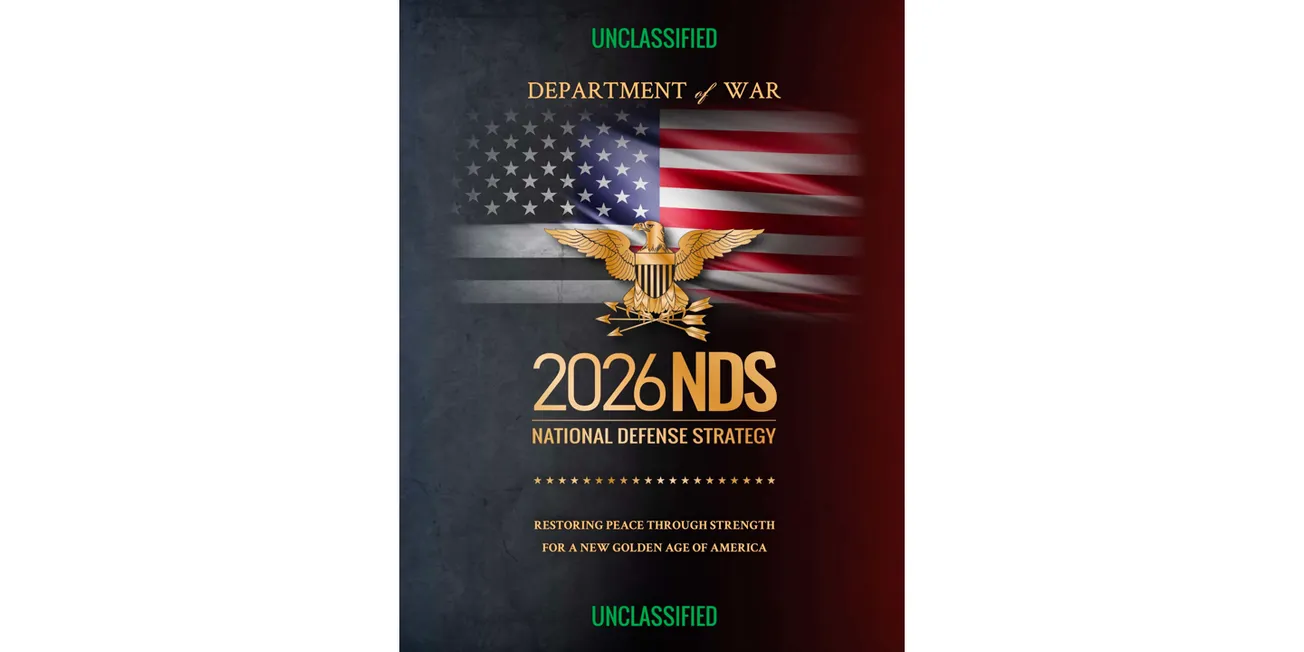
Meyer Lansky may have been a powerful mafia boss but he never had the U.S. military at his disposal to enforce his will. Donald Trump, with Pete Hegseth as his chief enforcer, has that now, and the 2026 National Defense Strategy, released last night, shows the way to achieving Trump’s drive for world domination. “Peace through strength” is the guiding mantra with last June’s bombing of the Iranian nuclear program and the Jan. 3 kidnapping of the president of Venezuela, as examples of how that will be done. Oh, and let’s not forget Israel’s genocide in Gaza. “In the Middle East, Israel showed that it was able and willing to defend itself after the barbaric attacks of October 7th—in short, that it is a model ally,” the NDS declares, explicitly contrasting Israel’s genocidal behavior with the “free riding” Europeans who have mooched off us for far too long. Never mind that the U.S. taxpayer has paid $18 billion for Israel’s war in Gaza and otherwise subsidized its military for decades.
According to the Introduction, America emerged from the Cold War as the most powerful nation on the planet, but rather than protect and use this advantage for our own benefit, succeeding presidencies frittered it away, by opening up borders, wasting resources on “rudderless wars,” and doing all sorts of other things. “They allowed, even enabled, our cunning adversaries to grow more powerful, even as they encouraged our allies to behave as dependents rather than partners, weakening our alliances and leaving us more vulnerable. And so we found ourselves, in January 2025, facing not only a world with individual regions at war or descending toward it but also increased risk of America itself being drawn into simultaneous major wars across theaters—a third world war….”
“Under President Trump’s leadership, consistent with his vision and direction as laid out in the National Security Strategy (NSS), the Department of War (DoW) is laser-focused on restoring peace through strength,” the Introduction goes on. “As detailed in the NSS, the President’s approach is one of a flexible, practical realism that looks at the world in a clear-eyed way, which is essential for serving Americans’ interests.” For the Pentagon this means concentrating on the following tasks:
• “Defend the U.S. Homeland. We will secure America’s borders and maritime approaches,” through the Golden Dome missile defense scheme, the U.S. nuclear deterrent, cyber defense and hunting down “Islamic terrorists,” among other things. “At the same time, we will actively and fearlessly defend America’s interests throughout the Western Hemisphere,” including the Panama Canal, and the Gulf of Mexico (rebranded as the “Gulf of America”).
• “Deter China in the Indo-Pacific Through Strength, Not Confrontation.” The goal here, the document claims, “is not to dominate China; nor is it to strangle or humiliate them. Rather, our goal is simple: To prevent anyone, including China, from being able to dominate us or our allies—in essence, to set the military conditions required to achieve the NSS goal of a balance of power in the Indo-Pacific that allows all of us to enjoy a decent peace.”
• “Increase Burden-Sharing with U.S. Allies and Partners.” That is, make U.S. allies pay more for their own defense so that they’re not “dependencies” of the U.S.
• “Supercharge the U.S. Defense Industrial Base,” so that it can build everything the Trump Administration demands of it.
The discussion of Russia has drawn the attention of analysts in Russia, since it casts U.S.-Russian relations in a much more confrontational light than earlier statements by the Trump administration. Although it claims that ultimately Russia is no match for NATO’s might, the document says:
“Russia will remain a persistent but manageable threat to NATO’s eastern members for the foreseeable future.” And “… the Department will ensure that U.S. forces are prepared to defend against Russian threats to the U.S. Homeland. The Department will also continue to play a vital role in NATO itself, even as we calibrate U.S. force posture and activities in the European theater to better account for the Russian threat to American interests as well as our allies’ own capabilities.”