

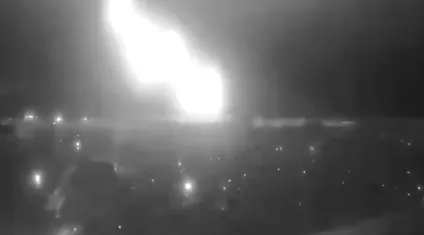
The Russian Defense Ministry announced in a statement this morning, Jan. 9, that the night before it had launched “a massive strike with high-precision long-range ground- and sea-based weapons, including the Oreshnik mobile ground-based medium-range missile system, as well as attack unmanned aerial vehicles, at critically important facilities on the territory of Ukraine.” The strike had been launched “in response to the terrorist attack by the Kiev regime on the residence of the President of the Russian Federation in Novgorod region, launched on the night of 29 December 2025.”
“All the assigned targets have been hit. Production facilities of unmanned aerial vehicles that were used during the terrorist attack as well as power infrastructure enterprises that supported the defense industry of Ukraine have been damaged,” the statement concluded. “Any terrorist actions by the criminal Ukrainian regime will not remain unanswered in the future.”
The Oreshnik’s target was the Bilche-Volytsko-Uherske underground gas storage (UGS) facility about 10 km north of the town of Striy, in the Lviv region. According to a report on the Slavyangrad Telegram channel, the facility “was rendered inoperable” by the Oreshnik strike.
The Bilche-Volytsko-Uherske UGS is reported to be the largest such storage facility in Europe, with a capacity of 17.05 billion cubic meters. It uses a depleted gas reservoir to store gas up to 2 km underground. It also served the needs of the European Union, storing many billions of cubic meters of European gas, more than 10% of Europe’s annual needs.