
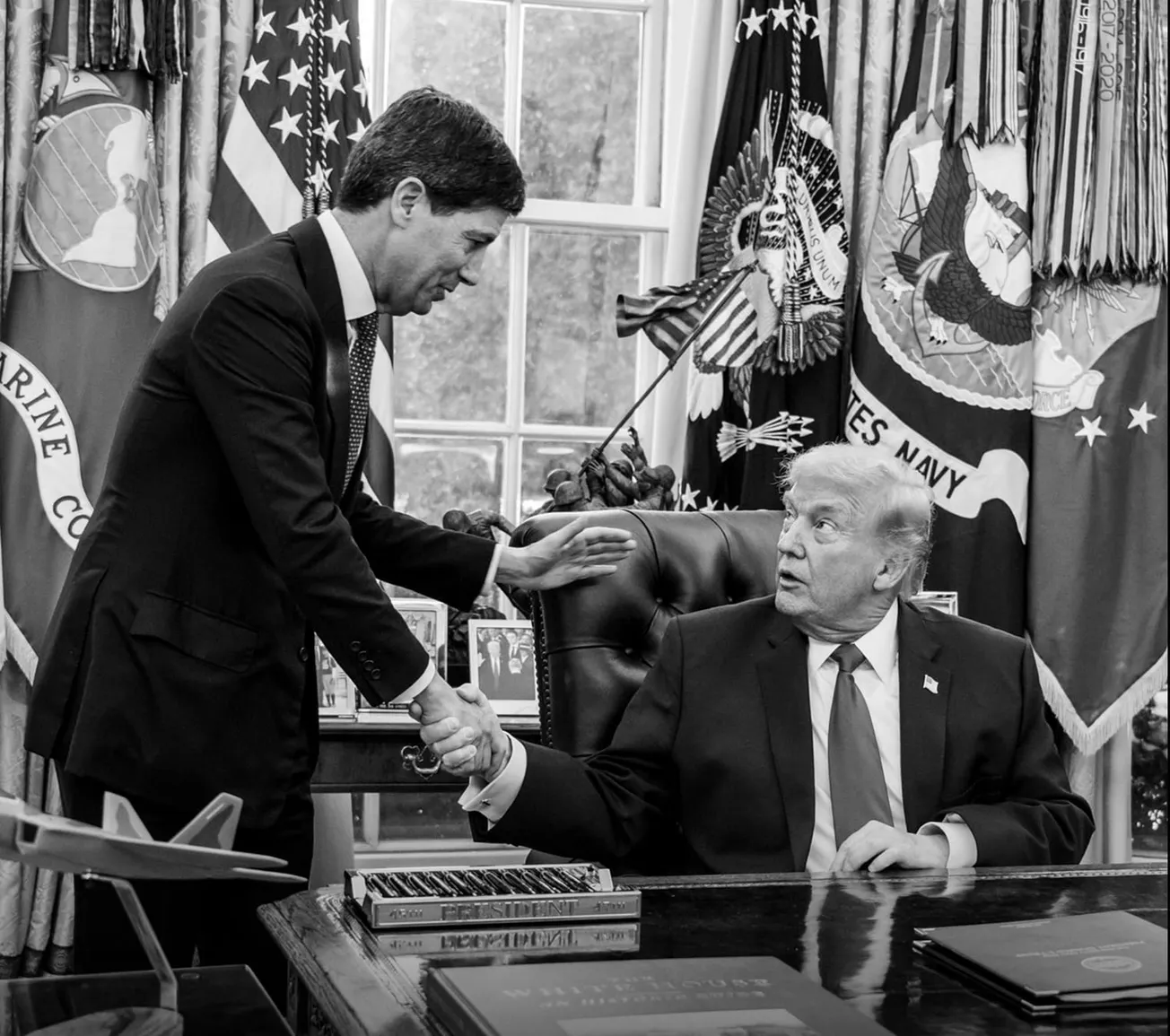
U.S. President Donald Trump announced on Jan. 30 that he had named Kevin Warsh to be the new chairman of the Federal Reserve. Warsh will take the post on May 15, when current head, Jerome Powell, steps down. Warsh is considered a market insider: He went to Stanford University; worked for over a decade at Morgan Stanley; has served on the steering committee of the Bilderberg Group; and was a member of the Federal Reserve Board of Governors from 2006 to 2011, and was assigned as the main Fed liaison to Wall Street and the G20 during that period. According to media reports, Warsh will have to lower interest rates at first, as per Trump’s demands, and he will then be very responsive to Wall Street.
However that turns out, one day earlier, on Jan. 29, Thursday morning, Trump threw a fit over current Fed chair Jerome Powell’s decision this week to not lower interest rates (and to provide “forward guidance” that no lowering should be expected soon). Trump wrote on Truth Social: “Jerome ‘Too Late’ Powell again refused to cut interest rates, even though he has absolutely no reason to keep them so high. He is hurting our Country, and its National Security. We should have a substantially lower rate now that even this moron admits inflation is no longer a problem or threat. He is costing America Hundreds of Billions of Dollar a year in totally unnecessary and uncalled for INTEREST EXPENSE. Because of the vast amounts of money flowing into our Country because of Tariffs, we should be paying the LOWEST INTEREST RATE OF ANY COUNTRY IN THE WORLD.”
This is revealing on a number of levels. First, his open statement that a major reason for lowering interest rates is to reduce the government’s yearly interest payments, which now total about $1 trillion per year, out of total expenditures of about $7 trillion (against revenues of about $5 trillion, which explains why the total debt is now $38.5 trillion and counting). Recall that the Steven Miran “Mar-a-Lago Accord” gamebook (formerly Trump’s top economic adviser, and now at the Fed) is to intentionally devalue the dollar in order to inflate away the U.S. debt, and also to increase U.S. manufacturing by encouraging exports with a cheaper U.S. dollar.
So how is that working out? As for reducing the U.S. trade deficit between the cheaper dollar and Trump’s tariffs, a study called “America’s Own Goal” by Germany’s Kiel Institute for the World Economy, published Jan. 19, reports that the U.S. trade deficit rose this year, by about 4% compared to 2024.
Well, at least there are “trillions” flowing into the U.S. from all of those “cheating foreign countries,” thanks to Trump’s tariffs… right? Wrong. Tariff revenue totaled $236 billion for the 11 months through November, which means the total for all of 2025 will be about $250 billion. Hardly an explosion of “trillions” sufficient to reduce the federal deficit or debt as Trump claims, which now stands at roughly $38.5 trillion. Furthermore, American businesses (importers, wholesalers, retailers) and consumers have paid 96% of the total tariff taxes to the U.S. government to date; foreign producers or service providers “paid” only 4%—but they did that not by lowering their prices, but rather by reducing the volume of their exports to the United States. In short, not a dollar “flowed into the United States from around the world” as a result of Trump’s tariffs. American citizens once again had their pockets picked by the government, in order to pay Wall Street and their military-industrial-financial complex buddies.
But at least manufacturing employment is rising, thanks to the tariffs… isn’t it? Nope. Manufacturing employment sank for 11 of 12 months of the year. Manufacturing activity ended 2025 at its lowest level for the year; global demand for U.S. products (new orders) was declining while manufacturing production was increasing. Employment in manufacturing declined throughout the year (11 months out of 12), resulting in “productivity” (aka speedup) increasing by 3.7%.
Despite the manufacturing decline, industrial employment did rise modestly because its second major component—electricity—went up, mainly due to increased output for data centers and crypto mining.