
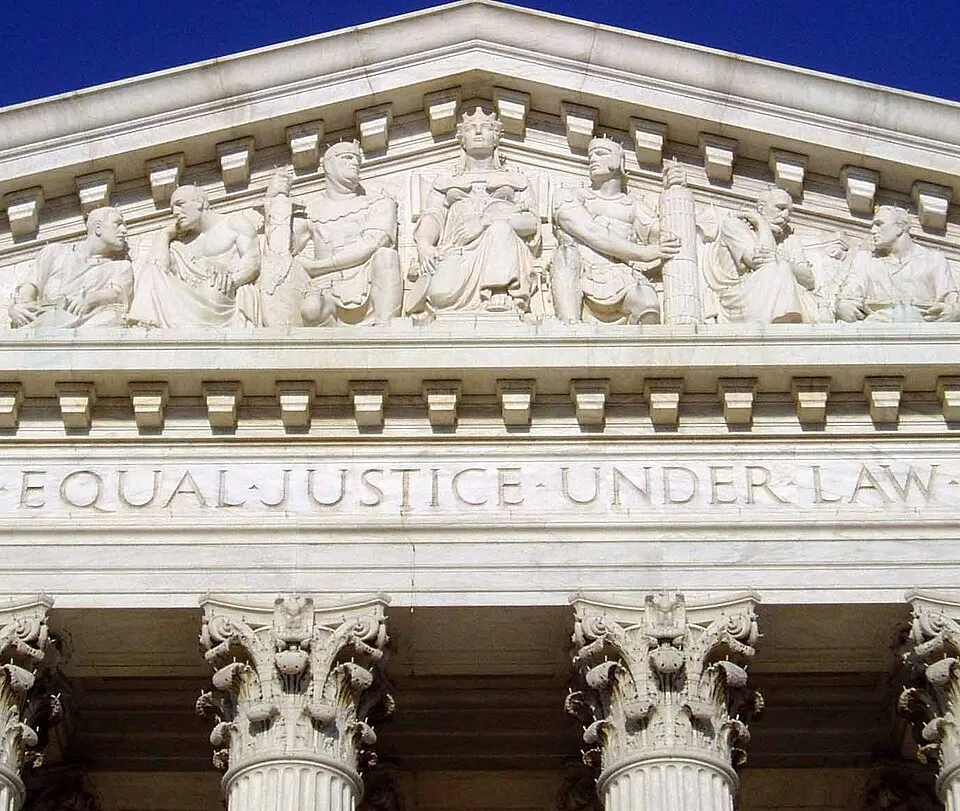
The current unfolding events regarding Greenland, Ukraine, and the Trump imperial order all signify a certain dramatic turn in history: We are at the beginning of the end of NATO. A long overdue—even welcome—happening, in one respect. But what happens next? This was a question put to Helga Zepp-LaRouche, founder of the Schiller Institute, on the Pakistan TV program “UNFOLD” on Jan. 17, who was asked to review the Greenland confrontation, and fractures within NATO. Doing this, and more, Zepp-LaRouche concluded, “I think this all cries out for an urgent discussion by the international community to find ways to return to international law.”
In Paris this week, a formal motion has been put before the legislature for France to withdraw from NATO. The La France Insoumise party, which has held this position for some time, now has put it on the agenda. There is support from both the left and right. In Greenland, the face-off between European NATO member nations and the United States continues, with token numbers of European military personnel on the ground, to oppose U.S. President Donald Trump’s demand to “own” Greenland. This week’s back-and-forth meetings between the United States and Denmark—two founding members of NATO—resulted in no resolution. A Danish delegation came to Washington, D.C., and a U.S. Congressional delegation went to Copenhagen.
In Ukraine, collapsing living conditions in the cold winter add to the military reality, that it is impossible for this combat against Russia to continue, despite the crazed insistence to date by acting President Zelenskyy, and principals of the Coalition of the Willing (Killing).
These, and other co-factors, are part of the backdrop in which in recent days, certain voices suddenly started speaking out, that “Europe must start talking with Russia.” These include even some heads of state who had until recently pledged to fight “demon-Putin” in perpetuum. On Jan. 16 Kremlin spokesman Dmitry Peskov addressed this shift saying: “We have noted statements made in recent days by a number of European leaders, namely by Paris, Rome, and even Berlin, strange as it may seem, in favor of the idea that, after all, in order to have stability in Europe, it is necessary to talk to the Russians…. If this truly reflects the Europeans’ strategic vision, then it is a positive development in their positions.”
Meantime, Washington continues military deployments around the world under the rubric expressed by President Trump on Jan. 7, “I don’t need international law.” At present there remain some 15,000 U.S. troops in the Caribbean, and 30,000 in the Southwest Asia theater, in and around the Persian Gulf. There are reports, unconfirmed by the Pentagon, that possibly two aircraft carrier strike groups are headed to the Arabian Sea area: the USS Abraham Lincoln, from the South China Sea; and the USS George H.W. Bush carrier group, which left its homeport of Norfolk, Virginia on Jan. 13.
Most ominous are the new, official warnings of caution in using the airspace over and nearby Iran, and above the Pacific along the coastlines of Mexico, Central America, and northwestern South America. The U.S. Federal Aviation Administration on Jan. 16 issued a public notice that it has given a 60-day advisory NOTAMS (Notice to Airmen) for civil aviation operations to watch out for “ongoing military activity” in the overwater portions of the Flight Information Regions of the Pacific Ocean from Mexico down to Ecuador. Similar warnings had appeared for Venezuelan Caribbean Sea airspace before the U.S. military moved into that nation to kidnap President Nicolás Maduro. The European Union regulator on Jan. 16 issued civil aviation warnings for the airspace over and nearby Iran.
Consistent with this pattern of show of might is what appears to be the content of the “Phase Two” plan for Gaza issued by Washington over the last 24 hours. In principle, the idea of the international community being involved in reconstruction and peace resolution in Southwest Asia is desirable, in the abstract, but in this case, the concept is that of a British-Empire viceroy.
The White House posted on Jan. 16: “Statement on President Trump’s Comprehensive Plan To End the Gaza Conflict.” The document, which nowhere even names or identifies Palestine or Palestinians, is termed Phase Two of the 20-point roadmap. It specifies new entities and appointments to each one, including a Board of Peace, a Gaza Executive Board, an International Stabilization Force, and so on. Sir Tony Blair is to serve on the top two entities.
President Trump has sent letters of invitation to certain heads of state, including Argentina President Javier Milei, who immediately accepted “the honor,” as Milei said. Egyptian President Abdel Fattah el-Sisi has the invitation under consideration. Türkiye President Recep Tayyip Erdogan, and Canadian Prime Minister Mark Carney are invited.
Once again, the point is clear that the world community is called upon to deliberate and intervene with policies truly in the interest of justice, economic development and peace. Jan. 16’s participants in the International Peace Coalition’s 137th weekly meeting deliberated on concepts related to a forthcoming “January 12 Declaration” of what must be done. Jan. 12 refers to the date of the Emergency Roundtable sponsored by EIR, as a platform for deliberation and intervention. Enlist in this effort.