
The following is an edited transcript of the Feb. 24, 2026 EIR interview with Larry Johnson. Mr. Johnson is a former CIA analyst and co-founder of the Veteran Intelligence Professionals for Sanity (VIPS). The interview was conducted by EIR’s Editor-in-Chief Helga Zepp-LaRouche. Subheads have been added. The interview is available here.
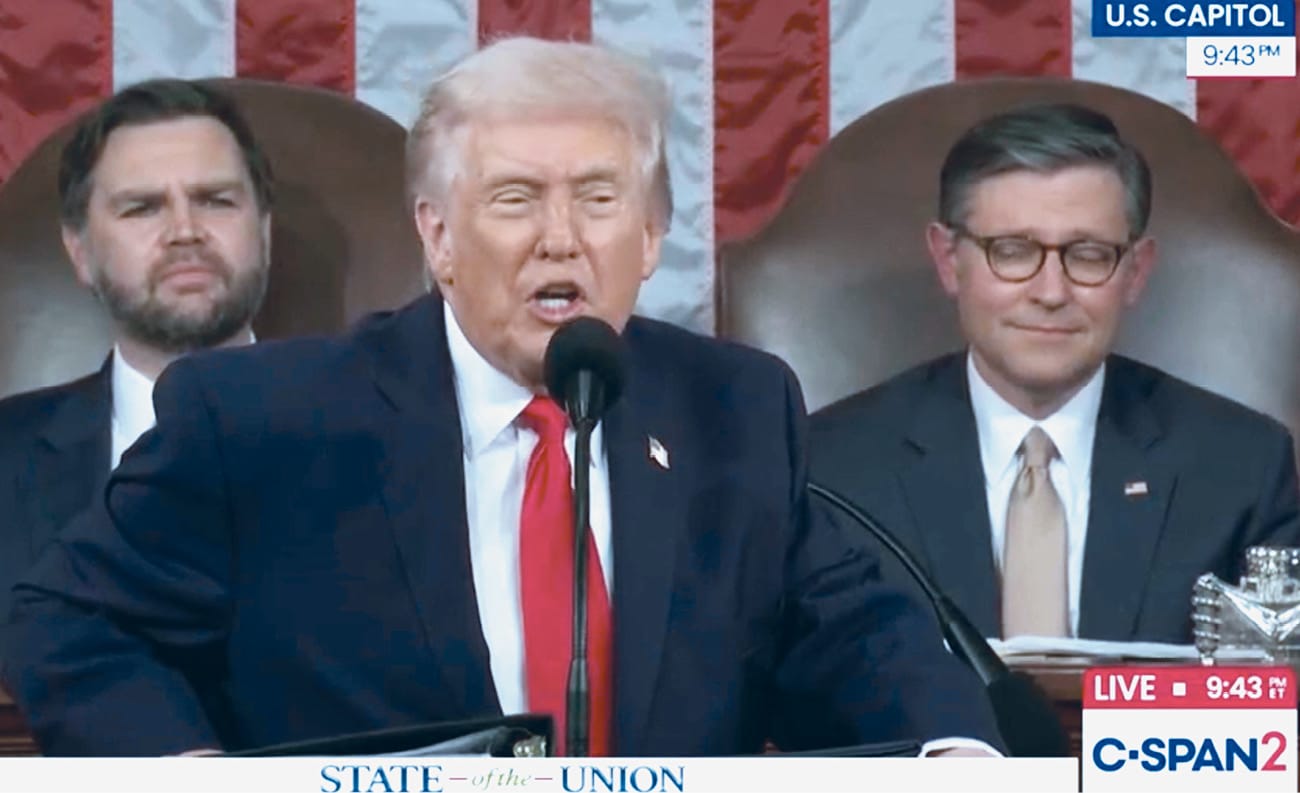
Helga Zepp-LaRouche: Hello, it is my great pleasure to greet Larry Johnson as my discussion partner today. He is a very outspoken former CIA analyst, part of the Veteran Intelligence Professionals for Sanity [VIPS], and extremely knowledgeable about many areas of the world. So welcome to you, and let’s discuss today our topic on sanity versus madness in the world. Under that category, one can summarize a lot of different topics, but maybe we should start with the key event of last night, which was the State of the Union Address by [U.S.] President [Donald] Trump. It was almost two hours, and all the Republicans were cheering him on, giving him standing ovations most of the time. So, what is your view on the content and the perspective which was laid out by President Trump?
Larry Johnson: Well, Helga, thanks. I enjoy the chance to just chat with you today. We chose the topic, “reason versus insanity.” Did you ever see the movie Amadeus? It was about the life of Mozart, but the opening scene is the people walking into this insane asylum, and as they’re walking through this insane asylum, making their way to Salieri, who is a competitor of Mozart, you see just all of these bizarre images of different states of madness. I think that entire scene right there is a metaphor for what we’re living through today, and last night was a case in point.
The delusions that were on display were remarkable. The one that really grated at me was when Trump stands up and proclaims Iran is the number-one sponsor of terrorism in the world, and they’ve killed millions of Americans; millions. I don’t know whether to ascribe that to dishonesty, stupidity, or a mixture of the two. And it’s not just Trump saying that; you find it repeated by Republicans and by Democrats. But it is objectively not true.
When I started working at [the U.S.] State [Department] in October of 1989, that was the first year that the State Department put out what was called Patterns of Global Terrorism, and the way it worked was, the CIA had started collecting the data identifying terrorist acts, and then they would compile all that data, and then we would write the report, and the report was submitted to Congress in April of 1990. That was the first version, and they have produced one every year since. In 2003, they changed the title. It went from Patterns of Global Terrorism to Country Reports on Terrorism. Most of them contained a statistical annex, so you could track who was actually doing the killing. And when you go back and pull all those reports and look through all the data, what you discover is that over 80% of the international terrorist attacks have been carried out by groups that are aligned with Sunni Muslims, particularly supported by individuals in Saudi Arabia, Qatar, United Arab Emirates, Pakistan. None, or none of the most prolific terrorist groups, are affiliated in any way with Iran. In fact, some of the top groups—ISIS, al-Qaeda—have been the enemies of Iran, not the supporters.
And with respect to the charge that they’ve killed thousands, millions of Americans? No. The actual numbers are—and these are attributed to proxy groups: The attack on the U.S. Marine barracks in October of 1983 in Beirut, Lebanon, killed, if I recall, around 241 Marines. And then the use of improvised explosive devices in Iraq during the U.S. invasion—an illegal invasion, I might add, of Iraq in 2003—that resulted in the deaths of 663 American soldiers. Now, I don’t want to minimize the loss of life of those individuals, but we’re talking less than a thousand. We’re not talking thousands, tens of thousands, or a hundred thousand, as President Trump said; nowhere approaching near a million.
Cold War Genocide Against Iran
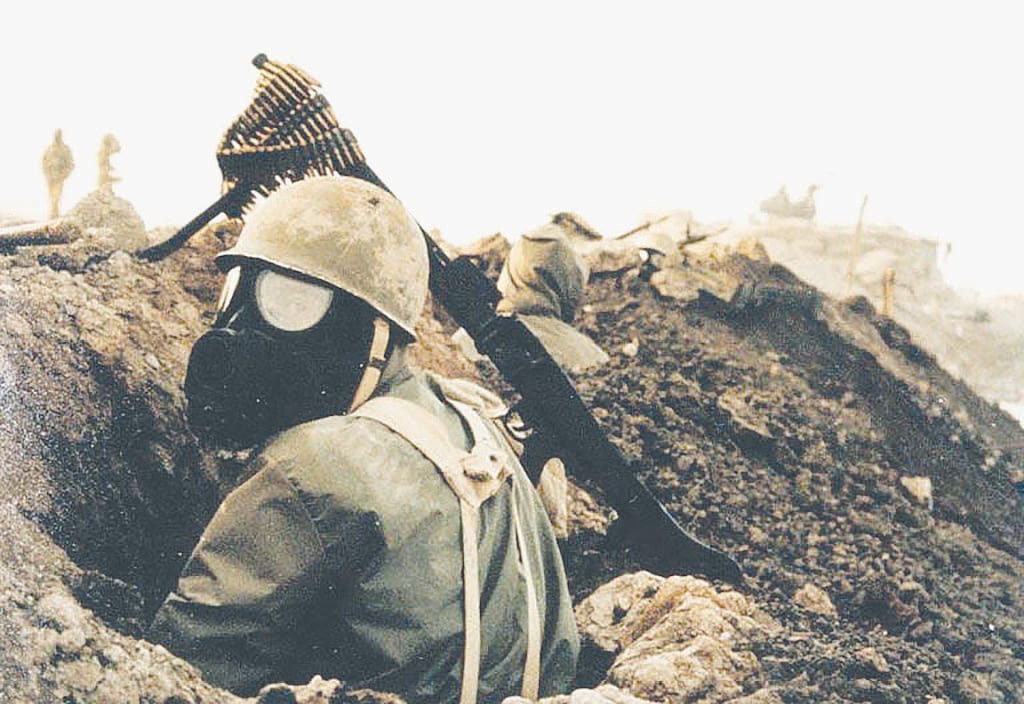
The fact of the matter is that in terms of Iran-U.S. relationships, the United States is responsible for the deaths of at least 250,000, if not more, Iranians. Back in 1980, in the switch from President Carter to President Reagan, the Deep State thought it was a great idea to encourage Iraq to invade Iran, because we thought, as long as the Iraqis and Iranians are killing each other, that’s great. It’ll weaken Soviet influence in the world at that point. And then, under [Defense Secretary] Donald Rumsfeld, we decided to provide precursor chemicals to Iraq that were used to create mustard gas, and they used chemical weapons against the Iranians.
So, you compare what is an actual, at least 250,000 dead Iranians because of U.S. involvement, against fewer than a thousand that have died because of— They weren’t even terrorist attacks, because I maintain, a terrorist attack is an attack against civilians; use of violence against civilians for political reasons. All these attacks were against military targets. You’re wearing a uniform, carrying a gun—sorry, that’s not terrorism, that’s war.
But the mythology, the lie persists. And what I’m stunned by is my attempts to try to reason this out with people. I mean, you can’t even penetrate the mind. Related to this is Hamas and Hezbollah. We’re told that Iran is the sponsor of terrorism, because of all the terrorist acts that Hamas and Hezbollah carry out. Two years ago, I stumbled across the Israeli Foreign Ministry website, which lists every single attack by Palestinians—which they label as terrorism—against Israelis, dating from August of 2000. And the numbers—they continue to update the list—but when I pulled it, it was on April 26, 2024. They don’t provide any summary data, so I had to go through it, with the assistance of one of my readers—and we put it into a spreadsheet. Well, there were 600 over that 24-year period, or 25-year period. Actually, there were 672 separate terrorist incidents; total deaths of Israelis or foreigners who were in Israel, fewer than 1,500. And again, I don’t want to say that there was no terrorism. But 1,500 is a lot different from 150,000. And of those 672 incidents, only 105 were linked to Hamas. That’s over a 25-year period. That’s basically 4 per year. So, in the scale of things, that’s nothing. For Hezbollah, five; five incidents that were linked directly to Hezbollah. Now, Hezbollah did fire 20,000 rockets [into Israel], but most of the rockets were being fired at military targets. And in any event, they caused very little physical loss of life: 65 people, again, over 24 years.
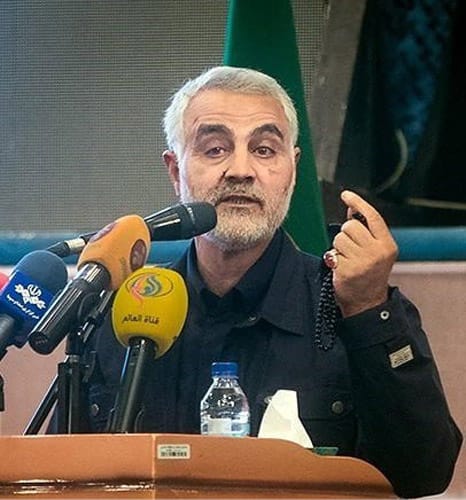
Zepp-LaRouche: In the recent period, President Trump again has proudly talked about his elimination of Qasem Soleimani—and as far as I remember, Soleimani was actually helpful in combating terrorism. But still, this narrative continues. Maybe it’s a sort of naïve point of view, but whenever I see that a people or a country is vilified for no good reason—and it just happens to be that I know several Iranians of different political backgrounds; some are with the present government, some are opposed—but the picture one gets is that this is an ancient civilization. They’re very proud to be Persians. No matter what government may be there for the time being, or some other time, they are proud that they are one of the greatest civilizations of humanity. They are proud of their paintings, their poetry. Can you shed some light on why people are so fixated about Persia?
Johnson: Yeah. It’s really irrational. We’ve created this narrative—and it really started with the takeover of the U.S. embassy, in October of 1979. The way it was presented to the United States was that this was unprovoked. Here we are, we got our diplomats, we’re just minding our own business, and these mad, crazy, radical Islamists stormed our embassy and held us hostage, with nobody in the American media and political sphere taking time to sit down and say, “Well, you know, actually, this is a reaction.” We were harboring a man [Shah Mohammed Reza Pahlavi] that had killed in the previous year-and-a-half in Iran, or was responsible for, the deaths of 30,000 Iranians.
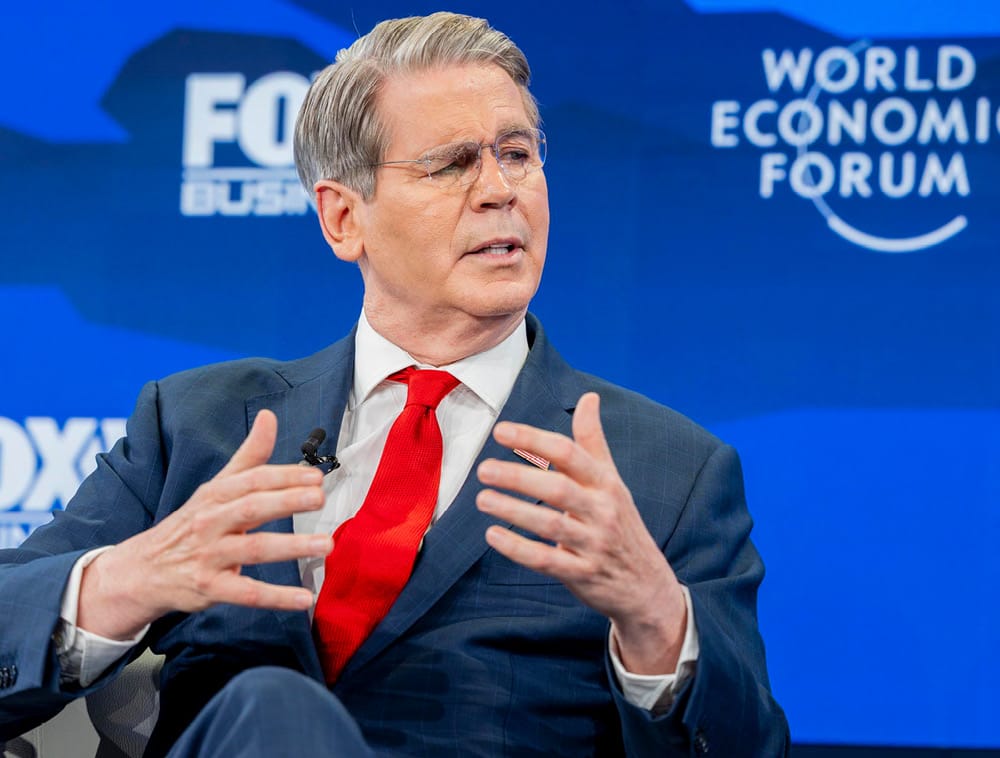
Now, we’ve heard that number 30,000 recently, because the United States and Israel tried to spark a “color revolution” in Iran on December 28, 2025. We crashed their economy. Scott Bessent, [U.S.] Secretary of Treasury, has admitted that openly. “Yeah, well, you know, we sabotaged the Iranian economy. People came out in protest. And then as part of that, we infiltrated outsiders to agitate, to stir up, to commit acts of violence. And we then began circulating numbers saying, oh, the current Iranian authorities have killed 30,000 protesters.” Not true.
But what happened back in 1979 was, the Shah of Iran, Pahlavi, with the Internal Security Service, SAVAK, that had been helped to be set up and trained by the CIA, had actually murdered over 30,000 Iranians. And that had led to this tremendous build-up of resentment. So, that’s what led to the takeover of the embassy.
U.S. Support for Al-Qaeda
Since then, Iran has been vilified repeatedly as this sponsor of terrorism, and creating mayhem in the Middle East. Iran hasn’t invaded a single country, not one. It did provide military support to Syria, which was facing a radical Sunni Islamic movement that was actually funded by the United States and, to a lesser extent, Britain. And we made the 9/11 [2001] attacks a rallying point for the United States about, “Oh, we’ve got to stand together to fight terrorism,” without the average American understanding that the very people that attacked us, we’d also been providing financial support to and had supported over the years. We’ve used them as proxies—not just al-Qaeda, but other radical Islamist proxies—to start a war in Chechnya back in 1999. So here was Iran as a natural ally against this.
And yet, instead, we mounted terrorist attacks against Iran. So, this is one, just one example of the lies and the misrepresentation. We’re not talking about a matter of opinion here. We’re talking about objective facts. Because if you say Iran’s the number-one sponsor of terrorism, I say, “Okay, tell me which incidents, who, which incidents are they responsible for? Is there a bombing? Is there a massacre? Lay it out.” Well, the State Department has laid it out. And not only the State Department. The French, they have a think tank; the acronym is FONDELAB. They also came to the same conclusion, and their data covers a period from 1979 through 2024. Their data says 85% of the terrorist attacks that lead to casualties are carried out by radical Sunni groups: the Taliban, Boko Haram, ISIS, al-Qaeda, Hayat Tahrir al-Sham—you know, the group that was headed up by the guy we now call al-Sharaa [president of Syria, as of Jan. 29, 2025], previously known as al-Jolani. So, again, there is this level of dishonesty.
And the average person, whether in Europe or in the United States, they don’t have a lot of time to do the research like I’ve done to dig into it. That’s why it’s important having discussions like this with you, and putting it out on social media as an attempt to try to educate people about the story. If the government’s telling you something, they’re probably lying.
Zepp-LaRouche: The tragedy is that Scott Bessent called this American interference in the internal affairs of Iran “economic statecraft.” You know, statecraft is something I cherish very highly. As a matter of fact, the Schiller Institute is called an institute for statecraft. And what we mean by that is to improve relations among nations, so that each one emphasizes the best tradition of the other; that you build trust and friendship; that you work together on science and Classical art. So, for Bessent to misuse that word statecraft in this way is really a total travesty. But, I think the reason President Trump is hesitating to launch a new strike against Iran is because he is being told by some top military, including the Chairman of the Joint Chiefs of Staff [Gen. Dan Caine], that this would not be so easy for the United States to get away with.
The Chinese, according to Reuters, have just sold to Iran underwater missiles which have a range of 290 km, and they go very fast—and they could really do damage to the naval armada, which President Trump has talked about. Also, since June, the Russians probably have reinforced the defenses of Iran.
So, what is your view of what would happen if there would be a new strike against Iran, either instigated by Israel, or by the United States on its own? What in your view would play out?
Johnson: I posted a piece last night at Sonar 21 laying out some of the reasons that I believe General Caine has now gotten cold feet or is having second thoughts about the advisability of attacking Iran. And again, this is a classical example of gaslighting, where you’re telling people lies, trying to feed them propaganda in order to create an effect or a perception. In the wake of the 12-day war last June, Iran turned to Russia and China, basically asking for help, to have a relationship on the military and intelligence front that previously they had rejected. Russia and China both eagerly said, of course we’ll help, and they have been providing enormous assistance.
Right now, I think one of the most important aspects is that the Chinese have a radar—I think it’s YLC-8B—but it’s capable of seeing out to about a distance of 400 miles. So, if you put that on the border of Iran, the western border, that means you can see well into Saudi Arabia. And that’s important, because right now, the bulk of U.S. combat aircraft have deployed to Prince Sultan Air Base in Saudi Arabia and to the Muwaffaq Salti Air Base in Jordan. The one in Saudi Arabia is about 700 miles from Tehran, and the one in Jordan is more nearly 1,000 miles away from Iran…. Well, that plane’s combat radius is 600 miles, and what that means is, it can fly for a total of 600 miles. So, the combat radius means you can go out 300 miles, and then it would have to return to its base if it wasn’t going to get refueled. But if it’s going to attack Iran, it could fly 600 miles and then would have to be refueled, and then could continue its trip, because from the western Saudi border of Iran to Tehran, it’s another 270 miles.
This Chinese radar basically looks well into Saudi Arabia, and it’s now integrated with air defense systems provided by Russia. That means that the possibility of the U.S. launching a surprise attack on Iran is very, very low; and that Iran now has, through the combination of the Chinese radar and the air defense systems that are integrated with that radar and integrated with satellite intelligence, a very good chance of not only defeating the— Because these planes are going to drop what are called air-guided missiles, AGMs, and those AGMs can travel around 450 miles. But even though the planes could stay safely inside Saudi Arabia, at the point at which they would have to drop their missiles, they’d be well within the range of the radar.
Iran Can and Will Retaliate
General Caine is looking at that and realizing that Iran’s not just going to sit there passively and say, “Oh, we’re being attacked.” They’ve got missiles and drones of their own that they can fire back. What I’m saying is, that this so-called threat package we have doesn’t really pose a significant threat to destroying Iran’s military assets throughout the country. Iran’s a big country. Most Americans don’t understand that it’s four times the size of Iraq. It’s almost triple the size of Ukraine, just to put it in perspective. So, here is the United States, pretending that we have this vast military power, which we really do not.
And I believe Trump is going to authorize an attack on Iran. It will happen. There’s supposed to be a meeting tomorrow in Geneva between the Iranians and the U.S. delegation, [U.S. Special Envoy] Steve Witkoff. I think this is almost pre-scripted in advance. The Iranians are willing to say, “Hey, yeah, we’ll provide you guarantees that we’re not building a nuclear weapon.” They did so under JCPOA [the 2015 Iran nuclear deal—ed.]. But Donald Trump rejected that; walked away from it. Iran’s willing to make some concessions on enrichment of uranium, but it’s the United States that refuses to accept that deal.
So, I think the United States will reject it. Again, I hope I’m wrong. I would love to hear that Trump’s going to come out and take credit: “Hey, I’ve eliminated nukes in Iran.” I mean, that could be his story. “I did this.” Now, he really didn’t. But the Iranians will let him take credit for it; the Russians will let him take credit for it. Sure, as long as it stops the war. Because if Trump proceeds with this attack on Iran, it is going to be a defeat for the United States. We may inflict damage on Iran, but what it’s going to show is the limits of U.S. power. The United States cannot sustain a war, a conflict with Iran, beyond two months, three months tops. We would run out of—we would exhaust our supply of Patriot missiles, air defense systems. And that includes both the Patriot and the THAAD.
I don’t know if you’ve paid attention to what’s happening with the U.S. aircraft carrier, the Gerald Ford, touted at $13 billion, the most magnificent ship in the world. They have plumbing problems. In the age of sailing ships with sails, they had something that was called the poop deck. Now, most people assume that the poop deck was a place where people took care of their answering the call of nature while at sea, but that wasn’t it. The poop was actually a French word for the deck. But they literally now have turned the Gerald R. Ford aircraft carrier into having its own poop deck, because there is raw sewage flooding certain parts of the ship—because the plumbing doesn’t work. You spend $13 billion on an aircraft carrier, and the plumbing doesn’t work.
So that’s where we get this difference between the insanity, the lies, and then the reality and the reason.
Zepp-LaRouche: The worry is, if the thing escalates—and it could, because you have the [Israeli Prime Minister Benjamin] Netanyahu factor, who has his own reasons why he is an adversary of Iran. And under the worst circumstances, Iran could deliver some really devastating blows to Israel. Then the big worry naturally is, would Israel in such a situation use nuclear weapons? And then everything would go off the charts, because I think neither Russia nor China could allow Iran to be destroyed by nuclear weapons.
You have the warning by [Russian Foreign Ministry spokeswoman] Maria Zakharova that the French and the British have now somehow offered nuclear weapons to Ukraine. Are these people out of their minds? In my understanding—I studied [nuclear weapons experts such as] Ted Postol, Steven Starr; I have really, for many years, looked at what they have been writing….
I was saying that I believe the theory that they both pursue, that once you use one nuclear weapon, there is a very high risk that within five days, you could have a global nuclear war. And still talking about insanity, how can any political leader who is in their right mind, how can they even consider the use of nuclear weapons, when it could lead to the annihilation of the human species? I mean, do we have any insight? Are they really thinking they can win a nuclear war?

Johnson: Yeah, yeah. We’ve divorced ourselves from reality, where we got this increased distance from World War II, the generation of Americans that went through that war. And look how, in a way, it traumatized even the United States, despite the fact that, objectively, the United States suffered very, very little damage from that war. That war was so beneficial to the United States in terms of really transforming it into an economic superpower. Our total deaths in combat from World War II in the European and North African theaters was 190,000. And I don’t want to minimize the loss of life of 190,000, but that pales in comparison to the Soviets, who lost over 700,000 dead at just the Battle of Stalingrad alone. We lost 110,000 in combat casualties in the Pacific War. And then there were another 113,000 that died from sickness and accidents. They weren’t combat casualties; they just died as a consequence of being in the military and getting sick. But nonetheless, losing 470,000 dead, it really left an impression. And we did have a generation that recognized—even [President] Richard Nixon—that there is no advantage to be had by going down the path where we could use nukes.
Russian SVR Exposes Plot by Britain and France To Arm Ukraine with Nukes
Feb. 24, the Press Bureau of the Russian Foreign Intelligence Service (SVR) issued a statement exposing a plot by London and Paris to provide the Kiev regime with some type of nuclear-weapons capability. Below is the statement, translated from the Russian.
London and Paris Are Preparing To Arm Kiev with a Nuclear Bomb
Press Bureau of the Russian Foreign Intelligence Service
February 24, 2026
The Press Bureau of the Russian Foreign Intelligence Service reports that, according to information received by the SVR, Great Britain and France recognize that the current situation in Ukraine leaves no chance of achieving their much-desired victory over Russia at the hands of the Ukrainian Armed Forces. However, the British and French elites are not prepared to accept defeat. They believe Ukraine needs to be equipped with “Wunderwaffe.” Kiev would be able to secure more favorable terms for ending the hostilities if it possessed a nuclear bomb, or at least a so-called “dirty bomb.” Berlin wisely declined to participate in this dangerous adventure.
Currently, according to information available to the Russian Foreign Intelligence Service, London and Paris are actively working to resolve the issue of providing Kiev with such weapons and their delivery systems. This involves the covert transfer of European components, equipment, and technologies to Ukraine. The French TN75 small-size warhead from the M51.1 submarine-launched ballistic missile is being considered as an option.
The British and French recognize that their plans constitute a gross violation of international law, primarily the Nuclear Non-Proliferation Treaty, and are fraught with the risk of destroying the global non-proliferation system. Therefore, the Westerners are focusing their efforts on making Kiev’s acquisition of nuclear weapons appear to be the result of Ukrainian development.
Such extremely dangerous plans by London and Paris demonstrate their loss of a sense of reality. They are futilely hoping to avoid responsibility. Moreover, all that is secret will inevitably be revealed. There are many sensible people in the military, political, and diplomatic circles of Great Britain and France who understand the danger their leaders’ reckless actions pose to the entire world.
Kennedy, [President] John F. Kennedy, stood strongly against that in the face of pressure from people like Gen. Curtis LeMay and others to try to bomb, to attack the Soviet Union during the Cuban Missile Crisis. But we did have a generation that basically said, no, we’re not going to go down that route.
War Is Not a Video Game
Now we’ve got a generation with no living memory of that. All they’ve seen—you know, we treat wars like video games, because we get to watch it, we get to cause death and mayhem, but it doesn’t really affect us. The United States has been protected by its oceans and with the buffer of Canada on the north and Mexico on the south. We get to go out and kill other people. We get to go out and destroy their societies. Doesn’t hurt us. In fact, we make money off of it. The military-industrial complex is just rolling along, doing great. People get dividends. What’s to complain about?
And so now we’re at a stage where, again, we insist that Iran can’t have a nuclear weapon. Iran has not been working on a nuclear weapon. But here’s Israel, who’s not a signatory to the Non-Proliferation Treaty, as Iran is. Iran allowed inspections by the International Atomic Energy Agency of its facilities; Israel doesn’t. And yet Israel is treated as a special case, that can do whatever it wants, kill whatever it wants, attack whoever it wants—with no consequences. And that is this other dimension of where we talk about the divorce between reason and insanity.
Zepp-LaRouche: I think that’s what accounts for the lack of sensibility on the danger of nuclear war among the young people and the general population. I look at the impact of video games, which were used by the military to lower the empathy in people shooting other people, because normally the person has an adrenaline reaction and is trembling for 15 minutes. And the video games were designed to eliminate that factor; to increase what they call the kill ratio. So that, I think, is why the general population is so numbed.
But the recently exposed depravity of the [Jeffrey] Epstein class, which has erupted as a big international scandal, accounts for the mindset of some of these people who are making the money out of this military-industrial complex and other operations. Because what becomes clearer is that some of these so-called elites—who are not elites at all, they are just some part of the depraved establishment—the mindset with which they commit these sexual crimes, and the mindset with which they launch military operations, with lack of regard for the casualties, like in Gaza, or engage in speculative action in financial derivative high-risk games, which puts the whole world economy at risk—that disconnection of any empathy for the consequence of their actions is the same in the personal behavior and the larger economic or financial activity. But, given the fact that you are probably following these Epstein revelations, can you give us what is your conclusion so far?
Johnson: Yeah, well, Jeffrey Epstein was a very, let’s call him a complicated figure, because he was not just a sexual predator, but he was intimately connected with the Rothschild’s financial network. He was tied and involved with intelligence activities, both with respect to Mossad and the CIA. He was sort of an agent; I’ll call him an agent of influence. He was somebody that could get access to people and then build networks, and then in the process create negotiating leverage over people, some of it through blackmail. But he’s a symptom of the system.
In other words, he wasn’t the leader of it, or the organizer of it. He was merely taking advantage of something that’s very dark, and I’ll even call it satanic. I do think it is organized, it is global. It is a rejection of everything involved around anybody who embraces the concept of a supreme deity, whether it’s in Christianity or in Judaism or in Islam as the major religions, but the notion that human beings are a creation of God, and by virtue of being a creation of God, have value; whereas this satanic movement sees people as commodities, things to be used and exploited, and with no sense that the life of a human being is precious. The life of a human being is something that can be used and consumed, and used for one’s own benefit. So that is an actual force and ideology that’s out there that drives, I think, a lot of what we see as foreign policy, the choices by governments: this thirst, this quest for war, and the notion that all we’ve got to do is kill people, that’ll solve our problem. Or we can murder women and children in Palestine, and nobody loses any sleep over it; what does it matter to us? They’re just in the wrong place.
Russia Embraces Multiculturalism
So, I argue that this is one of the reasons there’s such animus in the West directed at Russia. With the collapse of the Soviet Union, Russia rediscovered its roots in Orthodox Christianity. They don’t just pay lip service to it; they genuinely believe in the tenets of Christianity and how they apply it. And what I found fascinating in my— You know, I’ve been fortunate to travel to Russia seven times in the last two years. The Russians have a completely different attitude in how they deal with people from other cultures and other religions.

So, although there was this intense civil war in Chechnya back from 1999 through 2009, 2010, today you don’t find animus, hatred directed at Muslims. Instead, you find that the Islamic culture has been embraced and brought into the Russian culture as well, and among the Muslims in Russia, there’s great patriotism. Russia’s figured out a way to say, we are proudly Christian, but we respect—and not just talk about it, but they show it in how they deal with not just the Islamic culture, but there are other cultures. There’s one entire republic out in Siberia that is Jewish. You know, it’s one of the largest Jewish populations outside of Israel—surprisingly so. So, the Russians have found a way that they treat others with respect and don’t feel that they have to dominate them, control them, or transform them into Russians. They almost celebrate the diversity.
That’s something here in the West, and particularly within this demonic culture that is representative of Epstein, that you don’t get. Again, they will look at people as something that can be exploited, whether economically or sexually.
Zepp-LaRouche: But that is being recognized by what I would call the Global Majority, because in the recent period, I had many discussions with representatives of what you could call the Global South countries. And they are, I would say, in their own traditional orientation, like what you described for Russia; that they respect each other, they consciously want to rebuild a system based on the Five Principles of Peaceful Coexistence, non-interference in the internal affairs of the other one, respect for sovereignty, win-win cooperation.
And they are looking at the collective West basically as a dying civilization. And I think we may very well be. I mean, if Germany does not get the curve, so to speak, as we say in Germany—I know the Germanism, you don’t say that in English—but if we don’t get back to our more proud tradition of science and technology and excellence in the economy, we may end up being one of these civilizations where you can see the relics in museums of a culture which didn’t make it. And we find German artifacts in Mali or in Mongolia, as one of these failed societies.
So this is why we, from our organization—the Schiller Institute and the Executive Intelligence Review, our magazine and so forth—we decided to, when there was a combination at the beginning of this year, where you had President Trump who said he does not need international law; then you had the Epstein scandal erupting and the kidnapping of [Venezuelan] President [Nicolás] Maduro; now the choking of Cuba. So, all of these things have become so absolutely incredible that we said, “No, we have to have a different approach.” And we have been campaigning since the special military operation started almost exactly four years ago. We have been calling for a new paradigm, a new security and development architecture, which must take into account the interests of every single country or it does not work.
Because if you look at the evolution of international law, whenever the principle of taking into account the interests of the other was observed, it led to peace. And when that was violated, like in the Versailles Treaty, where interests of China and Germany and others were left out, it was just a stepping stone to the next war. So, this is why we need a new security architecture, a new paradigm in international relations.
And we are campaigning very hard to put that seriously on the table of governments. You need a reform of the United Nations. It’s not functioning because of the veto power of the five permanent members [of the UN Security Council]. I will not give up on that goal. Even so, the likelihood that the United States may join such a new architecture right now looks very slim, except that we have our own presidential candidate in the person of Diane Sare. But naturally, she has a big uphill road to go.
But what is your perspective on the 250th anniversary of the United States? Can we get the United States to ever be part of the community of countries again?
Johnson: Only after it passes through a tragedy, unfortunately. I think it’s going to require some tragic event, where the United States actually suffers, whether it’s economically or militarily, to awaken it from this delusion. You and I, we’ve grown up, we’re sort of the post–World War II generation that witnessed the rise of this new kind of international economic order that was backed by the United Nations and with different institutions, the International Monetary Fund, the World Bank. And it really created a system of rules and a system of order.
And we’re now witnessing the end of that. It is collapsing. That was sort of the last, let’s call it the last hurrah of colonial imperialism, where, as [U.S. Secretary of State/National Security Advisor] Marco Rubio articulated at the Munich Security Conference last week, this vision of recreating this colonial relationship, where the Global South basically is subjugated by the United States, where we control everything, and with the Europeans now tagging along. But that entire system was based upon exploitation, not building, not capacitating people with their own powers to create and to grow. And that’s what we’re witnessing right now, this massive conflict as that old order is trying to stay alive. It doesn’t want to die. But its very existence depends upon exploiting others, controlling others, dominating others.
A New Order of Collaboration
And this new age, this new version that’s emerging with Russia and China in the lead, it’s not one built on the premise of exploitation. It is genuinely, how can we collaborate? How can we help you be better? And we’re starting to see the early signs of that in places like the Sahel in Africa, Niger, and Mali; that once the French were forced out, and the Chinese are in with their Belt and Road Initiative, those economies are actually starting to operate, to thrive, to provide benefits not just to a select group of elites, but to a broader base of people.
And so, I think if we look at the world through the lens of this dying colonial imperialist empire, it is a frightening, dark world. But if we look at it through what is actually starting to emerge in the Global South, we see that there’s actually a hope and a future for humanity. But it requires really rejecting this Western way of thinking that the only way you can deal with people is to exploit them, instead of empowering them. It’s an attitude shift.
And that’s what I’ve encountered in Russia. They don’t approach a foreign country, people from another country, as, how do we take advantage of them? How do we exploit them? But, how do we work with them? How do we help? What can we learn from them? And what do we have that can help them? It’s a very sane approach; it’s a healthy approach.
Zepp-LaRouche: I think that that is definitely the case among most countries, ranging from Brazil to Indonesia, but also, naturally, countries in Africa, where basically what the population in the West has not yet grasped is, that because of the Belt and Road Initiative, and now 12 years of projects being built, industrial parks being built, corridors being built, the countries of the Global South have experienced a different foreign policy than they have gotten from the United States. From the United States, they got security, military training, U.S. bases—almost more than 800 bases around the world—but no development. NATO was for 20 years in Afghanistan. And you probably remember the abysmal pictures of how people were hanging from the plane when finally, NATO left Kabul. There was nothing. Immediately, the World Health Organization declared Afghanistan to be the worst humanitarian crisis on the planet at that time.
There is not one example where, in Africa, Latin America, or Asia, U.S. foreign policy would have uplifted the livelihood of the respective citizens. While if you had the collaboration with China, it led to a tremendous economic improvement. The reason why many countries in Africa are on the side of Russia, is because they remember that it was the Soviet Union who supported them in their struggle for independence. And that is also why the Global South never bought into the NATO narrative about the origins of the Ukraine war, because they recognized that what was happening to Russia was essentially born out of the same mindset, like the colonialism towards them.
So, we have to do a lot of education so that the people of the collective West understand that there is a paradigm shift which is fully underway. It’s not starting; it’s already very, very far advanced, whereby we are in an epochal change, where the countries of the Global South do not want to ever again have colonialism. I always describe that the change in the axioms of thinking, which we need, is as much as the change from the 14th Century to the 15th Century; from the Middle Ages, where superstition and the Inquisition and witchcraft were dominating the thinking, and then to the modern time, starting with the Italian Renaissance, where all of a sudden, the role of the individual, urban life, the view of the universe, the view of science and technology, completely changed the axioms of thinking.
And what we need in the West is a change in the axioms of thinking exactly like that. We have to understand that what people believed so far was utterly wrong, and that a new thinking is required. Do you have any thoughts about that?
Johnson: I think one of the important contributions that the Schiller Institute has made is in sort of, let’s call it, promoting, protecting the positive cultural elements that came out of Europe, with music, with art, with literature, with science. There was a period in which, particularly in the 19th and then halfway through the 20th Century, Europe played an important role, particularly in the 19th Century, in advancing industry in tandem with great art, great science. But that’s shifted away now.

And, it is what we see emerging with both Russia and China; the leading role they’re playing in creating societies that work, societies that actually meet the needs of people. And, one of the foundations of that is the one thing Russia and China have shared in common. They’ve not wasted their money on fighting foreign wars. They’ve not wasted their money in building up armies and military bureaucracies in order to go out and conquer other countries and inflict death and destruction on other countries. They basically stayed home and focused upon building up the infrastructure, educating their people.
America Takes Pride in Mediocrity
I was shocked to learn, when I started doing some research, that the literacy rate in the United States over the last 20 years has fallen. It’s not increased, it’s fallen below 80%. And that the number of people that read above a sixth-grade level is quite small; more than half the population read at sixth-grade level or lower. Well, when you’re reading at sixth-grade level, you’re not doing critical thinking at all. You’re fed, you don’t think about it, you just go along with what you’re being told.
Whereas, you see in places like Russia and China, the education, the expectations for children are so much higher. That children are not only expected to learn their own language, but they’re going to learn at least one other language. And, as you know through your own experience, being able to communicate with people in their own language broadens you as a person. It makes you a fuller human being.
The United States is taking great pride in being mediocre. You know, when you start celebrating mediocrity, that is a sign that your society is dying. And that, unfortunately, is where the United States is right now. It celebrates mediocrity—which is why trying to capture the full potential of what human beings can do continues to be a challenge.
And that’s why I say, see what’s happening with BRICS! And then the Global South, that movement within BRICS is directed in that direction of helping people achieve their full human potential, as opposed to being satisfied with the mediocre.
Zepp-LaRouche: This is a topic we could continue to talk about for a long time. Unfortunately, we are coming to the end of the hour.
The United States, it’s far from being the golden age Trump is talking about. The minimum wage, I just found out, is somewhere around $7 an hour. So how many hours do you have to work to make a living off of that? And if you have a job where you can get a tip, the minimum wage is $2. I mean, this is like a Third World level. So I think that the only hope is that we can prevent this catastrophe, what you have referred to, and maybe the year of the 250th anniversary will evoke a memory of the vision by Benjamin Franklin of what the United States was meant to—who was a pupil of Confucius. Most people don’t even know that.
The Founding Fathers had the highest ideals. John Quincy Adams had a foreign policy that it’s not the aim of the United States to go abroad and chase foreign monsters. There are so many beautiful ideas in the initial history of the United States, that maybe we can encourage not only people inside the United States, but also abroad, to study and refresh their memory of what the American experiment initially was. What do you think?

Johnson: Yeah. Actually, I have personal ties to the founders. My fifth great-uncle—the brother of my fifth great-grandfather—Charles Thompson, was taken as an apprentice by Benjamin Franklin when he was around 14 years of age. He and his older brother, William, had come from Ireland in 1738. As they approached the shore of the United States, their father died. Their mother had died the previous year, so they arrived as orphans. My fifth great-grandfather was 17, and Charles was like 12, and they got split up. William went to Virginia; became a farmer.
Charles, though, was apprenticed to Benjamin Franklin, and in 1776, Charles was the Secretary of the Continental Congress. So, after the Declaration of Independence was signed, he had physical possession of the Declaration of Independence for 18 years. So, for me, the 250th anniversary is— I had 28 different relatives who fought in various capacities in that Revolution. Maybe that’s why I’m genetically predisposed towards revolution.
But to recapture that age where there was seen as a great possibility—here was a boy, an orphan that arrived on the shores of America, and was able, given the opportunity, he had to do the work, he had to learn. He became a scholar of Latin and Greek, and then used that to elevate himself within society to a point that he played an important role in the founding and the birth of the United States.
Zepp-LaRouche: I think this is great, because the War of Independence was the first anti-colonial war in history. And if Americans would remember that, it would be a big stepping stone in the right direction.
So, I want to thank you for your time and insights, and I want to invite you again to discuss more about this American Revolution. I believe that bringing that to life is the most important thing you can do for Americans—and for the whole world.
Johnson: Well listen, Helga, thank you for your generous invitation and the time to chat with you; greatly appreciated. Thank you.
Zepp-LaRouche: Okay, then, till very soon. Thank you so much.