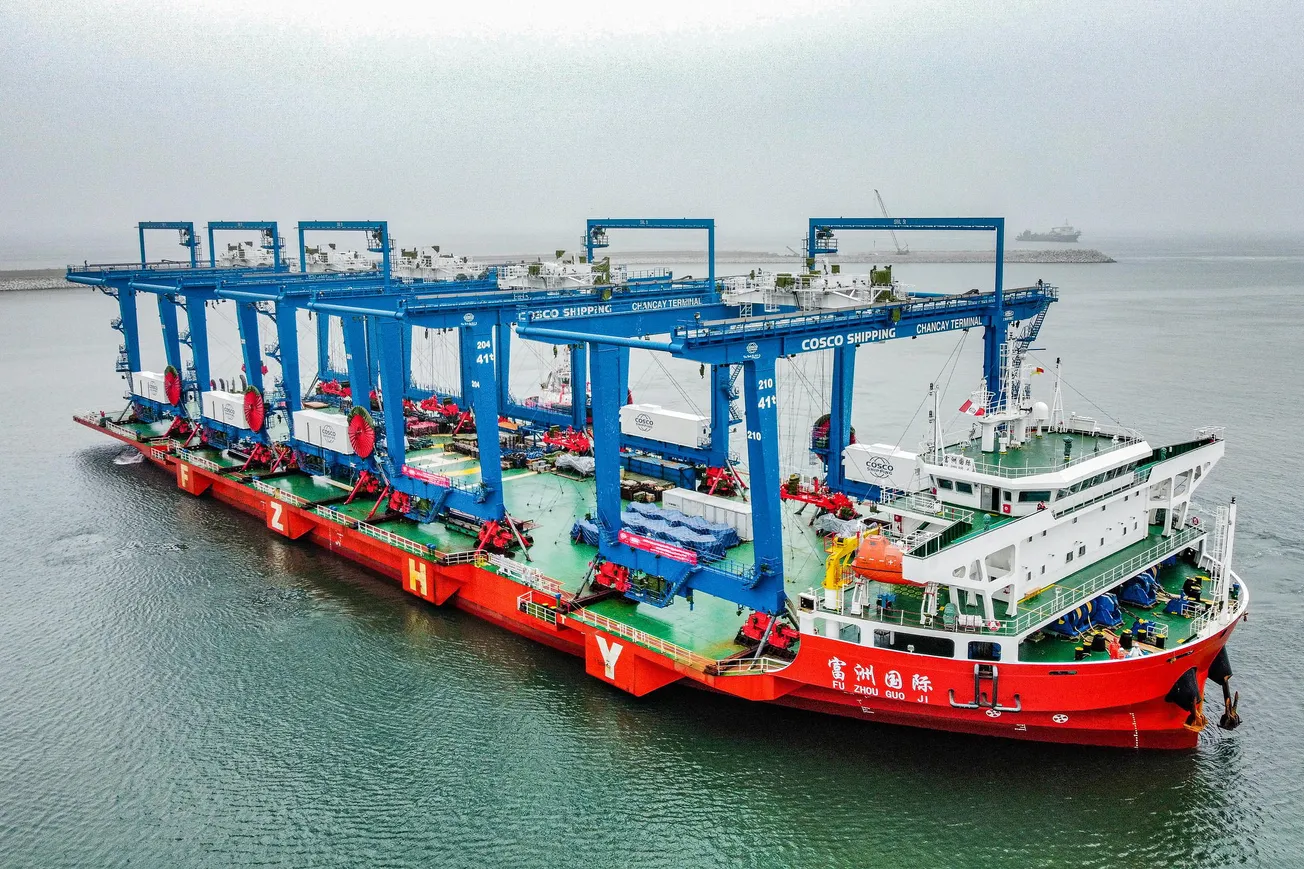
The Trump administration’s rampage to drive China out of the Western Hemisphere is now getting serious about its next target: Peru’s Chancay Port. The port, a joint Peruvian-Chinese business venture, is a signature project of the Belt and Road, designed to become the cornerstone of the greatest infrastructure project in South American history: a transcontinental railway and development corridor connecting the Atlantic and Pacific coasts.
In mid-January, a media scandal was blown up over Peru’s interim President José Jeri having dined “privately” with a Chinese businessman in a “chifa,” as Chinese restaurants are known in Peru, several times in late December and early January. “Chifagate” was born and Congressional hearings into his alleged “corruption” with China were set into motion.
On Feb. 9, U.S. Ambassador Bernie Navarro called President Jeri in for a leisurely meal at the Ambassador’s residence, posting pictures on his social media afterwards of the two of them eating hamburgers, with the snarky comment “Changing the menu.”
On Feb. 12, the U.S. State Department Bureau of Western Hemisphere Affairs weighed in, posting on X that that the U.S. is “concerned about latest reports that Peru could be powerless to oversee Chancay, one of its largest ports, which is under the jurisdiction of predatory Chinese owners. We support Peru’s sovereign right to oversee critical infrastructure in its own territory. Let this be a cautionary tale for the region and the world: cheap Chinese money costs sovereignty.”
That same day, two right-wing Peruvian parties collected enough signatures from fellow Congressmen to recall Congress, currently in recess, for a vote of impeachment to oust Jeri—who had assumed office as interim President only last October after the impeachment of President Dina Boluarte, and new presidential elections are already set for this April.
China’s Global Times denounced the United States’ blatant “hegemonic anxiety and geopolitical calculation…. From the Panama Canal to Venezuela’s oil, and the Chancay Port, a key logistics hub, Washington’s purpose remains consistent: Major assets in Latin America must fall under its say,” it wrote.
It is not China that is threatening the region’s sovereignty, but the United States, as Pan Deng, director of the Latin America and Caribbean Region Law Center at the China University of Political Science and Law, told the Global Times that Washington’s “ultimate aim is to push Latin American countries into a position where their sovereignty is effectively outsourced to the U.S., making them dependent on and subject to Washington.”