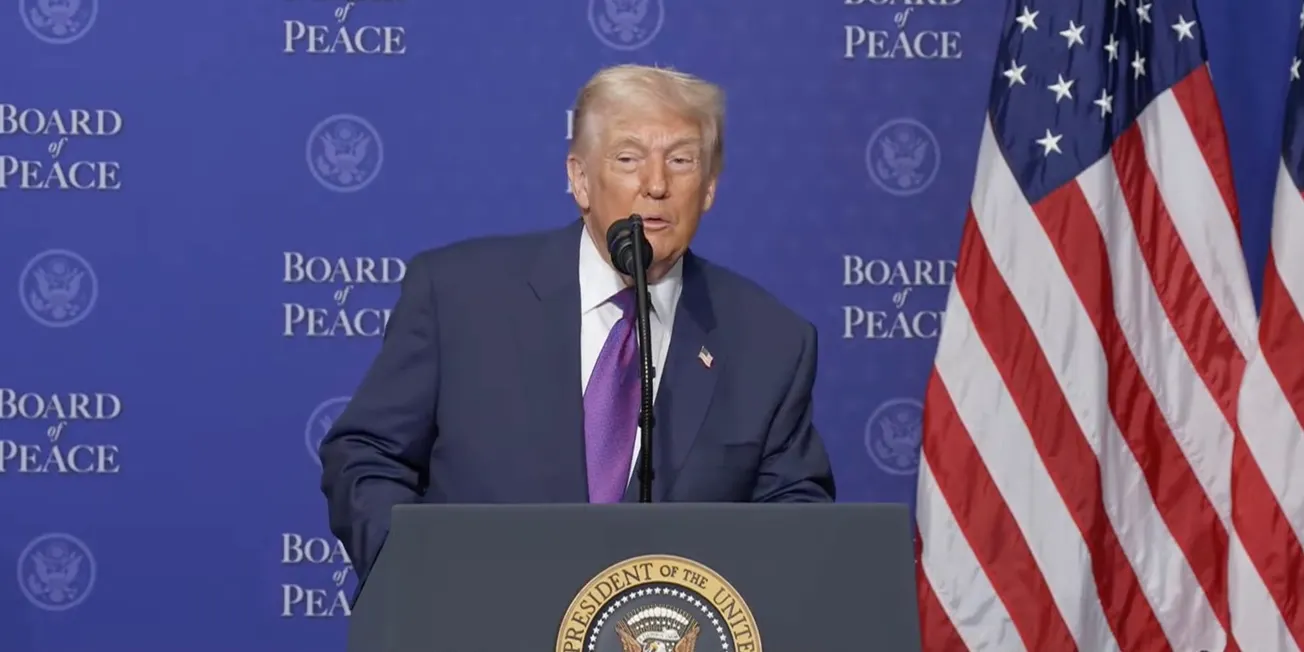
U.S. President Donald Trump convened his Board of Peace (BOP) in an extensive 2.5-hour show this morning, Feb. 19, in Washington, D.C., with his largely extemporaneous comments for the first hour, and then short prepared comments in the remaining period from a couple dozen participants.
Trump’s theme was that he has solved eight intractable wars by threatening the participants with tariffs until they discovered losing money was worse than dealing with one’s neighbor. He described his method as, for example in the case of India and China, threatening participants that “if you fight, I’ll put a 200% tariff on your nation ... when it came to money, they said, ‘I guess we don’t want to fight.’”
Perhaps his most intelligent observation was that there’s “nothing less expensive than peace,” which is 100 times less expensive than war. However, the pervading ugliness was that the success of getting hostages back to Israel was cited repeatedly, the killing of tens of thousands of women and children in Gaza, not once.
Trump announced that $6.5 billion in pledges had been made and that the U.S. would contribute $10 billion. He called the $10 billion “a small number when compared to war,” about “two weeks of fighting.” He took pains to characterize the BOP, not as a substitute for the UN, but as a new model for dealing with conflict around the world, and one that could make the UN begin to work correctly. “We’re going to be working with the UN. It has great potential, but it has not lived up to its potential. The Board of Peace will almost be looking over the UN. We’ll make sure the UN is viable.” And “if we see trouble around the world,” BOP will go “a step further,” showing the UN the way.
Various countries’ representatives tried to hint to Trump that Israel’s persistent violations put the reconstruction of Gaza into jeopardy. Egypt said the annexation of the West Bank must be rejected and there must be self-determination and statehood for Palestine. Morocco called the war “tragic” and stressed the necessity of stability in the West Bank. Qatar said that there needs to be “fairness and justice for both Palestinians and Israelis.” Turkiye went as far as saying that there had been “two years of human suffering” and that now violations of the ceasefire continue, which need to be dealt with promptly, and that a two-state solution is the foundation. And Pakistan voiced the most explicit warning, saying that Palestinians “have long endured illegal occupation. Ceasefire violations must end, to allow reconstruction efforts.” They must have “full control of their land,” self-determination, with full sovereignty as a state, in accordance with UN resolutions.
However, nothing Trump said reflected any such reality. He simply identified that Hamas must comply with disarming. “If they don’t, it’ll be harsh.” So, the “world is now waiting on Hamas.” Israel’s Foreign Minister Gideon Saar likewise said no reconstruction can start until Hamas disarms, including that its tunnels are destroyed and other demands. Israeli Prime Minister Benjamin Netanyahu also said today that Gaza reconstruction cannot start now. It is reported that U.S. Secretary of State Marco Rubio will go to Israel next week to meet with Netanyahu.
The U.S. Ambassador to the UN Mike Waltz claimed that aid trucks are up to 600 per week. Even if that were proven true, he unfortunately called it, “the longest stretch of high-volume assistance to Gaza in years.” What it is, is the level called for in the October settlement, and the prewar level; so, it is “the longest stretch” since Israel cut off the truck deliveries in October 2023. But, given the starvation and disease, it is not good enough to address the situation. He reported that child malnutrition has been cut in half, that “severe hunger” has gone from 30% to 1%, and that there is five times more food—basically admitting that Israel had reduced Gaza to 20% of the necessary food, with 30% of the population in “severe hunger,” and large-scale child malnutrition still not sufficiently addressed.
Much was made about redevelopment from digitalization and a new Mediterranean Riviera, with nothing about expansion of energy production, desalination, industrialization, or large-scale agriculture. Projects start in Rafah, where 100,000 homes are to be built (no timeframe provided) for the over 1 million people in the area, with the promise of eventually adding enough homes sometime later.