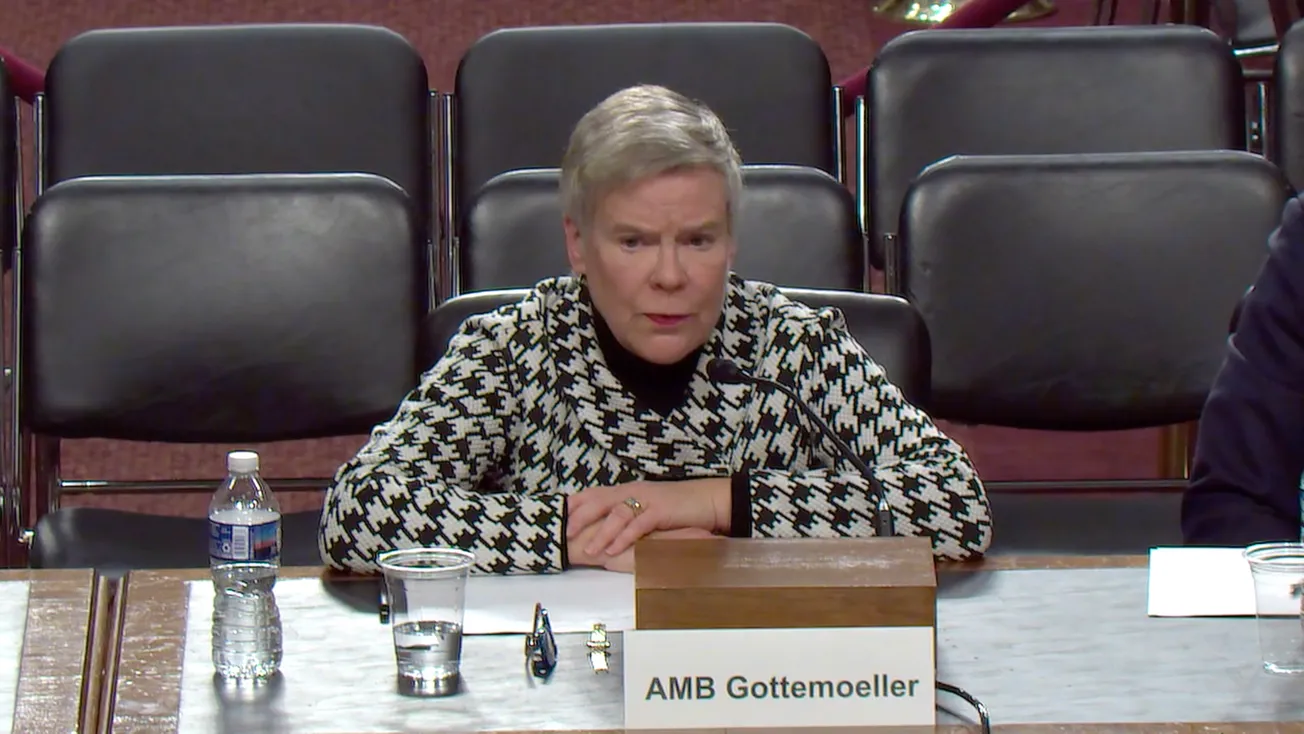
Walter Pincus—national security reporter for the Washington Post for decades, who then retired to set up his own newsletter called the Cipher Brief—offered his own take on Feb. 10 on what the U.S. might do in the wake of the expiration of New START. He did this in the form of a review of the Feb. 3 hearing of the Senate Armed Services Committee, where Rose Gottemoeller, the principal negotiator for the U.S. side of New START and retired Adm. Charles Richard, former commander of U.S. Strategic Command, both testified.
“I do not support trying to do a trilateral negotiation. I believe that these negotiations [with Russia and China] should be done in parallel,” Gottemoeller said. “We have 50-plus years of experience limiting and reducing nuclear weapons with the Russians. We can continue that kind of process [to include tactical and hypersonic nuclear weapons] with them.”
Gottemoeller added: “And by the way, I agree that non-strategic nuclear weapons [should be included]. We did not constrain non-strategic nuclear weapons in the New START Treaty. It was not designed for that purpose. So to fault it for not controlling those weapons is a bit bizarre, but nevertheless, I agreed with the Trump administration during the first term, when they said we need an all-warhead limit in the next negotiation. I think that is definitely the priority we need to proceed on with the Russians.”
Gottemoeller also said: “It’s been my recent experience working with them [the Chinese] in track two [non-U.S. government] settings that they seem very interested in trying to figure out ways to begin a conversation with the United States about nuclear risks … developing better communications, links with them at the strategic level, hotline arrangements, these types of things. I think they are valuable to begin a conversation about the necessity of controlling nuclear weapons at the negotiating table and [for the Chinese] not being so un-transparent about what they’re doing with their modernization. That has to be the first and foremost objective talking to them about what their intentions are.”
She added: “I’ve already spoken about the Chinese. I think they are willing to talk to us now, but it is about risk reduction and the beginning of more predictability and transparency about their nuclear objectives,” matters that up to now they have refused to discuss.
Both Gottemoeller and Richard agreed about the need for the U.S. to increase its nuclear forces.
Gottemoeller said: “I actually agree with the notion that we need to think carefully about the threat that is presented by two nuclear peers by China and by the Russian Federation going forward. And we need to make judicious choices juxtaposed against the other demands on our defense budget.”
Richard was much more specific. He said, “I think that the United States needs to immediately start taking steps, steps that are currently precluded by the New START Treaty … to include uploading [currently stored U.S. nuclear] warheads to our intercontinental ballistic missiles, removing covers off the four [launch] tubes on our Trident [strategic] submarines that are currently empty [of strategic nuclear sea-launched ballistic missiles], and several other posture steps that should be taken now, and not a year from now."Feb. 11, 2026 (EIRNS)—Walter Pincus—national security reporter for the Washington Post for decades, who then retired to set up his own newsletter called the Cipher Brief—offered his own take on Feb. 10 on what the U.S. might do in the wake of the expiration of New START. He did this in the form of a review of the Feb. 3 hearing of the Senate Armed Services Committee, where Rose Gottemoeller, the principal negotiator for the U.S. side of New START and retired Adm. Charles Richard, former commander of U.S. Strategic Command, both testified.
“I do not support trying to do a trilateral negotiation. I believe that these negotiations [with Russia and China] should be done in parallel,” Gottemoeller said. “We have 50-plus years of experience limiting and reducing nuclear weapons with the Russians. We can continue that kind of process [to include tactical and hypersonic nuclear weapons] with them.”
Gottemoeller added: “And by the way, I agree that non-strategic nuclear weapons [should be included]. We did not constrain non-strategic nuclear weapons in the New START Treaty. It was not designed for that purpose. So to fault it for not controlling those weapons is a bit bizarre, but nevertheless, I agreed with the Trump administration during the first term, when they said we need an all-warhead limit in the next negotiation. I think that is definitely the priority we need to proceed on with the Russians.”
Gottemoeller also said: “It’s been my recent experience working with them [the Chinese] in track two [non-U.S. government] settings that they seem very interested in trying to figure out ways to begin a conversation with the United States about nuclear risks … developing better communications, links with them at the strategic level, hotline arrangements, these types of things. I think they are valuable to begin a conversation about the necessity of controlling nuclear weapons at the negotiating table and [for the Chinese] not being so un-transparent about what they’re doing with their modernization. That has to be the first and foremost objective talking to them about what their intentions are.”
She added: “I’ve already spoken about the Chinese. I think they are willing to talk to us now, but it is about risk reduction and the beginning of more predictability and transparency about their nuclear objectives,” matters that up to now they have refused to discuss.
Both Gottemoeller and Richard agreed about the need for the U.S. to increase its nuclear forces.
Gottemoeller said: “I actually agree with the notion that we need to think carefully about the threat that is presented by two nuclear peers by China and by the Russian Federation going forward. And we need to make judicious choices juxtaposed against the other demands on our defense budget.”
Richard was much more specific. He said, “I think that the United States needs to immediately start taking steps, steps that are currently precluded by the New START Treaty … to include uploading [currently stored U.S. nuclear] warheads to our intercontinental ballistic missiles, removing covers off the four [launch] tubes on our Trident [strategic] submarines that are currently empty [of strategic nuclear sea-launched ballistic missiles], and several other posture steps that should be taken now, and not a year from now.”