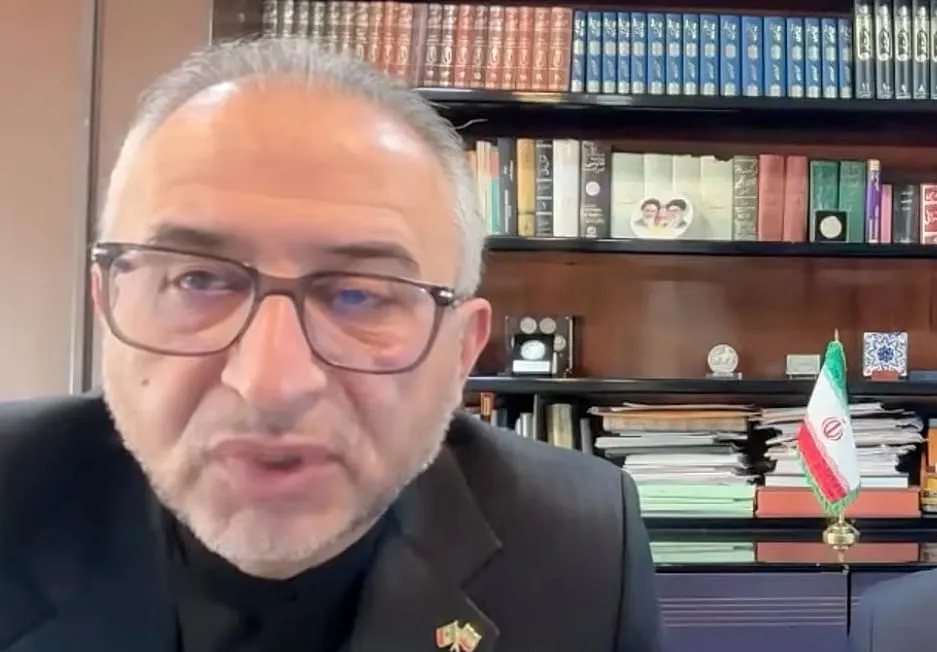
On Friday, March 13, more than 600 people from 35 nations gathered online for the 145th consecutive weekly meeting of the International Peace Coalition. They heard from the Iranian ambassador to Mexico, a Catholic priest with 70 years of service, a veteran and peace activist, the former President of Guyana, and Schiller Institute founder Helga Zepp-LaRouche. The meeting was, as the Schiller Institute’s press release put it, “a watershed in the presentation of alternatives” to the war.
While meaningful peace conversation has been largely driven off the official stage—out of the Senate chamber, out of the White House briefing room, and let’s not speak about whatever it is that Witkoff and Kushner were doing in Oman—it persists, with a consistency and a seriousness that shames the institutions that have abandoned it.
Ambassador of Iran to Mexico Abolfazl Pasandideh, speaking from Mexico City, identified the nature of the problem: “We have very few platforms to counter the narratives of powerful actors. Before becoming victims of F-35 and B-2 warplanes, we had already become victims of narrative-building,” he said. “The tools of thinkers and intellectuals are the pen and the word. With the pen and the word, it is also possible to neutralize the effects of guns.”
Zepp-LaRouche noted that a classified national intelligence report, completed a week before the strikes began on Feb. 28, had already concluded that even a large-scale assault would not produce regime change in Iran, Trump was told, or at least had the opportunity to hear. He attacked anyway.
The military picture continues to darken. Israel is running critically low on ballistic missile interceptors. David Sacks—no peace activist, but a man who can read a balance sheet—is publicly warning that if the war continues, “Israel could just be destroyed,” and raising the specter of nuclear escalation. The Hebrew press, largely suppressed in English translation, is reporting that the war’s stated goals are already slipping away: regime change “now seems imaginary,” Netanyahu is “preparing an alibi,” and the Israeli public and IDF are exhausted. The IDF itself has confirmed it will not deploy ground troops in Iran. If this is victory, it does not yet have a shape anyone can describe.
Meanwhile, in Rome, Peter Thiel is delivering closed-door lectures on the Antichrist—his thesis being that those who warn of catastrophe are the real danger, and that the builders of surveillance systems and AI targeting platforms should be left to build without interference. His Palantir systems are, at this moment, helping to select targets in Iran. That a man whose company is conducting this war at the algorithmic level is simultaneously lecturing on eschatology in the shadow of the Vatican is not an irony to be passed over. It is a choice being presented to Western civilization, a challenge.
Zepp-LaRouche has presented a different choice. Her open letter to Pope Leo XIV—who last October invoked Nicholas of Cusa’s De Pace Fidei from the pulpit—calls on the first American pope to do what American institutions have refused to do: speak for humanity against the logic of annihilation. “I am writing to you at this grave hour of mankind,” she writes, “as you may be the only person who could hopefully avoid a descent into what you yourself have called an ‘irreparable abyss.’” She calls on Leo to unite the churches of East and West—reaching out to Patriarchs Kirill and Bartholomew—and to appeal to all religious leaders, in the spirit of Cusa’s dialogue in which representatives of all faiths ask God how they can find peace. She is not alone in this appeal: a senior Iranian Shia cleric has independently written his own letter to the same Pope, arriving at the same conclusion by a different path.
Pope Leo XIV has since called from St. Peter’s Square for an immediate ceasefire, denouncing the “atrocious violence” of the war and later declaring that “God cannot be enlisted by darkness.”